 Add to Chrome
 Add to Firefox
 Add to Edge
Explaining Neural Networks in Preference Learning: a Post-hoc Inductive Logic Programming Approach
Apr 08, 2026
In this paper, we propose using Learning from Answer Sets to approximate black-box models, such as Neural Networks (NN), in the specific case of learning user preferences. We specifically explore the use of ILASP (Inductive Learning of Answer Set Programs) to approximate preference learning systems through weak constraints. We have created a dataset on user preferences over a set of recipes, which is used to train the NNs that we aim to approximate with ILASP. Our experiments investigate ILASP both as a global and a local approximator of the NNs. These experiments address the challenge of approximating NNs working on increasingly high-dimensional feature spaces while achieving appropriate fidelity on the target model and limiting the increase in computational time. To handle this challenge, we propose a preprocessing step that exploits Principal Component Analysis to reduce the dataset's dimensionality while keeping our explanations transparent. Under consideration for publication in Theory and Practice of Logic Programming (TPLP).

An Application of a Runtime Epistemic Probabilistic Event Calculus to Decision-making in e-Health Systems
Sep 26, 2022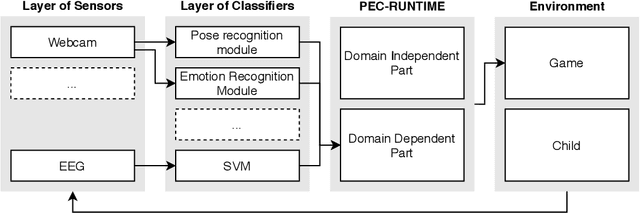
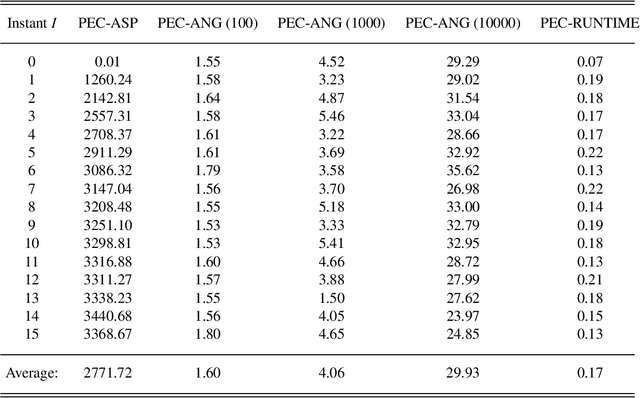
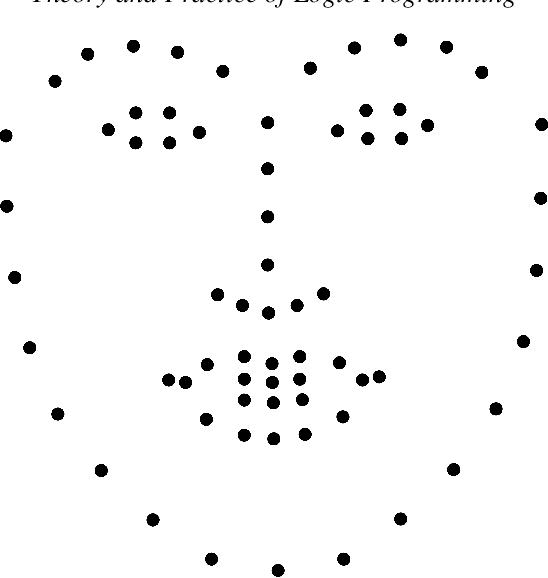
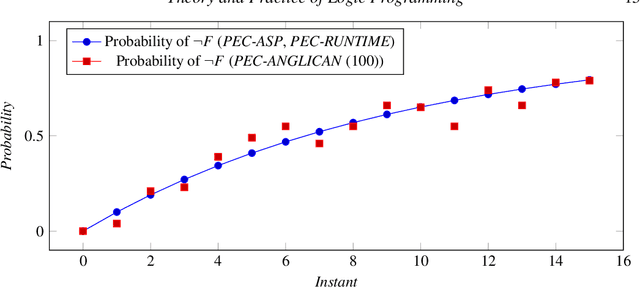
We present and discuss a runtime architecture that integrates sensorial data and classifiers with a logic-based decision-making system in the context of an e-Health system for the rehabilitation of children with neuromotor disorders. In this application, children perform a rehabilitation task in the form of games. The main aim of the system is to derive a set of parameters the child's current level of cognitive and behavioral performance (e.g., engagement, attention, task accuracy) from the available sensors and classifiers (e.g., eye trackers, motion sensors, emotion recognition techniques) and take decisions accordingly. These decisions are typically aimed at improving the child's performance by triggering appropriate re-engagement stimuli when their attention is low, by changing the game or making it more difficult when the child is losing interest in the task as it is too easy. Alongside state-of-the-art techniques for emotion recognition and head pose estimation, we use a runtime variant of a probabilistic and epistemic logic programming dialect of the Event Calculus, known as the Epistemic Probabilistic Event Calculus. In particular, the probabilistic component of this symbolic framework allows for a natural interface with the machine learning techniques. We overview the architecture and its components, and show some of its characteristics through a discussion of a running example and experiments. Under consideration for publication in Theory and Practice of Logic Programming (TPLP).