 Add to Chrome
 Add to Firefox
 Add to Edge
Explaining Neural Networks in Preference Learning: a Post-hoc Inductive Logic Programming Approach
Apr 08, 2026
In this paper, we propose using Learning from Answer Sets to approximate black-box models, such as Neural Networks (NN), in the specific case of learning user preferences. We specifically explore the use of ILASP (Inductive Learning of Answer Set Programs) to approximate preference learning systems through weak constraints. We have created a dataset on user preferences over a set of recipes, which is used to train the NNs that we aim to approximate with ILASP. Our experiments investigate ILASP both as a global and a local approximator of the NNs. These experiments address the challenge of approximating NNs working on increasingly high-dimensional feature spaces while achieving appropriate fidelity on the target model and limiting the increase in computational time. To handle this challenge, we propose a preprocessing step that exploits Principal Component Analysis to reduce the dataset's dimensionality while keeping our explanations transparent. Under consideration for publication in Theory and Practice of Logic Programming (TPLP).

On the $k$-Hamming and $k$-Edit Distances
Jun 15, 2023In this paper we consider the weighted $k$-Hamming and $k$-Edit distances, that are natural generalizations of the classical Hamming and Edit distances. As main results of this paper we prove that for any $k\geq 2$ the DECIS-$k$-Hamming problem is $\mathbb{P}$-SPACE-complete and the DECIS-$k$-Edit problem is NEXPTIME-complete.
Multiple Sclerosis Lesions Identification/Segmentation in Magnetic Resonance Imaging using Ensemble CNN and Uncertainty Classification
Aug 26, 2021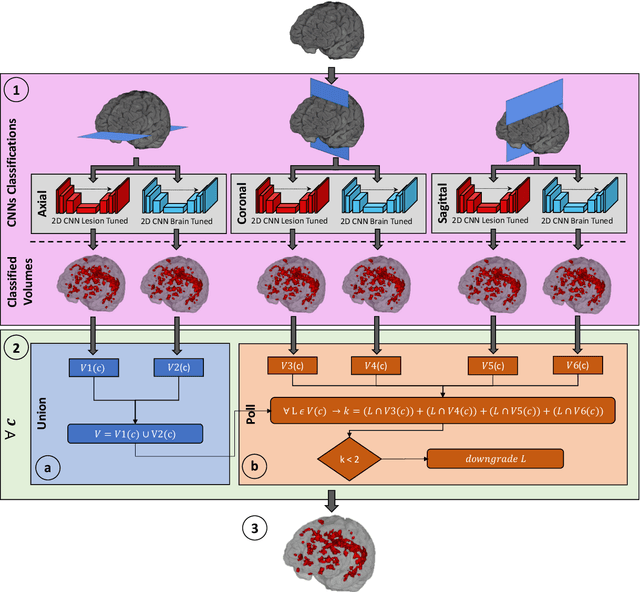
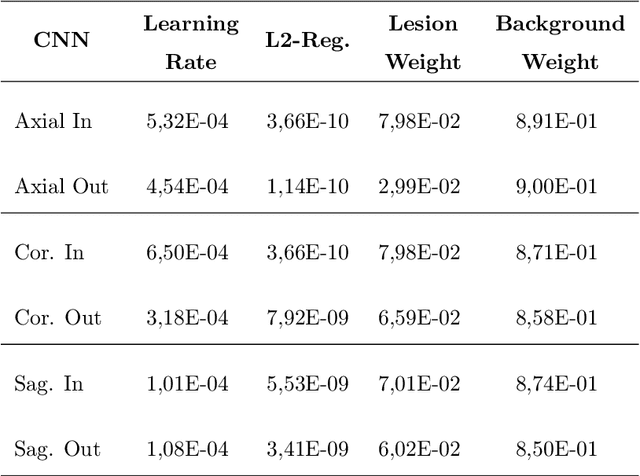

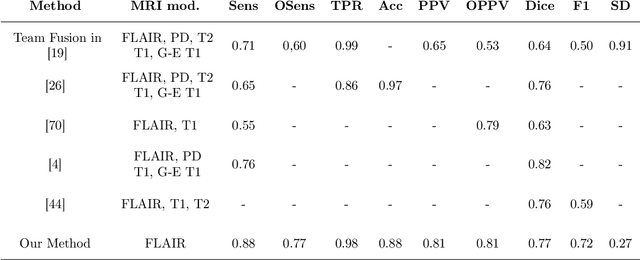
To date, several automated strategies for identification/segmentation of Multiple Sclerosis (MS) lesions by Magnetic Resonance Imaging (MRI) have been presented which are either outperformed by human experts or, at least, whose results are well distinguishable from humans. This is due to the ambiguity originated by MRI instabilities, peculiar MS Heterogeneity and MRI unspecific nature with respect to MS. Physicians partially treat the uncertainty generated by ambiguity relying on personal radiological/clinical/anatomical background and experience. We present an automated framework for MS lesions identification/segmentation based on three pivotal concepts to better emulate human reasoning: the modeling of uncertainty; the proposal of two, separately trained, CNN, one optimized with respect to lesions themselves and the other to the environment surrounding lesions, respectively repeated for axial, coronal and sagittal directions; the ensemble of the CNN output. The proposed framework is trained, validated and tested on the 2016 MSSEG benchmark public data set from a single imaging modality, FLuid-Attenuated Inversion Recovery (FLAIR). The comparison, performed on the segmented lesions by means of most of the metrics normally used with respect to the ground-truth and the 7 human raters in MSSEG, prove that there is no significant difference between the proposed framework and the other raters. Results are also shown for the uncertainty, though a comparison with the other raters is impossible.