 Add to Chrome
 Add to Firefox
 Add to Edge
The Case for Model Science: Verify, Explore, Steer, Refine
May 31, 2026
We argue that the AI community is now ready to move beyond benchmarking and consolidate scattered efforts in model analysis into a systematic discipline, a direction we term Model Science. Complex AI models now serve billions of users, yet our understanding of how they work lags far behind our ability to deploy them. Decades of benchmark-driven research have delivered remarkable progress: extensive leaderboards, a wide range of performance metrics, tracking capability gains across diverse tasks; yet this success has also revealed the limits of benchmarks as they tell us whether models perform but not why they succeed or fail, they miss critical failure modes, such as hallucinations or shortcuts. Precedents from established sciences point the way forward: cognitive science shows that understanding complex systems requires complementary levels of analysis; neuroscience demonstrates that deep study of single cases reveals what population studies miss; medicine teaches that specialised training must develop alongside research practice; and agriculture models how shared infrastructure and principles enable cumulative progress. These lessons inform three foundations for Model Science. First, we propose to consolidate research around four functional perspectives: Verify, Explore, Steer, and Refine that address complementary questions about model behaviour. Second, we discuss the required infrastructure for cumulative knowledge: catalogues of datasets, models and findings. Third, we highlight the need for deep analysis of individual model instances, not just model families, because single cases can reveal what population studies miss.

No Single Metric Tells the Whole Story: A Multi-Dimensional Evaluation Framework for Uncertainty Attributions
Mar 25, 2026Research on explainable AI (XAI) has frequently focused on explaining model predictions. More recently, methods have been proposed to explain prediction uncertainty by attributing it to input features (uncertainty attributions). However, the evaluation of these methods remains inconsistent as studies rely on heterogeneous proxy tasks and metrics, hindering comparability. We address this by aligning uncertainty attributions with the well-established Co-12 framework for XAI evaluation. We propose concrete implementations for the correctness, consistency, continuity, and compactness properties. Additionally, we introduce conveyance, a property tailored to uncertainty attributions that evaluates whether controlled increases in epistemic uncertainty reliably propagate to feature-level attributions. We demonstrate our evaluation framework with eight metrics across combinations of uncertainty quantification and feature attribution methods on tabular and image data. Our experiments show that gradient-based methods consistently outperform perturbation-based approaches in consistency and conveyance, while Monte-Carlo dropconnect outperforms Monte-Carlo dropout in most metrics. Although most metrics rank the methods consistently across samples, inter-method agreement remains low. This suggests no single metric sufficiently evaluates uncertainty attribution quality. The proposed evaluation framework contributes to the body of knowledge by establishing a foundation for systematic comparison and development of uncertainty attribution methods.
SHAPCA: Consistent and Interpretable Explanations for Machine Learning Models on Spectroscopy Data
Mar 19, 2026In recent years, machine learning models have been increasingly applied to spectroscopic datasets for chemical and biomedical analysis. For their successful adoption, particularly in clinical and safety-critical settings, professionals and researchers must be able to understand and trust the reasoning behind model predictions. However, the inherently high dimensionality and strong collinearity of spectroscopy data pose a fundamental challenge to model explainability. These properties not only complicate model training but also undermine the stability and consistency of explanations, leading to fluctuations in feature importance across repeated training runs. Feature extraction techniques have been used to reduce the input dimensionality; these new features hinder the connection between the prediction and the original signal. This study proposes SHAPCA, an explainable machine learning pipeline that combines Principal Component Analysis (for dimensionality reduction) and Shapely Additive exPlanations (for post hoc explanation) to provide explanations in the original input space, which a practitioner can interpret and link back to the biological components. The proposed framework enables analysis from both global and local perspectives, revealing the spectral bands that drive overall model behaviour as well as the instance-specific features that influence individual predictions. Numerical analysis demonstrated the interpretability of the results and greater consistency across different runs.
L2GTX: From Local to Global Time Series Explanations
Mar 13, 2026Deep learning models achieve high accuracy in time series classification, yet understanding their class-level decision behaviour remains challenging. Explanations for time series must respect temporal dependencies and identify patterns that recur across instances. Existing approaches face three limitations: model-agnostic XAI methods developed for images and tabular data do not readily extend to time series, global explanation synthesis for time series remains underexplored, and most existing global approaches are model-specific. We propose L2GTX, a model-agnostic framework that generates class-wise global explanations by aggregating local explanations from a representative set of instances. L2GTX extracts clusters of parameterised temporal event primitives, such as increasing or decreasing trends and local extrema, together with their importance scores from instance-level explanations produced by LOMATCE. These clusters are merged across instances to reduce redundancy, and an instance-cluster importance matrix is used to estimate global relevance. Under a user-defined instance selection budget, L2GTX selects representative instances that maximise coverage of influential clusters. Events from the selected instances are then aggregated into concise class-wise global explanations. Experiments on six benchmark time series datasets show that L2GTX produces compact and interpretable global explanations while maintaining stable global faithfulness measured as mean local surrogate fidelity.
Extending Decision Predicate Graphs for Comprehensive Explanation of Isolation Forest
May 06, 2025The need to explain predictive models is well-established in modern machine learning. However, beyond model interpretability, understanding pre-processing methods is equally essential. Understanding how data modifications impact model performance improvements and potential biases and promoting a reliable pipeline is mandatory for developing robust machine learning solutions. Isolation Forest (iForest) is a widely used technique for outlier detection that performs well. Its effectiveness increases with the number of tree-based learners. However, this also complicates the explanation of outlier selection and the decision boundaries for inliers. This research introduces a novel Explainable AI (XAI) method, tackling the problem of global explainability. In detail, it aims to offer a global explanation for outlier detection to address its opaque nature. Our approach is based on the Decision Predicate Graph (DPG), which clarifies the logic of ensemble methods and provides both insights and a graph-based metric to explain how samples are identified as outliers using the proposed Inlier-Outlier Propagation Score (IOP-Score). Our proposal enhances iForest's explainability and provides a comprehensive view of the decision-making process, detailing which features contribute to outlier identification and how the model utilizes them. This method advances the state-of-the-art by providing insights into decision boundaries and a comprehensive view of holistic feature usage in outlier identification. -- thus promoting a fully explainable machine learning pipeline.
CORTEX: A Cost-Sensitive Rule and Tree Extraction Method
Feb 05, 2025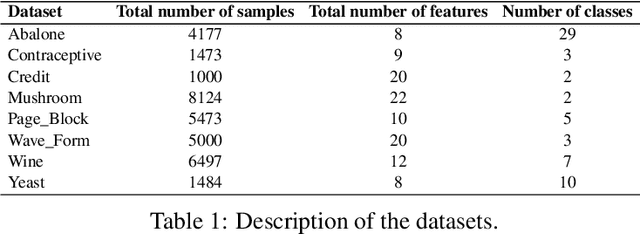
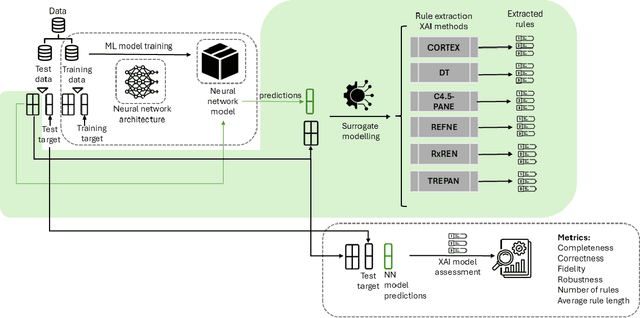
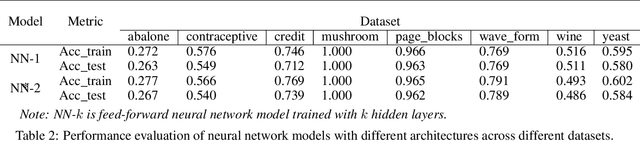
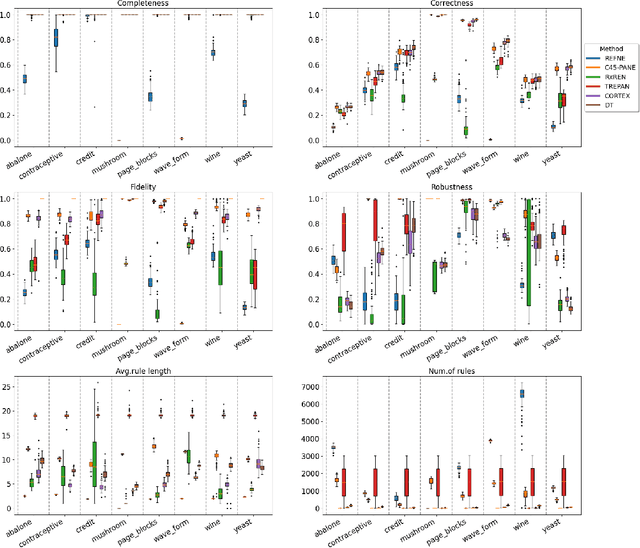
Tree-based and rule-based machine learning models play pivotal roles in explainable artificial intelligence (XAI) due to their unique ability to provide explanations in the form of tree or rule sets that are easily understandable and interpretable, making them essential for applications in which trust in model decisions is necessary. These transparent models are typically used in surrogate modeling, a post-hoc XAI approach for explaining the logic of black-box models, enabling users to comprehend and trust complex predictive systems while maintaining competitive performance. This study proposes the Cost-Sensitive Rule and Tree Extraction (CORTEX) method, a novel rule-based XAI algorithm grounded in the multi-class cost-sensitive decision tree (CSDT) method. The original version of the CSDT is extended to classification problems with more than two classes by inducing the concept of an n-dimensional class-dependent cost matrix. The performance of CORTEX as a rule-extractor XAI method is compared to other post-hoc tree and rule extraction methods across several datasets with different numbers of classes. Several quantitative evaluation metrics are employed to assess the explainability of generated rule sets. Our findings demonstrate that CORTEX is competitive with other tree-based methods and can be superior to other rule-based methods across different datasets. The extracted rule sets suggest the advantages of using the CORTEX method over other methods by producing smaller rule sets with shorter rules on average across datasets with a diverse number of classes. Overall, the results underscore the potential of CORTEX as a powerful XAI tool for scenarios that require the generation of clear, human-understandable rules while maintaining good predictive performance.
GPT Assisted Annotation of Rhetorical and Linguistic Features for Interpretable Propaganda Technique Detection in News Text
Jul 16, 2024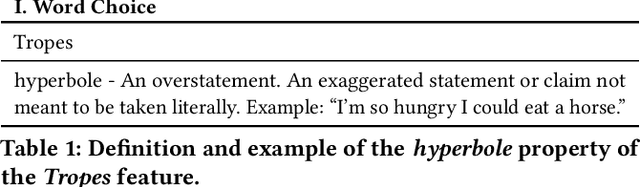
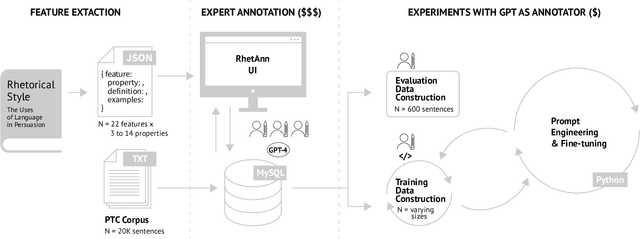
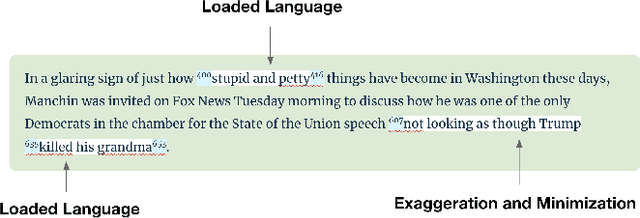
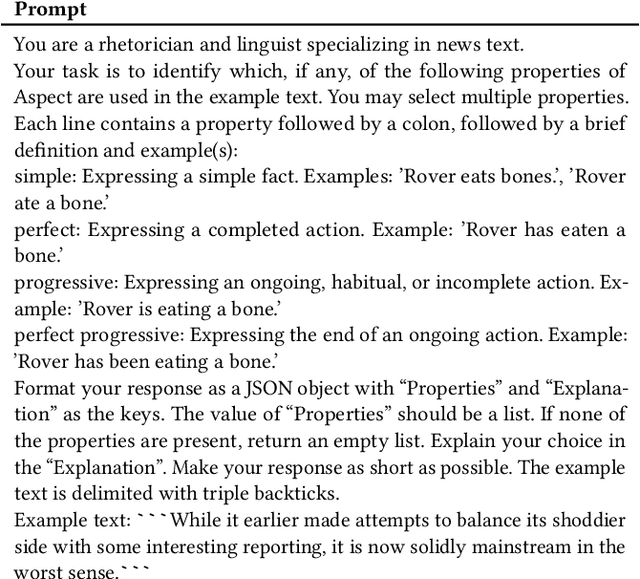
While the use of machine learning for the detection of propaganda techniques in text has garnered considerable attention, most approaches focus on "black-box" solutions with opaque inner workings. Interpretable approaches provide a solution, however, they depend on careful feature engineering and costly expert annotated data. Additionally, language features specific to propagandistic text are generally the focus of rhetoricians or linguists, and there is no data set labeled with such features suitable for machine learning. This study codifies 22 rhetorical and linguistic features identified in literature related to the language of persuasion for the purpose of annotating an existing data set labeled with propaganda techniques. To help human experts annotate natural language sentences with these features, RhetAnn, a web application, was specifically designed to minimize an otherwise considerable mental effort. Finally, a small set of annotated data was used to fine-tune GPT-3.5, a generative large language model (LLM), to annotate the remaining data while optimizing for financial cost and classification accuracy. This study demonstrates how combining a small number of human annotated examples with GPT can be an effective strategy for scaling the annotation process at a fraction of the cost of traditional annotation relying solely on human experts. The results are on par with the best performing model at the time of writing, namely GPT-4, at 10x less the cost. Our contribution is a set of features, their properties, definitions, and examples in a machine-readable format, along with the code for RhetAnn and the GPT prompts and fine-tuning procedures for advancing state-of-the-art interpretable propaganda technique detection.
CNN-based explanation ensembling for dataset, representation and explanations evaluation
Apr 16, 2024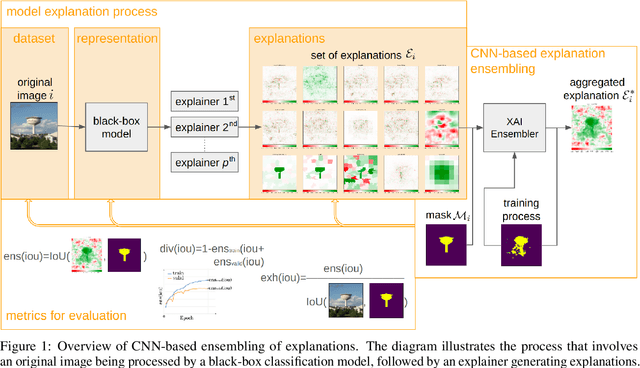
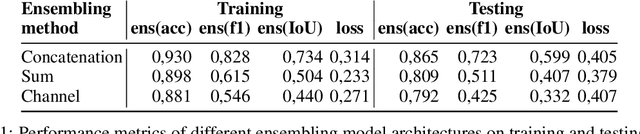
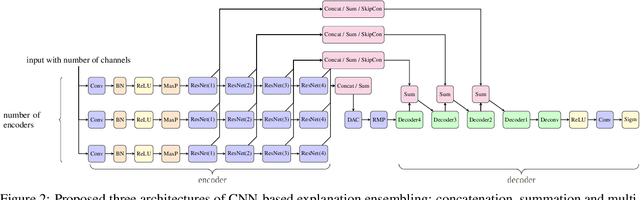
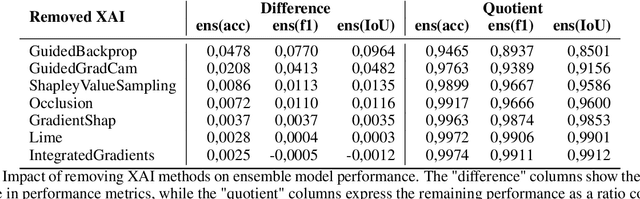
Explainable Artificial Intelligence has gained significant attention due to the widespread use of complex deep learning models in high-stake domains such as medicine, finance, and autonomous cars. However, different explanations often present different aspects of the model's behavior. In this research manuscript, we explore the potential of ensembling explanations generated by deep classification models using convolutional model. Through experimentation and analysis, we aim to investigate the implications of combining explanations to uncover a more coherent and reliable patterns of the model's behavior, leading to the possibility of evaluating the representation learned by the model. With our method, we can uncover problems of under-representation of images in a certain class. Moreover, we discuss other side benefits like features' reduction by replacing the original image with its explanations resulting in the removal of some sensitive information. Through the use of carefully selected evaluation metrics from the Quantus library, we demonstrated the method's superior performance in terms of Localisation and Faithfulness, compared to individual explanations.
Explainable Artificial Intelligence (XAI) 2.0: A Manifesto of Open Challenges and Interdisciplinary Research Directions
Oct 30, 2023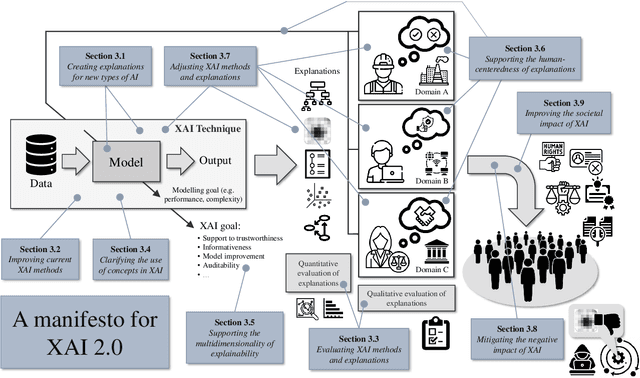
As systems based on opaque Artificial Intelligence (AI) continue to flourish in diverse real-world applications, understanding these black box models has become paramount. In response, Explainable AI (XAI) has emerged as a field of research with practical and ethical benefits across various domains. This paper not only highlights the advancements in XAI and its application in real-world scenarios but also addresses the ongoing challenges within XAI, emphasizing the need for broader perspectives and collaborative efforts. We bring together experts from diverse fields to identify open problems, striving to synchronize research agendas and accelerate XAI in practical applications. By fostering collaborative discussion and interdisciplinary cooperation, we aim to propel XAI forward, contributing to its continued success. Our goal is to put forward a comprehensive proposal for advancing XAI. To achieve this goal, we present a manifesto of 27 open problems categorized into nine categories. These challenges encapsulate the complexities and nuances of XAI and offer a road map for future research. For each problem, we provide promising research directions in the hope of harnessing the collective intelligence of interested stakeholders.
Interpretable Timbre Synthesis using Variational Autoencoders Regularized on Timbre Descriptors
Jul 18, 2023Controllable timbre synthesis has been a subject of research for several decades, and deep neural networks have been the most successful in this area. Deep generative models such as Variational Autoencoders (VAEs) have the ability to generate a high-level representation of audio while providing a structured latent space. Despite their advantages, the interpretability of these latent spaces in terms of human perception is often limited. To address this limitation and enhance the control over timbre generation, we propose a regularized VAE-based latent space that incorporates timbre descriptors. Moreover, we suggest a more concise representation of sound by utilizing its harmonic content, in order to minimize the dimensionality of the latent space.