 Add to Chrome
 Add to Firefox
 Add to Edge
RF-LEGO: Modularized Signal Processing-Deep Learning Co-Design for RF Sensing via Deep Unrolling
Apr 11, 2026
Wireless sensing, traditionally relying on signal processing (SP) techniques, has recently shifted toward data-driven deep learning (DL) to achieve performance breakthroughs. However, existing deep wireless sensing models are typically end-to-end and task-specific, lacking reusability and interpretability. We propose RF-LEGO, a modular co-design framework that transforms interpretable SP algorithms into trainable, physics-grounded DL modules through deep unrolling. By replacing hand-tuned parameters with learnable ones while preserving core processing structures and mathematical operators, RF-LEGO ensures modularity, cascadability, and structure-aligned interpretability. Specifically, we introduce three deep-unrolled modules for critical RF sensing tasks: frequency transform, spatial angle estimation, and signal detection. Extensive experiments using real-world data for Wi-Fi, millimeter-wave, UWB, and 6G sensing demonstrate that RF-LEGO significantly outperforms existing SP and DL baselines, both standalone and when integrated into multiple downstream tasks. RF-LEGO pioneers a novel SP-DL co-design paradigm for wireless sensing via deep unrolling, shedding light on efficient and interpretable deep wireless sensing solutions. Our code is available at https://github.com/aiot-lab/RF-LEGO.

"Take Me Home, Wi-Fi Drone": A Drone-based Wireless System for Wilderness Search and Rescue
Apr 10, 2026Wilderness Search and Rescue (WiSAR) represents a longstanding and critical societal challenge, demanding innovative and automatic technological solutions. In this paper, we introduce Wi2SAR, a novel autonomous drone-based wireless system for long-range, through-occlusion WiSAR operations, without relying on existing infrastructure. Our basic insight is to leverage the automatic reconnection behavior of modern Wi-Fi devices to known networks. By mimicking these networks via on-drone Wi-Fi, Wi2SAR uniquely facilitates the discovery and localization of victims through their accompanying mobile devices. Translating this simple idea into a practical system poses substantial technical challenges. Wi2SAR overcomes these challenges via three distinct innovations: (1) a rapid and energy-efficient device discovery mechanism to discover and identify the target victim, (2) a novel RSS-only, long-range direction finding approach using a 3D-printed Luneburg Lens, amplifying the directional signal strength differences and significantly extending the operational range, and (3) an adaptive drone navigation scheme that guides the drone toward the target efficiently. We implement an end-to-end prototype and evaluate Wi2SAR across various mobile devices and real-world wilderness scenarios. Experimental results demonstrate Wi2SAR's high performance, efficiency, and practicality, highlighting its potential to advance autonomous WiSAR solutions. Wi2SAR is open-sourced at https://aiot-lab.github.io/Wi2SAR to facilitate further research and real-world deployment.
* 16 pages, 12 figures, 1 table. Project page: https://aiot-lab.github.io/Wi2SAR
Unfolding Target Detection with State Space Model
Oct 30, 2024
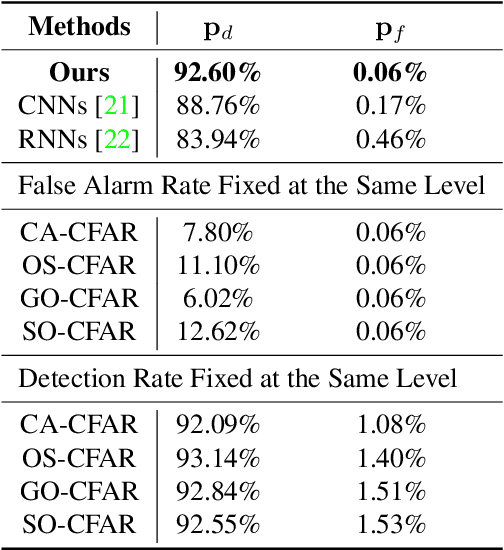
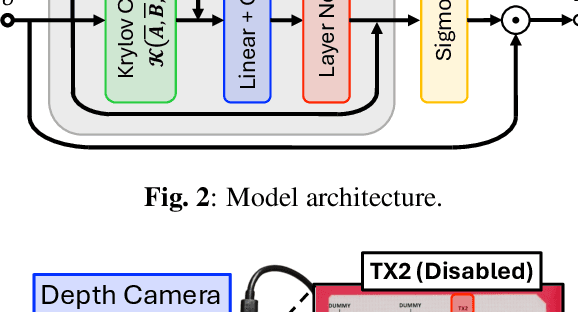
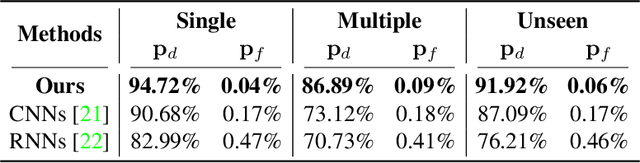
Target detection is a fundamental task in radar sensing, serving as the precursor to any further processing for various applications. Numerous detection algorithms have been proposed. Classical methods based on signal processing, e.g., the most widely used CFAR, are challenging to tune and sensitive to environmental conditions. Deep learning-based methods can be more accurate and robust, yet usually lack interpretability and physical relevance. In this paper, we introduce a novel method that combines signal processing and deep learning by unfolding the CFAR detector with a state space model architecture. By reserving the CFAR pipeline yet turning its sophisticated configurations into trainable parameters, our method achieves high detection performance without manual parameter tuning, while preserving model interpretability. We implement a lightweight model of only 260K parameters and conduct real-world experiments for human target detection using FMCW radars. The results highlight the remarkable performance of the proposed method, outperforming CFAR and its variants by 10X in detection rate and false alarm rate. Our code is open-sourced here: https://github.com/aiot-lab/NeuroDet.
USpeech: Ultrasound-Enhanced Speech with Minimal Human Effort via Cross-Modal Synthesis
Oct 29, 2024


Speech enhancement is crucial in human-computer interaction, especially for ubiquitous devices. Ultrasound-based speech enhancement has emerged as an attractive choice because of its superior ubiquity and performance. However, inevitable interference from unexpected and unintended sources during audio-ultrasound data acquisition makes existing solutions rely heavily on human effort for data collection and processing. This leads to significant data scarcity that limits the full potential of ultrasound-based speech enhancement. To address this, we propose USpeech, a cross-modal ultrasound synthesis framework for speech enhancement with minimal human effort. At its core is a two-stage framework that establishes correspondence between visual and ultrasonic modalities by leveraging audible audio as a bridge. This approach overcomes challenges from the lack of paired video-ultrasound datasets and the inherent heterogeneity between video and ultrasound data. Our framework incorporates contrastive video-audio pre-training to project modalities into a shared semantic space and employs an audio-ultrasound encoder-decoder for ultrasound synthesis. We then present a speech enhancement network that enhances speech in the time-frequency domain and recovers the clean speech waveform via a neural vocoder. Comprehensive experiments show USpeech achieves remarkable performance using synthetic ultrasound data comparable to physical data, significantly outperforming state-of-the-art ultrasound-based speech enhancement baselines. USpeech is open-sourced at https://github.com/aiot-lab/USpeech/.