 Add to Chrome
 Add to Firefox
 Add to Edge
Honeyval: A Comprehensive Evaluation Framework for LLM-powered HTTP Honeypots
May 28, 2026
Honeypots are decoy systems mimicking real system components designed to defend against cyber attacks. Recently, LLMs increasingly serve as simulation backbones for honeypots. They enable defenders to construct high-interaction honeypots with low system security risks. However, LLM-powered honeypot development lacks a unified evaluation framework. Most evaluations consist of measuring response similarity on fixed commands, manual testing, or real-world deployment. These methods are often not scalable for development, reproducible across evaluations, representative of practical attacks, or adaptable to various attacker and honeypot configurations. In this work, we bridge this gap and propose Honeyval, a comprehensive evaluation framework for LLM-powered HTTP honeypots. We address the limitations of prior evaluations by grounding the honeypots in 16 backend applications, using AI hacking agents as attackers, employing two control tasks to monitor agent and honeypot capabilities across customizations, and defining clear and verifiable exploit goals for the attacker. Using Honeyval, we conduct an extensive evaluation of recent cost-efficient LLMs as HTTP honeypots. Our experiments highlight the promise of LLM-powered honeypots; they lead to substantially longer interactions with the attacker than rule-based baseline honeypots and are far less frequently detected even by frontier models, all while, on average, preserving a running cost advantage against agentic attackers. Further, we experiment with different counter-offensive honeypots configurations, and observe unique trade-offs, such as longer interactions at the cost of increased detection.

Evaluating the Robustness of a Production Malware Detection System to Transferable Adversarial Attacks
Oct 02, 2025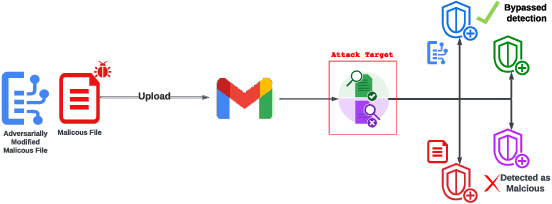
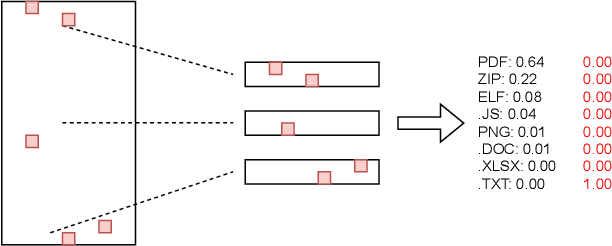
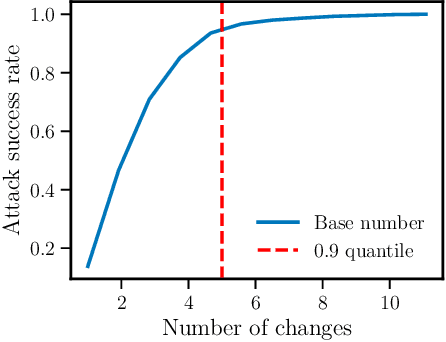
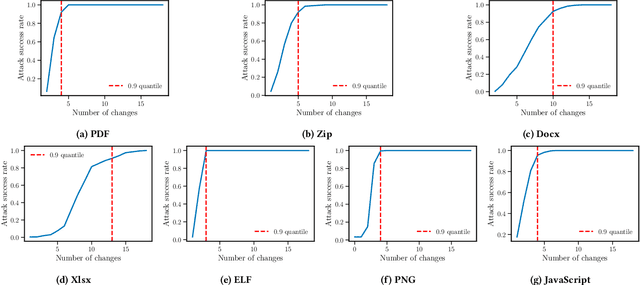
As deep learning models become widely deployed as components within larger production systems, their individual shortcomings can create system-level vulnerabilities with real-world impact. This paper studies how adversarial attacks targeting an ML component can degrade or bypass an entire production-grade malware detection system, performing a case study analysis of Gmail's pipeline where file-type identification relies on a ML model. The malware detection pipeline in use by Gmail contains a machine learning model that routes each potential malware sample to a specialized malware classifier to improve accuracy and performance. This model, called Magika, has been open sourced. By designing adversarial examples that fool Magika, we can cause the production malware service to incorrectly route malware to an unsuitable malware detector thereby increasing our chance of evading detection. Specifically, by changing just 13 bytes of a malware sample, we can successfully evade Magika in 90% of cases and thereby allow us to send malware files over Gmail. We then turn our attention to defenses, and develop an approach to mitigate the severity of these types of attacks. For our defended production model, a highly resourced adversary requires 50 bytes to achieve just a 20% attack success rate. We implement this defense, and, thanks to a collaboration with Google engineers, it has already been deployed in production for the Gmail classifier.