 Add to Chrome
 Add to Firefox
 Add to Edge
Near-Field Beampointing with Low Exposure Regions: a Dominant Subspace Projection Approach
Feb 13, 2026
The spherical nature of the wavefronts exhibited in the near-field of antenna arrays enables advanced beamforming capabilities, such as beampointing and beamnulling. In this paper, we exploit these properties to design a near-field beam pattern under a low exposure region constraint. We address the continuous region constraint through spatial discretization, which results in a large number of constraints that lead to prohibitive computational complexity. We propose a novel low-complexity algorithm that enables a computationally tractable beam pattern design. It uses a low-dimensional subspace representation of the low exposure region based on a singular value decomposition. Our approach achieves low complexity while providing a power received at a target user close to the optimal achievable power, yet with uniform power mitigation over the low exposure region.

Resolution-Aliasing Trade-off in Near-Field Localisation
Feb 02, 2026Extremely Large-scale MIMO (XL-MIMO) systems operating in Near-Field (NF) introduce new degrees of freedom for accurate source localisation, but make dense arrays impractical. Sparse or distributed arrays can reduce hardware complexity while maintaining high resolution, yet sub-Nyquist spatial sampling introduces aliasing artefacts in the localisation ambiguity function. This paper presents a unified framework to jointly characterise resolution and aliasing in NF localisation and study the trade-off between the two. Leveraging the concept of local chirp spatial frequency, we derive analytical expressions linking array geometry and sampling density to the spatial bandwidth of the received field. We introduce two geometric tools--Critical Antenna Elements (CAEs) and the Non-Contributive Zone (NCZ)--to intuitively identify how individual antennas contribute to resolution and/or aliasing. Our analysis reveals that resolution and aliasing are not always strictly coupled, e.g., increasing the array aperture can improve resolution without necessarily aggravating aliasing. These results provide practical guidelines for designing NF arrays that optimally balance resolution and aliasing, supporting efficient XL-MIMO deployment.
Joint Pilot and Unknown Data-based Localization for OFDM Opportunistic Radar Systems
Jan 22, 2026Integrated Sensing and Communications (ISAC) has emerged as a promising paradigm for Sixth Generation (6G) and Wi-Fi 7 networks, with the communication-centric approach being particularly attractive due to its compatibility with current standards. Typical communication signals comprise both deterministic known pilot signals and random unknown data payloads. Most existing approaches either rely solely on pilots for positioning, thereby ignoring the radar information present in the received data symbols that constitute the majority of each frame, or rely on data decisions, which bounds positioning performance to that of the communication system. To overcome these limitations, we propose a novel method that extracts positioning information from data payloads without decoding them. We consider an opportunistic scenario in which communication signals from a user are captured by an opportunistic radar equipped with a Uniform Linear Arrays of antennas. We show that, in this setting, the estimation can be efficiently implemented using Fast Fourier Transforms. Finally, we demonstrate superior localization performance compared to existing methods in the literature through numerical simulations.
Aliasing in Near-Field Array Ambiguity Functions: a Spatial Frequency-Domain Framework
Dec 13, 2025Next-generation communication and localization systems increasingly rely on extremely large-scale arrays (XL-arrays), which promise unprecedented spatial resolution and new functionalities. These gains arise from their inherent operation in the near field (NF) regime, where the spherical nature of the wavefront can no longer be ignored; consequently, characterizing the ambiguity function -- which amounts to the matched beam pattern -- is considerably more challenging. Implementing very wide apertures with half-wavelength element spacing is costly and complex. This motivates thinning the array (removing elements), which introduces intricate aliasing structures, i.e., grating lobes. Whereas prior work has addressed this challenge using approximations tailored to specific array geometries, this paper develops a general framework that reveals the fundamental origins and geometric behavior of grating lobes in near-field ambiguity functions. Using a local spatial-frequency analysis of steering signals, we derive a systematic methodology to model NF grating lobes as aliasing artifacts, quantifying their structure on the AF, and providing design guidelines for XL-arrays that operate within aliasing-safe regions. We further connect our framework to established far-field principles. Finally, we demonstrate the practical value of the approach by deriving closed-form expressions for aliasing-free regions in canonical uniform linear arrays and uniform circular arrays.
Point Target Near-Field Bistatic Imaging: Chirp-Based Aliasing Analysis
Dec 12, 2025This paper presents a chirp-based framework for characterising aliasing in a bistatic Near-Field (NF) imaging system equipped with multidimensional antenna arrays. Extending monostatic formulations, we derive closed-form expressions for the maximum spatial frequency, enabling the analytical derivations of the conditions for aliasing-free image reconstruction. The framework also provides a geometric interpretation of aliasing based on the antenna array geometry, target position, and antenna element spacing. Numerical results corroborate theoretical findings and show that the aliasing-free region enlarges with smaller antenna spacing, greater target range, lower array dimensionality, and smaller arrays. These results enable more effective design of bistatic NF imaging systems.
Chirp-Based Aliasing Analysis of Arrays in the Spherical Wavefront Regime
May 08, 2025In antenna arrays, wave propagation modeling based on Euclidean principles is typically represented by steering vectors or signals. This paper provides a new, chirp-based, interpretation of steering vectors in the Spherical Wavefront Regime (SWR), establishing a relationship between the spatial spectrum of the received (resp. transmitted) signal and the geometry of the array and the source (resp. target). Leveraging the well-known sampling theorem, we analyze aliasing effects arising from spatial sampling with a finite number of antennas and understand how these effects degrade the Ambiguity Function (AF). Our framework provides geometric insight into these degradations, offering a deeper understanding of the non-space-invariant aliasing mechanisms in the SWR. The proposed approach is formulated for general antenna arrays and then instantiated to Circular Array and to Uniform Linear Array structures operating in Near Field conditions.
Electromagnetic Modelling of Extended Targets in a Distributed Antenna System
Apr 30, 2025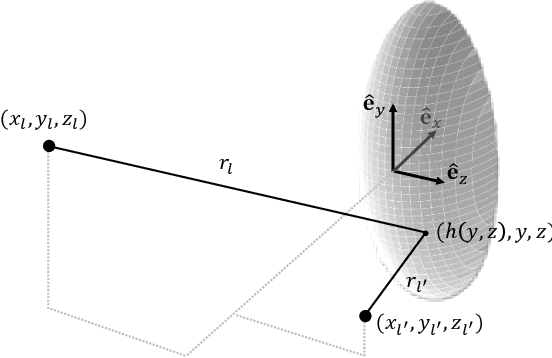
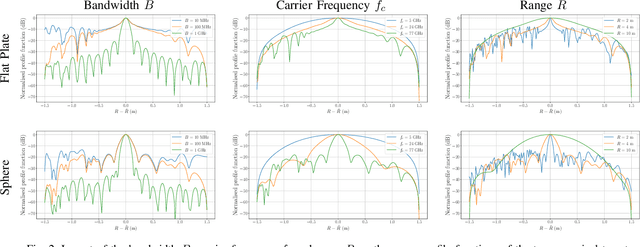
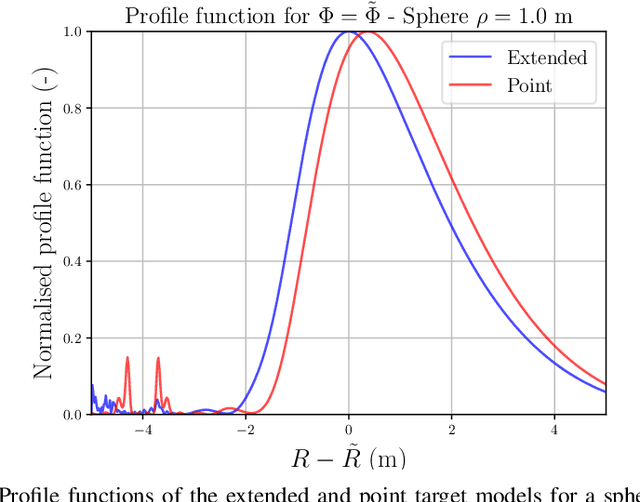
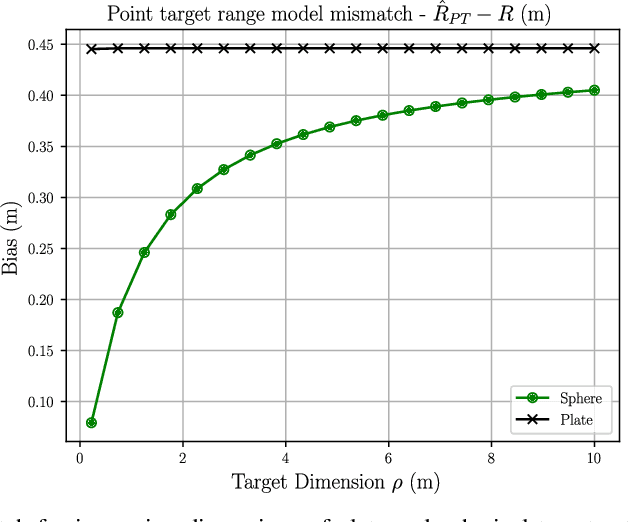
Traditional radar and integrated sensing and communication (ISAC) systems often approximate targets as point sources, a simplification that fails to capture the essential scattering characteristics for many applications. This paper presents a novel electromagnetic (EM)-based framework to accurately model the near-field (NF) scattering response of extended targets, which is then applied to three canonical shapes : a flat rectangular plate, a sphere and a cylinder. Mathematical expressions for the received signal are provided in each case. Based on this model, the influence of bandwidth, carrier frequency and target distance on localisation accuracy is analysed, showing how higher bandwidths and carrier frequencies improve resolution. Additionally, the impact of target curvature on localisation performance is studied. Results indicate that detection performance is slightly enhanced when considering curved objects. A comparative analysis between the extended and point target models shows significant similarities when targets are small and curved. However, as the target size increases or becomes flatter, the point target model introduces estimation errors owing to model mismatch. The impact of this model mismatch as a function of system parameters is analysed, and the operational zones where the point abstraction remains valid and where it breaks down are identified. These findings provide theoretical support for experimental results based on point-target models in previous studies.
Interference Cancellation Schemes for Full-Duplex Integrated Sensing and Communication
Oct 01, 2024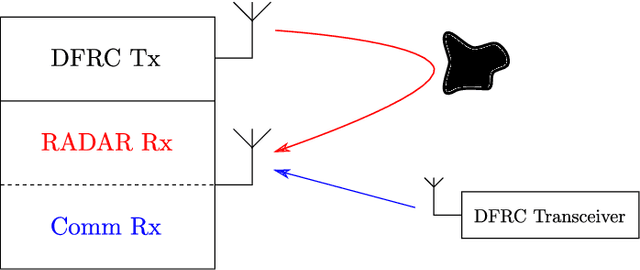
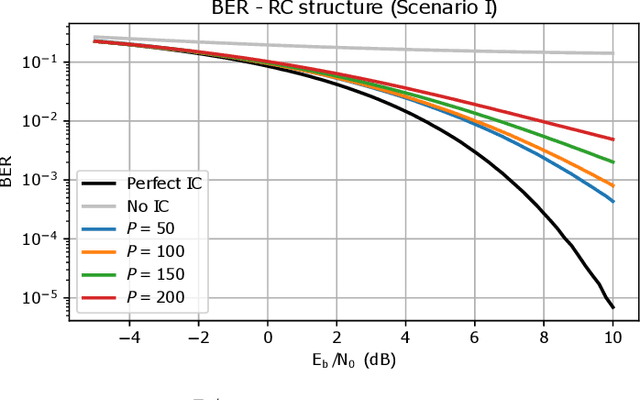
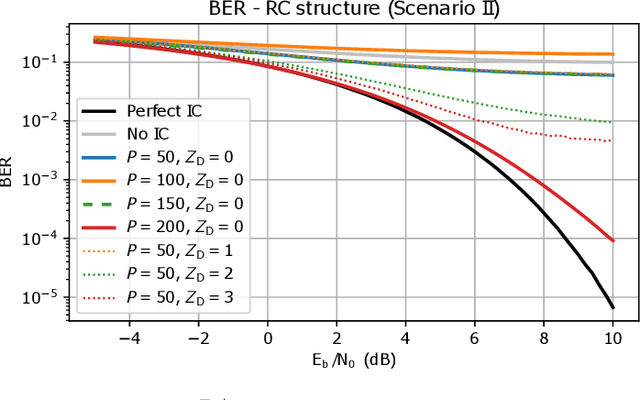
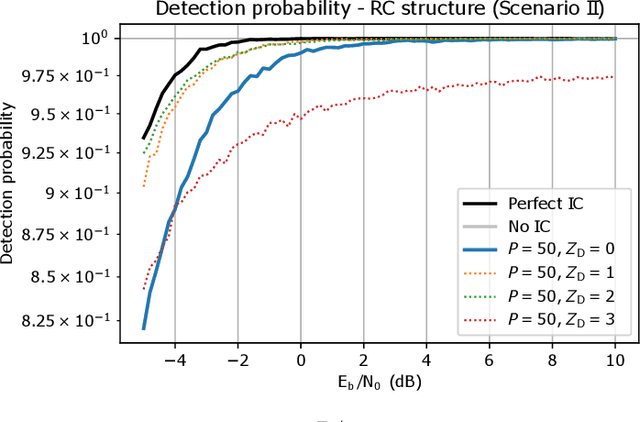
In this paper, the introduction of interference cancellation in full-duplex joint radar and communication receivers is analysed. More specifically, a focus is made on scenarios in which the receiver simultaneously receives radar echoes from the environment, and communication signals from other joint radar and communication transceivers. First, the phase-coded frequency modulated continuous wave waveform designed for integrated sensing and communication is presented. Then, simple structures in which interference cancellation is only applied at the radar or communication function are proposed, relying on the information gathered at the other function. The detection probability and bit error rate improvements are analysed numerically w.r.t. different system parameters, such as the communication constellation, or the number of transmitted pulses. The introduction of error correcting codes is also considered. Next, iterative interference cancellation structures are investigated. Thanks to multiple interference cancellation layers, both the radar and communication performance are improved, and the robustness of the system to any scenario is enhanced. This is shown numerically through the analysis of the performance achieved by simple and iterative structures, which are compared for different radar echo to communication signal power ratio. Finally, a dynamic automotive scenario is considered. Leveraging on previous radar measurements, the parameters of the radar echo are inferred, and it is reconstructed beforehand, enabling to remove the first radar processing block. The complexity of the iterative structures is thus reduced, at the price of a slight performance reduction. A dynamic automotive scenario is considered, highlighting the impact of the tracking of the next vehicle ahead on the system.
Positioning and transmission in cell-free networks: ambiguity function, and MRC/MRT array gains
Sep 12, 2024
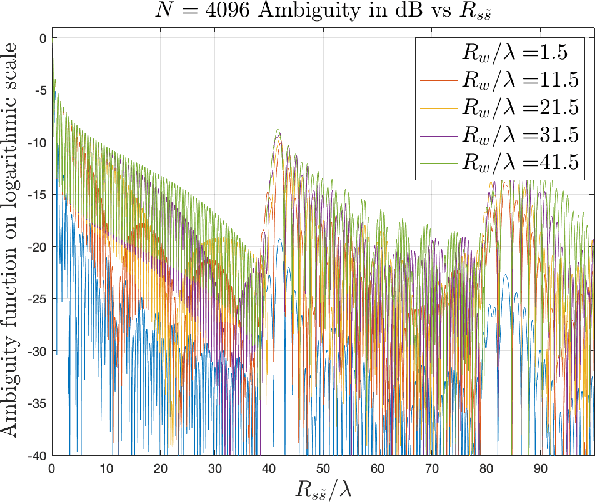
Cell-free network is a new paradigm, originating from distributed MIMO, that has been investigated for a few recent years as an alternative to the celebrated cellular structure. Future networks not only consider classical data transmission but also positioning, along the lines of Integrated Communications and Sensing (ISAC). The goal of this paper is to investigate at the same time the ambiguity function which is an important metric for positioning and the understanding of its associated resolution and ambiguities, and the array gain when maximum ratio transmission (MRT) or MR combining (MRC) is implemented for data communications. In particular, the role and impact of using a waveform with non-zero bandwidth is investigated. The theoretical findings are illustrated by means of computational results.
Full-Duplex V2X Integrated Sensing and Communication Scenario: Stochastic geometry, Monte-Carlo, and Ray-Tracing Comparison
Jul 09, 2024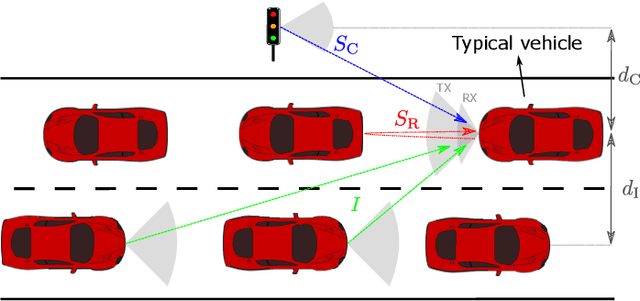
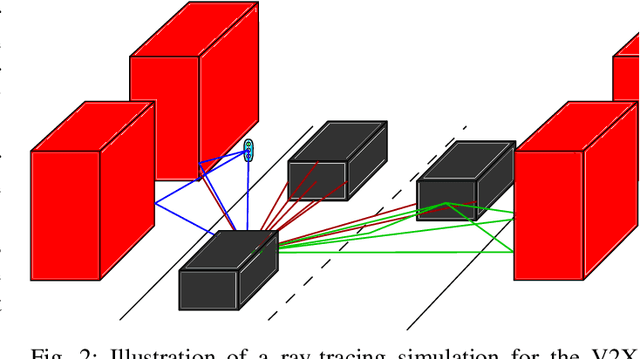
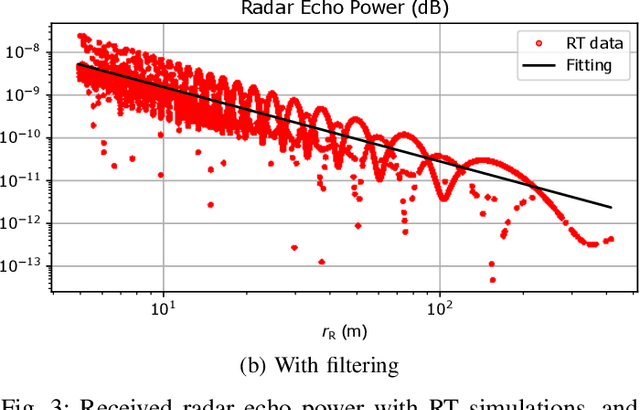
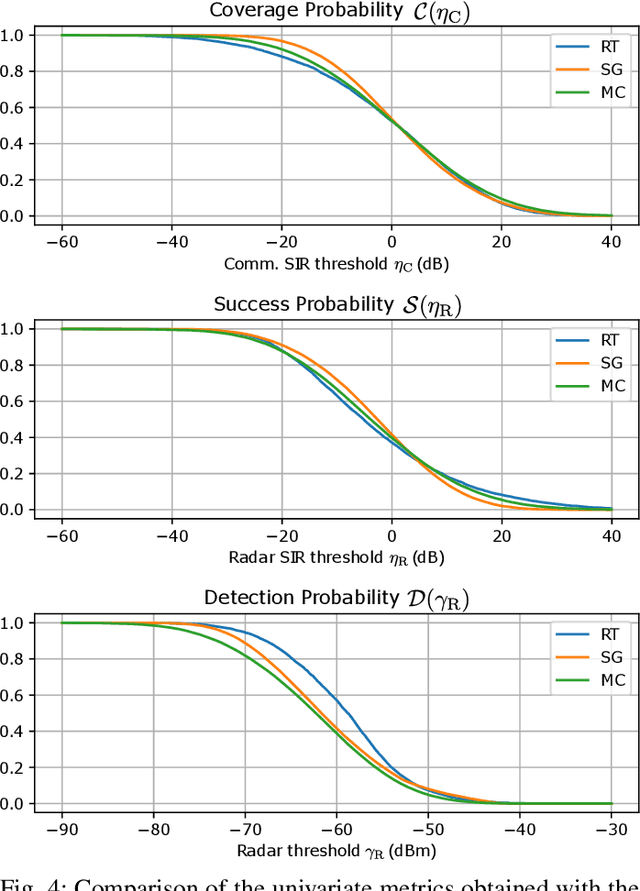
In this paper, performance of an Integrated Sensing and Communication (ISAC) Vehicle-to-Everything (V2X) scenario is evaluated, in which a vehicle simultaneously detects the next vehicle ahead while receiving a communication signal from a RoadSide Unit (RSU) of the infrastructure. Univariate and joint radar and communication performance metrics are evaluated within three different frameworks, namely the Stochastic Geometry (SG), Monte-Carlo (MC), and Ray-Tracing (RT) frameworks. The parameters of the system model are extracted from the RT simulations, and the metrics are compared to assess the accuracy of the SG framework. It is shown that the SG and MC system models are relevant w.r.t. RT simulations for the evaluation of univariate communication and sensing metrics, but larger discrepancies are observed for the joint metrics.