 Add to Chrome
 Add to Firefox
 Add to Edge
Near-Field Beampointing with Low Exposure Regions: a Dominant Subspace Projection Approach
Feb 13, 2026
The spherical nature of the wavefronts exhibited in the near-field of antenna arrays enables advanced beamforming capabilities, such as beampointing and beamnulling. In this paper, we exploit these properties to design a near-field beam pattern under a low exposure region constraint. We address the continuous region constraint through spatial discretization, which results in a large number of constraints that lead to prohibitive computational complexity. We propose a novel low-complexity algorithm that enables a computationally tractable beam pattern design. It uses a low-dimensional subspace representation of the low exposure region based on a singular value decomposition. Our approach achieves low complexity while providing a power received at a target user close to the optimal achievable power, yet with uniform power mitigation over the low exposure region.

Aliasing in Near-Field Array Ambiguity Functions: a Spatial Frequency-Domain Framework
Dec 13, 2025Next-generation communication and localization systems increasingly rely on extremely large-scale arrays (XL-arrays), which promise unprecedented spatial resolution and new functionalities. These gains arise from their inherent operation in the near field (NF) regime, where the spherical nature of the wavefront can no longer be ignored; consequently, characterizing the ambiguity function -- which amounts to the matched beam pattern -- is considerably more challenging. Implementing very wide apertures with half-wavelength element spacing is costly and complex. This motivates thinning the array (removing elements), which introduces intricate aliasing structures, i.e., grating lobes. Whereas prior work has addressed this challenge using approximations tailored to specific array geometries, this paper develops a general framework that reveals the fundamental origins and geometric behavior of grating lobes in near-field ambiguity functions. Using a local spatial-frequency analysis of steering signals, we derive a systematic methodology to model NF grating lobes as aliasing artifacts, quantifying their structure on the AF, and providing design guidelines for XL-arrays that operate within aliasing-safe regions. We further connect our framework to established far-field principles. Finally, we demonstrate the practical value of the approach by deriving closed-form expressions for aliasing-free regions in canonical uniform linear arrays and uniform circular arrays.
Chirp-Based Aliasing Analysis of Arrays in the Spherical Wavefront Regime
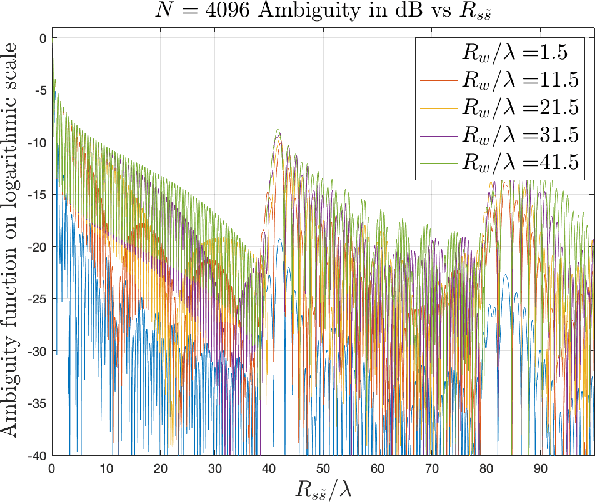
May 08, 2025In antenna arrays, wave propagation modeling based on Euclidean principles is typically represented by steering vectors or signals. This paper provides a new, chirp-based, interpretation of steering vectors in the Spherical Wavefront Regime (SWR), establishing a relationship between the spatial spectrum of the received (resp. transmitted) signal and the geometry of the array and the source (resp. target). Leveraging the well-known sampling theorem, we analyze aliasing effects arising from spatial sampling with a finite number of antennas and understand how these effects degrade the Ambiguity Function (AF). Our framework provides geometric insight into these degradations, offering a deeper understanding of the non-space-invariant aliasing mechanisms in the SWR. The proposed approach is formulated for general antenna arrays and then instantiated to Circular Array and to Uniform Linear Array structures operating in Near Field conditions.
Positioning and transmission in cell-free networks: ambiguity function, and MRC/MRT array gains
Sep 12, 2024
Cell-free network is a new paradigm, originating from distributed MIMO, that has been investigated for a few recent years as an alternative to the celebrated cellular structure. Future networks not only consider classical data transmission but also positioning, along the lines of Integrated Communications and Sensing (ISAC). The goal of this paper is to investigate at the same time the ambiguity function which is an important metric for positioning and the understanding of its associated resolution and ambiguities, and the array gain when maximum ratio transmission (MRT) or MR combining (MRC) is implemented for data communications. In particular, the role and impact of using a waveform with non-zero bandwidth is investigated. The theoretical findings are illustrated by means of computational results.