 Add to Chrome
 Add to Firefox
 Add to Edge
Particle-Based Conformal Prediction for Contact-Aware Uncertainty Calibration in Stratified Configuration Spaces
Aug 10, 2026
Reliable uncertainty representation is essential for deploying autonomous systems that interact with their environment, as robots must reason about how uncertainty arising from both stochasticity and model mismatch is impacted by contacts with obstacles (e.g., when navigating through a cluttered environment or inserting a part into an assembly). We propose Calibrated Particle-sets for Trans-dimensional Uncertainty Representation (CaPTURe), a geometry-aware, conformal prediction-based algorithm that generates probabilistically valid prediction regions of the unknown future system configuration using particle-based models of arbitrary fidelity. While calibrated uncertainty predictions are essential for safe and efficient planning, analytical or learned motion models are often inaccurate - due to limited data, simplifying assumptions, unmodeled effects, etc. - which can lead to unsafe executions or task failure. Additionally, when a robot contacts an obstacle, the distribution of its future configurations can become multimodal or disjoint, or lie along manifolds of lower intrinsic dimension than the space of possible robot configurations. Our method uses a calibration dataset of system transitions to locally calibrate motion uncertainty estimates, constructing regions guaranteed to contain the future robot configuration at a user-set probability. Our calibration procedure captures how motion uncertainty varies between contact-rich and contactless motions, leading to sufficient coverage in both cases. We evaluate our method on two simulated planning tasks: controlling a marble around a labyrinth and performing tight-tolerance peg-in-hole insertion with a manipulator. Compared to relevant baselines, CaPTURe achieves the user-specified coverage requirement both in and out of contact and achieves up to a 30% absolute improvement in task success rate over the best baseline.

Local Conformal Calibration of Dynamics Uncertainty from Semantic Images
May 13, 2026We introduce Observation-aware Conformal Uncertainty Local-Calibration (OCULAR), a conformal prediction-based algorithm that uses perception information to provide uncertainty quantification guarantees for unseen test-time environments. While previous conformal approaches lack the ability to discriminate between state-action space regions leading to higher or lower model mismatch, and require environment-specific data, our method uses data collected from visually similar environments to provably calibrate a given linear Gaussian dynamics model of arbitrary fidelity. The prediction regions generated from OCULAR are guaranteed to contain the future system states with, at least, a user-set likelihood, despite both aleatoric and epistemic uncertainty -- i.e., uncertainty arising from both stochastic disturbances and lack of data. Our guarantees are non-asymptotic and distribution-free, not requiring strong assumptions about the unknown real system dynamics. Our calibration procedure enables distinguishing between observation-velocity-action inputs leading to higher and lower next-state-uncertainty, which is helpful for probabilistically-safe planning. We numerically validate our algorithm on a double-integrator system subject to random perturbations and significant model mismatch, using both a simplified sensor and a more realistic simulated camera. Our approach appropriately quantifies uncertainty both when in-distribution and out-of-distribution, being comparatively volume-efficient to baselines requiring environment-specific data.
Lies We Can Trust: Quantifying Action Uncertainty with Inaccurate Stochastic Dynamics through Conformalized Nonholonomic Lie Groups
Dec 11, 2025We propose Conformal Lie-group Action Prediction Sets (CLAPS), a symmetry-aware conformal prediction-based algorithm that constructs, for a given action, a set guaranteed to contain the resulting system configuration at a user-defined probability. Our assurance holds under both aleatoric and epistemic uncertainty, non-asymptotically, and does not require strong assumptions about the true system dynamics, the uncertainty sources, or the quality of the approximate dynamics model. Typically, uncertainty quantification is tackled by making strong assumptions about the error distribution or magnitude, or by relying on uncalibrated uncertainty estimates - i.e., with no link to frequentist probabilities - which are insufficient for safe control. Recently, conformal prediction has emerged as a statistical framework capable of providing distribution-free probabilistic guarantees on test-time prediction accuracy. While current conformal methods treat robots as Euclidean points, many systems have non-Euclidean configurations, e.g., some mobile robots have SE(2). In this work, we rigorously analyze configuration errors using Lie groups, extending previous Euclidean Space theoretical guarantees to SE(2). Our experiments on a simulated JetBot, and on a real MBot, suggest that by considering the configuration space's structure, our symmetry-informed nonconformity score leads to more volume-efficient prediction regions which represent the underlying uncertainty better than existing approaches.
Quantifying Aleatoric and Epistemic Dynamics Uncertainty via Local Conformal Calibration
Sep 12, 2024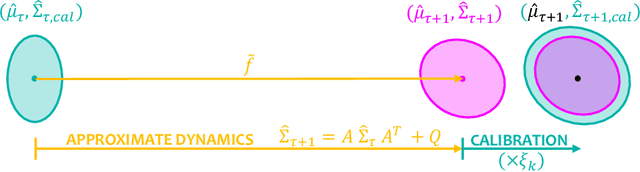
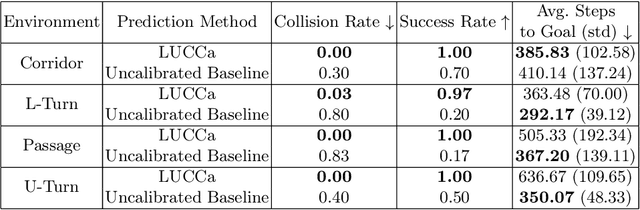
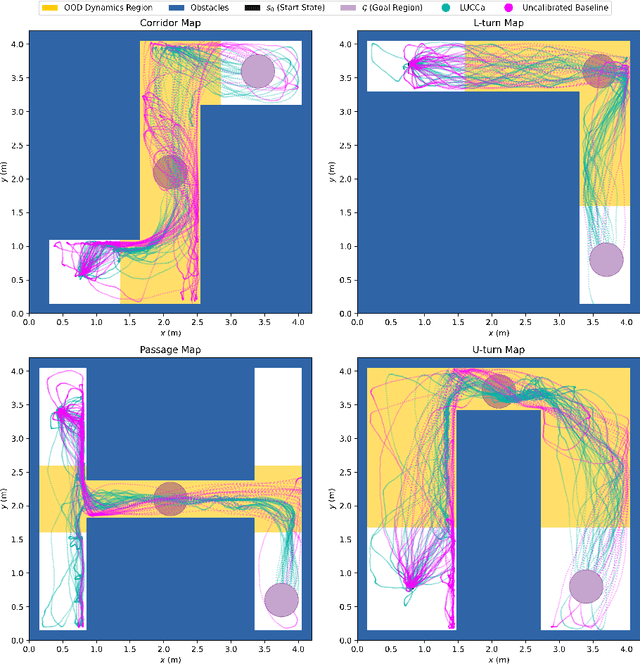
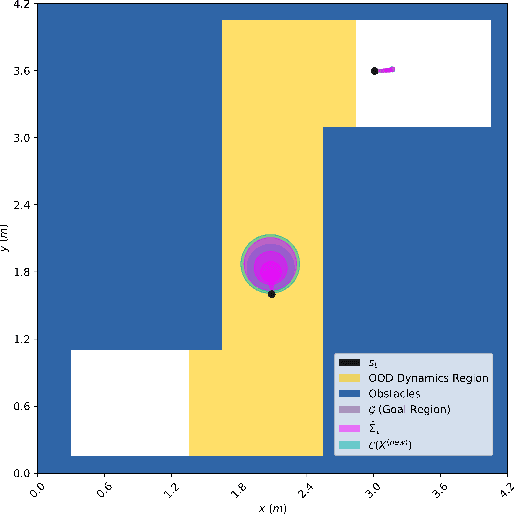
Whether learned, simulated, or analytical, approximations of a robot's dynamics can be inaccurate when encountering novel environments. Many approaches have been proposed to quantify the aleatoric uncertainty of such methods, i.e. uncertainty resulting from stochasticity, however these estimates alone are not enough to properly estimate the uncertainty of a model in a novel environment, where the actual dynamics can change. Such changes can induce epistemic uncertainty, i.e. uncertainty due to a lack of information/data. Accounting for both epistemic and aleatoric dynamics uncertainty in a theoretically-grounded way remains an open problem. We introduce Local Uncertainty Conformal Calibration (LUCCa), a conformal prediction-based approach that calibrates the aleatoric uncertainty estimates provided by dynamics models to generate probabilistically-valid prediction regions of the system's state. We account for both epistemic and aleatoric uncertainty non-asymptotically, without strong assumptions about the form of the true dynamics or how it changes. The calibration is performed locally in the state-action space, leading to uncertainty estimates that are useful for planning. We validate our method by constructing probabilistically-safe plans for a double-integrator under significant changes in dynamics.