 Add to Chrome
 Add to Firefox
 Add to Edge
ProtoAoA: Few-Shot Angle-of-Arrival Estimation using Prototypical Networks
Apr 15, 2026
Angle-of-arrival (AoA) estimation is a crucial function in wireless communications used for localization, beam-forming, interference management, and other applications. Deep learning (DL) solutions have been proposed for AoA to mitigate limitations of traditional AoA estimation techniques such as sensitivity to noise and the inability to generalize across different array characteristics. A challenge, however, of DL-based approaches is their reliance on large data collection campaigns and model training. This paper proposes the application of Prototypical Networks (PN) to address this challenge and utilizes a real-world dataset collected on a software defined radio (SDR) testbed to validate the effectiveness of the proposed solution. Prototypical Networks excel in extracting representative embeddings from unstructured input data, establishing class prototypes during training that can be few-shot trained on unseen classes. We demonstrate the efficacy of PNs for AoA classification using complex IQ samples, focusing on its ability to correctly classify new, unseen angles that the model was not trained on previously. Our results show that training our proposed ProtoAoA on only 23% of the AoA dataset classes can attain a mean absolute error (MAE) of 3 degrees with only 4-shots of training on the unseen angles - and an MAE of 2 degrees with 32-shots of training data. These results demonstrate that the developed prototypical network architecture requires remarkably few data samples to achieve reliable AoA estimation - and highlights its potential for other wireless applications where data availability is limited.

ProtoBeam: Generalizing Deep Beam Prediction to Unseen Antennas using Prototypical Networks
Jan 06, 2025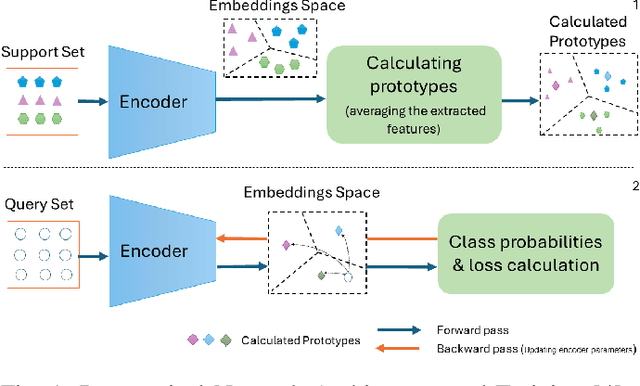

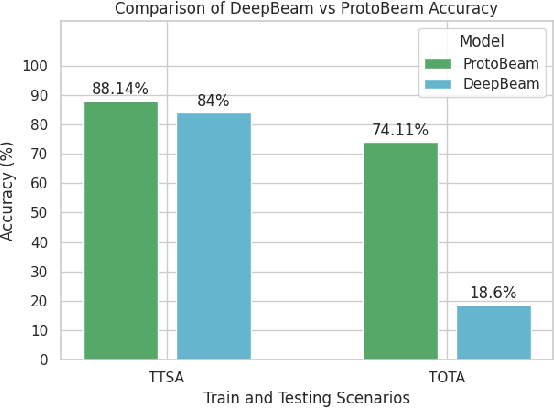
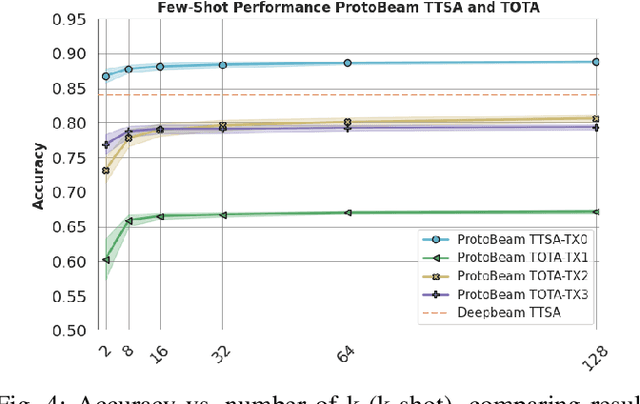
Deep learning techniques have recently emerged to efficiently manage mmWave beam transmissions without requiring time consuming beam sweeping strategies. A fundamental challenge in these methods is their dependency on hardware-specific training data and their limited ability to generalize. Large drops in performance are reported in literature when DL models trained in one antenna environment are applied in another. This paper proposes the application of Prototypical Networks to address this challenge and utilizes the DeepBeam real-world dataset to validate the developed solutions. Prototypical Networks excel in extracting features to establish class-specific prototypes during the training, resulting in precise embeddings that encapsulate the defining features of the data. We demonstrate the effectiveness of PN to enable generalization of deep beam predictors across unseen antennas. Our approach, which integrates data normalization and prototype normalization with the PN, achieves an average beam classification accuracy of 74.11 percent when trained and tested on different antenna datasets. This is an improvement of 398 percent compared to baseline performances reported in literature that do not account for such domain shifts. To the best of our knowledge, this work represents the first demonstration of the value of Prototypical Networks for domain adaptation in wireless networks, providing a foundation for future research in this area.