 Add to Chrome
 Add to Firefox
 Add to Edge
ProtoAoA: Few-Shot Angle-of-Arrival Estimation using Prototypical Networks
Apr 15, 2026
Angle-of-arrival (AoA) estimation is a crucial function in wireless communications used for localization, beam-forming, interference management, and other applications. Deep learning (DL) solutions have been proposed for AoA to mitigate limitations of traditional AoA estimation techniques such as sensitivity to noise and the inability to generalize across different array characteristics. A challenge, however, of DL-based approaches is their reliance on large data collection campaigns and model training. This paper proposes the application of Prototypical Networks (PN) to address this challenge and utilizes a real-world dataset collected on a software defined radio (SDR) testbed to validate the effectiveness of the proposed solution. Prototypical Networks excel in extracting representative embeddings from unstructured input data, establishing class prototypes during training that can be few-shot trained on unseen classes. We demonstrate the efficacy of PNs for AoA classification using complex IQ samples, focusing on its ability to correctly classify new, unseen angles that the model was not trained on previously. Our results show that training our proposed ProtoAoA on only 23% of the AoA dataset classes can attain a mean absolute error (MAE) of 3 degrees with only 4-shots of training on the unseen angles - and an MAE of 2 degrees with 32-shots of training data. These results demonstrate that the developed prototypical network architecture requires remarkably few data samples to achieve reliable AoA estimation - and highlights its potential for other wireless applications where data availability is limited.

6G WavesFM: A Foundation Model for Sensing, Communication, and Localization
Apr 18, 2025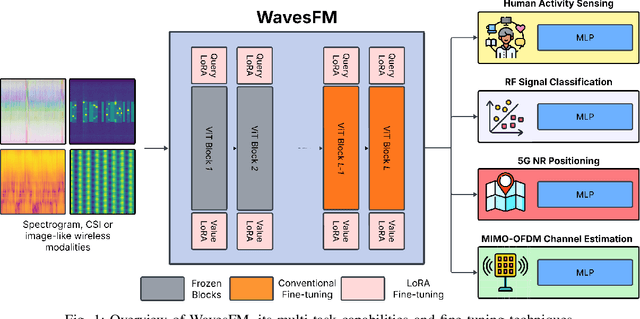

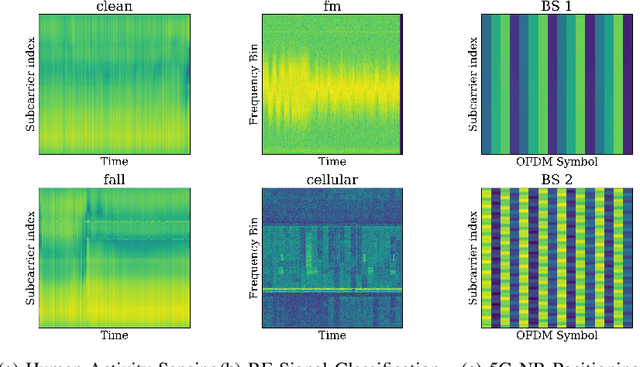
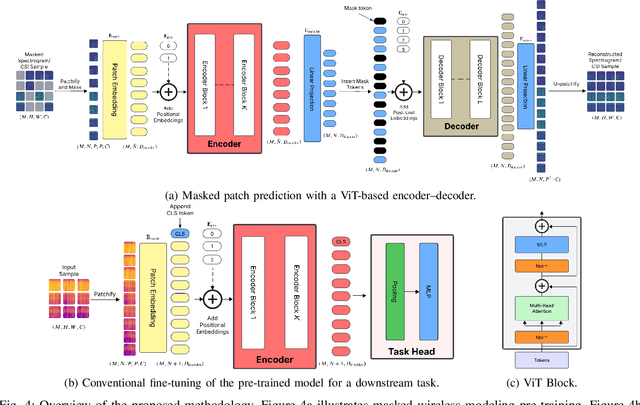
This paper introduces WavesFM, a novel Wireless Foundation Model (WFM) framework, capable of supporting a wide array of communication, sensing, and localization tasks. Our proposed architecture combines a shared Vision Transformer (ViT) backbone with task-specific multi-layer perceptron (MLP) heads and incorporates Low-Rank Adaptation (LoRA) for parameter-efficient fine-tuning. This design promotes full parameter sharing across tasks, significantly reducing the computational and memory footprint without sacrificing performance. The model processes both image-like wireless modalities, such as spectrograms and channel state information (CSI), and in-phase and quadrature (IQ) signals arranged as orthogonal frequency-division multiplexing (OFDM) resource grids. We demonstrate the strong generalization capabilities of WavesFM through extensive experiments on four downstream tasks: Fifth Generation New Radio (5G NR) positioning; multiple-input multiple-output OFDM (MIMO-OFDM) channel estimation; human activity sensing; and radio-frequency (RF) signal classification. Compared to supervised baselines trained individually, our approach achieves superior performance while sharing 80% of its parameters across tasks. Furthermore, we show that pretraining on domain-relevant data not only boosts performance but also accelerates convergence, reducing training time by up to 5x. These results demonstrate that our unified WFM can support diverse tasks and deliver significant gains in both performance and efficiency, highlighting the transformative potential of foundation models to drive AI-native paradigms in future sixth-generation (6G) networks.
ProtoBeam: Generalizing Deep Beam Prediction to Unseen Antennas using Prototypical Networks
Jan 06, 2025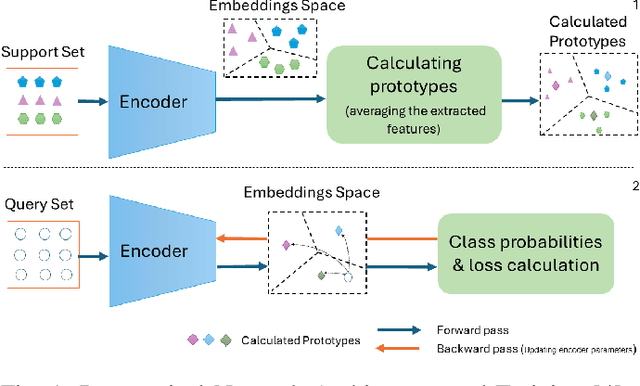

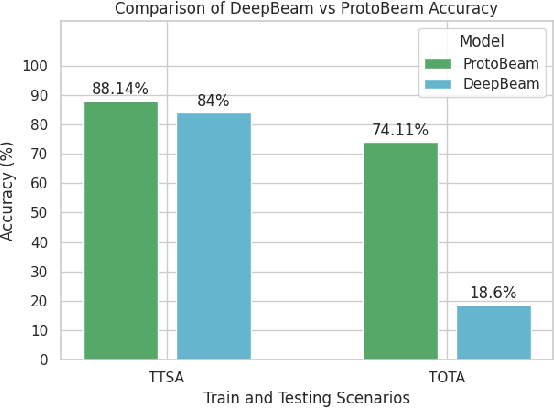
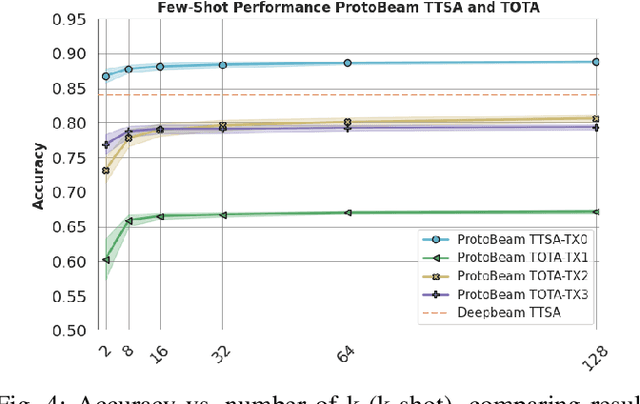
Deep learning techniques have recently emerged to efficiently manage mmWave beam transmissions without requiring time consuming beam sweeping strategies. A fundamental challenge in these methods is their dependency on hardware-specific training data and their limited ability to generalize. Large drops in performance are reported in literature when DL models trained in one antenna environment are applied in another. This paper proposes the application of Prototypical Networks to address this challenge and utilizes the DeepBeam real-world dataset to validate the developed solutions. Prototypical Networks excel in extracting features to establish class-specific prototypes during the training, resulting in precise embeddings that encapsulate the defining features of the data. We demonstrate the effectiveness of PN to enable generalization of deep beam predictors across unseen antennas. Our approach, which integrates data normalization and prototype normalization with the PN, achieves an average beam classification accuracy of 74.11 percent when trained and tested on different antenna datasets. This is an improvement of 398 percent compared to baseline performances reported in literature that do not account for such domain shifts. To the best of our knowledge, this work represents the first demonstration of the value of Prototypical Networks for domain adaptation in wireless networks, providing a foundation for future research in this area.
Using Early Exits for Fast Inference in Automatic Modulation Classification
Aug 22, 2023Automatic modulation classification (AMC) plays a critical role in wireless communications by autonomously classifying signals transmitted over the radio spectrum. Deep learning (DL) techniques are increasingly being used for AMC due to their ability to extract complex wireless signal features. However, DL models are computationally intensive and incur high inference latencies. This paper proposes the application of early exiting (EE) techniques for DL models used for AMC to accelerate inference. We present and analyze four early exiting architectures and a customized multi-branch training algorithm for this problem. Through extensive experimentation, we show that signals with moderate to high signal-to-noise ratios (SNRs) are easier to classify, do not require deep architectures, and can therefore leverage the proposed EE architectures. Our experimental results demonstrate that EE techniques can significantly reduce the inference speed of deep neural networks without sacrificing classification accuracy. We also thoroughly study the trade-off between classification accuracy and inference time when using these architectures. To the best of our knowledge, this work represents the first attempt to apply early exiting methods to AMC, providing a foundation for future research in this area.