 Add to Chrome
 Add to Firefox
 Add to Edge
Statistical Learning from Attribution Sets
Feb 06, 2026
We address the problem of training conversion prediction models in advertising domains under privacy constraints, where direct links between ad clicks and conversions are unavailable. Motivated by privacy-preserving browser APIs and the deprecation of third-party cookies, we study a setting where the learner observes a sequence of clicks and a sequence of conversions, but can only link a conversion to a set of candidate clicks (an attribution set) rather than a unique source. We formalize this as learning from attribution sets generated by an oblivious adversary equipped with a prior distribution over the candidates. Despite the lack of explicit labels, we construct an unbiased estimator of the population loss from these coarse signals via a novel approach. Leveraging this estimator, we show that Empirical Risk Minimization achieves generalization guarantees that scale with the informativeness of the prior and is also robust against estimation errors in the prior, despite complex dependencies among attribution sets. Simple empirical evaluations on standard datasets suggest our unbiased approach significantly outperforms common industry heuristics, particularly in regimes where attribution sets are large or overlapping.

Optimal Learning from Label Proportions with General Loss Functions
Sep 18, 2025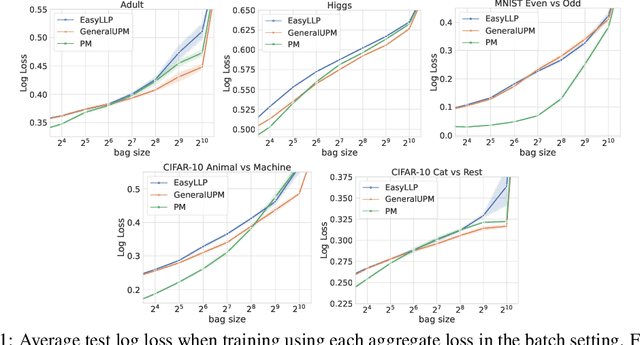
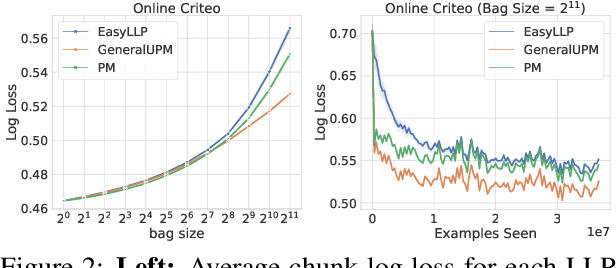
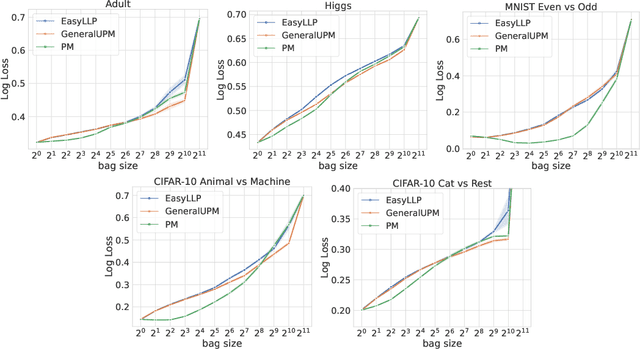
Motivated by problems in online advertising, we address the task of Learning from Label Proportions (LLP). In this partially-supervised setting, training data consists of groups of examples, termed bags, for which we only observe the average label value. The main goal, however, remains the design of a predictor for the labels of individual examples. We introduce a novel and versatile low-variance de-biasing methodology to learn from aggregate label information, significantly advancing the state of the art in LLP. Our approach exhibits remarkable flexibility, seamlessly accommodating a broad spectrum of practically relevant loss functions across both binary and multi-class classification settings. By carefully combining our estimators with standard techniques, we substantially improve sample complexity guarantees for a large class of losses of practical relevance. We also empirically validate the efficacy of our proposed approach across a diverse array of benchmark datasets, demonstrating compelling empirical advantages over standard baselines.