 Add to Chrome
 Add to Firefox
 Add to Edge
M$^2$E-UAV: A Benchmark and Analysis for Onboard Motion-on-Motion Event-Based Tiny UAV Detection
May 11, 2026
Tiny UAV detection from an onboard event camera is difficult when the observer and target move at the same time. In this motion-on-motion regime, ego-motion activates background edges across buildings, vegetation, and horizon structures, while the UAV may appear as a sparse event cluster. To explore this practical problem, we present M$^2$E-UAV, a benchmark and analysis setup for onboard motion-on-motion event-based tiny UAV detection. The processed M$^2$E-UAV benchmark contains 87,223 training samples and 21,395 validation samples across four scene families: sunny building-forest, sunny farm-village, sunset building-forest, and sunset farm-village. We provide M$^2$E-Point, a point-based event baseline, and M$^2$E-Point + IMU, an IMU-conditioned variant, to analyze the role of inertial cues under onboard motion-on-motion detection. M$^2$E-Point encodes events as $[x,y,t,p]$ point sets, extracts local event structure with EdgeConv, and predicts event-level UAV foreground scores, from which bounding boxes are derived via DBSCAN. Our validation-stage analysis shows that point-based event modeling is a strong baseline, while simple IMU conditioning provides only marginal aggregate gains. Under the train/validation split, M$^2$E-Point achieves 0.9673 F1 and 0.5501 mAP50-95, while the IMU-conditioned variant reaches 0.5561 mAP50-95 with only marginal aggregate changes, serving as an initial baseline for future exploration in this domain. Code will be ready in https://github.com/Wickyan/M2E-UAV.

AFMRL: Attribute-Enhanced Fine-Grained Multi-Modal Representation Learning in E-commerce
Apr 22, 2026Multimodal representation is crucial for E-commerce tasks such as identical product retrieval. Large representation models (e.g., VLM2Vec) demonstrate strong multimodal understanding capabilities, yet they struggle with fine-grained semantic comprehension, which is essential for distinguishing highly similar items. To address this, we propose Attribute-Enhanced Fine-Grained Multi-Modal Representation Learning (AFMRL), which defines product fine-grained understanding as an attribute generation task. It leverages the generative power of Multimodal Large Language Models (MLLMs) to extract key attributes from product images and text, and enhances representation learning through a two-stage training framework: 1) Attribute-Guided Contrastive Learning (AGCL), where the key attributes generated by the MLLM are used in the image-text contrastive learning training process to identify hard samples and filter out noisy false negatives. 2) Retrieval-aware Attribute Reinforcement (RAR), where the improved retrieval performance of the representation model post-attribute integration serves as a reward signal to enhance MLLM's attribute generation during multimodal fine-tuning. Extensive experiments on large-scale E-commerce datasets demonstrate that our method achieves state-of-the-art performance on multiple downstream retrieval tasks, validating the effectiveness of harnessing generative models to advance fine-grained representation learning.
StegaVAR: Privacy-Preserving Video Action Recognition via Steganographic Domain Analysis
Dec 14, 2025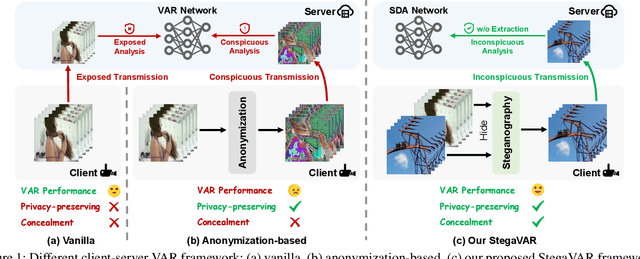
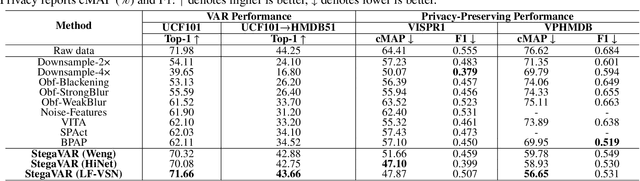
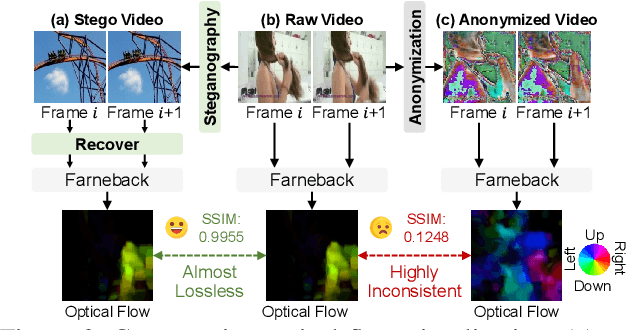
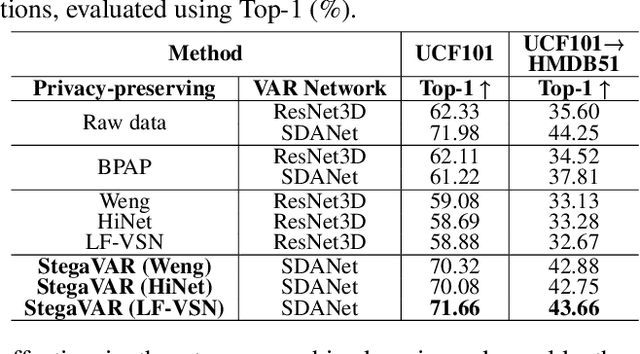
Despite the rapid progress of deep learning in video action recognition (VAR) in recent years, privacy leakage in videos remains a critical concern. Current state-of-the-art privacy-preserving methods often rely on anonymization. These methods suffer from (1) low concealment, where producing visually distorted videos that attract attackers' attention during transmission, and (2) spatiotemporal disruption, where degrading essential spatiotemporal features for accurate VAR. To address these issues, we propose StegaVAR, a novel framework that embeds action videos into ordinary cover videos and directly performs VAR in the steganographic domain for the first time. Throughout both data transmission and action analysis, the spatiotemporal information of hidden secret video remains complete, while the natural appearance of cover videos ensures the concealment of transmission. Considering the difficulty of steganographic domain analysis, we propose Secret Spatio-Temporal Promotion (STeP) and Cross-Band Difference Attention (CroDA) for analysis within the steganographic domain. STeP uses the secret video to guide spatiotemporal feature extraction in the steganographic domain during training. CroDA suppresses cover interference by capturing cross-band semantic differences. Experiments demonstrate that StegaVAR achieves superior VAR and privacy-preserving performance on widely used datasets. Moreover, our framework is effective for multiple steganographic models.
SMEC: Rethinking Matryoshka Representation Learning for Retrieval Embedding Compression
Oct 14, 2025Large language models (LLMs) generate high-dimensional embeddings that capture rich semantic and syntactic information. However, high-dimensional embeddings exacerbate computational complexity and storage requirements, thereby hindering practical deployment. To address these challenges, we propose a novel training framework named Sequential Matryoshka Embedding Compression (SMEC). This framework introduces the Sequential Matryoshka Representation Learning(SMRL) method to mitigate gradient variance during training, the Adaptive Dimension Selection (ADS) module to reduce information degradation during dimension pruning, and the Selectable Cross-batch Memory (S-XBM) module to enhance unsupervised learning between high- and low-dimensional embeddings. Experiments on image, text, and multimodal datasets demonstrate that SMEC achieves significant dimensionality reduction while maintaining performance. For instance, on the BEIR dataset, our approach improves the performance of compressed LLM2Vec embeddings (256 dimensions) by 1.1 points and 2.7 points compared to the Matryoshka-Adaptor and Search-Adaptor models, respectively.