 Add to Chrome
 Add to Firefox
 Add to Edge
Towards Conversational Medical AI with Eyes, Ears and a Voice
May 10, 2026
The practice of medicine relies not only upon skillful dialogue but also on the nuanced exchange and interpretation of rich auditory and visual cues between doctors and patients. Building on the low-latency voice and video processing capabilities of Gemini, we introduce AI co-clinician, a first-of-its-kind conversational AI system utilizing continuous streams of audio-visual data from live patient conversations to inform real-time clinical decisions. Its dual-agent architecture balances deep clinical reasoning with the low latency required for natural dialogue. To assess this system, we implemented a video-based interface emulating telemedicine consultations. We crafted 20 standardized outpatient scenarios requiring proactive real-time auditory and visual reasoning and designed "TelePACES" evaluation criteria alongside case-specific rubrics. In a randomized, interface-blinded, crossover simulation study (n = 120 encounters) with 10 internal medicine residents as patient actors, we compared AI co-clinician with primary care physicians (PCPs), GPT-Realtime, and a baseline agent. AI co-clinician approached PCPs in key TelePACES dimensions, including management plans and differential diagnosis, while significantly outperforming GPT-Realtime across all general criteria. While our agent demonstrated parity with PCPs in case-specific triage measures, physicians maintained superior overall performance in case-specific assessments. Although AI co-clinician marks a significant advance in real-time telemedical AI, gaps remain in physical examination and disease-specific reasoning. Our work shows that text-only approaches fail to capture the true challenges of medical consultation and suggests that high-stakes real-time diagnostic AI is most safely advanced in collaborative, triadic models where AI can be a supportive co-clinician for doctors and patients.

Learning to Generate Image Embeddings with User-level Differential Privacy
Nov 20, 2022
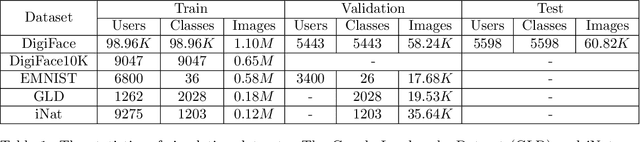


Small on-device models have been successfully trained with user-level differential privacy (DP) for next word prediction and image classification tasks in the past. However, existing methods can fail when directly applied to learn embedding models using supervised training data with a large class space. To achieve user-level DP for large image-to-embedding feature extractors, we propose DP-FedEmb, a variant of federated learning algorithms with per-user sensitivity control and noise addition, to train from user-partitioned data centralized in the datacenter. DP-FedEmb combines virtual clients, partial aggregation, private local fine-tuning, and public pretraining to achieve strong privacy utility trade-offs. We apply DP-FedEmb to train image embedding models for faces, landmarks and natural species, and demonstrate its superior utility under same privacy budget on benchmark datasets DigiFace, EMNIST, GLD and iNaturalist. We further illustrate it is possible to achieve strong user-level DP guarantees of $\epsilon<2$ while controlling the utility drop within 5%, when millions of users can participate in training.
Nutrition5k: Towards Automatic Nutritional Understanding of Generic Food
Mar 04, 2021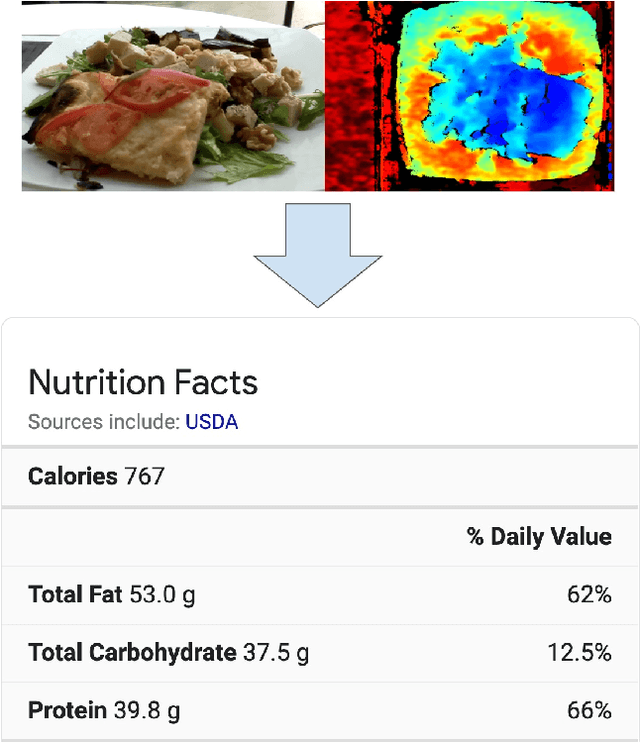
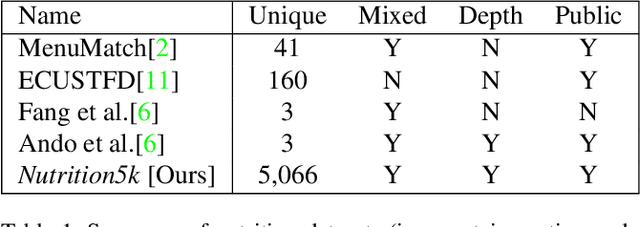
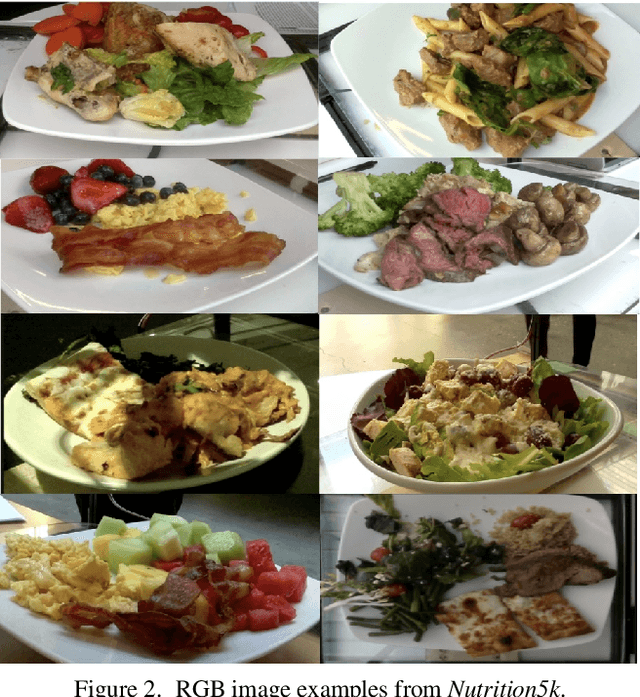
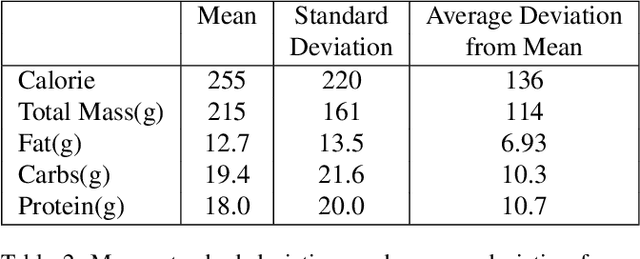
Understanding the nutritional content of food from visual data is a challenging computer vision problem, with the potential to have a positive and widespread impact on public health. Studies in this area are limited to existing datasets in the field that lack sufficient diversity or labels required for training models with nutritional understanding capability. We introduce Nutrition5k, a novel dataset of 5k diverse, real world food dishes with corresponding video streams, depth images, component weights, and high accuracy nutritional content annotation. We demonstrate the potential of this dataset by training a computer vision algorithm capable of predicting the caloric and macronutrient values of a complex, real world dish at an accuracy that outperforms professional nutritionists. Further we present a baseline for incorporating depth sensor data to improve nutrition predictions. We will publicly release Nutrition5k in the hope that it will accelerate innovation in the space of nutritional understanding.