 Add to Chrome
 Add to Firefox
 Add to Edge
VideoStir: Understanding Long Videos via Spatio-Temporally Structured and Intent-Aware RAG
Apr 07, 2026
Scaling multimodal large language models (MLLMs) to long videos is constrained by limited context windows. While retrieval-augmented generation (RAG) is a promising remedy by organizing query-relevant visual evidence into a compact context, most existing methods (i) flatten videos into independent segments, breaking their inherent spatio-temporal structure, and (ii) depend on explicit semantic matching, which can miss cues that are implicitly relevant to the query's intent. To overcome these limitations, we propose VideoStir, a structured and intent-aware long-video RAG framework. It firstly structures a video as a spatio-temporal graph at clip level, and then performs multi-hop retrieval to aggregate evidence across distant yet contextually related events. Furthermore, it introduces an MLLM-backed intent-relevance scorer that retrieves frames based on their alignment with the query's reasoning intent. To support this capability, we curate IR-600K, a large-scale dataset tailored for learning frame-query intent alignment. Experiments show that VideoStir is competitive with state-of-the-art baselines without relying on auxiliary information, highlighting the promise of shifting long-video RAG from flattened semantic matching to structured, intent-aware reasoning. Codes and checkpoints are available at Github.

DifAttack: Query-Efficient Black-Box Attack via Disentangled Feature Space
Sep 26, 2023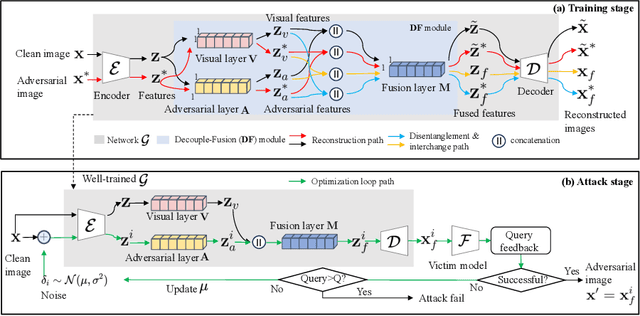
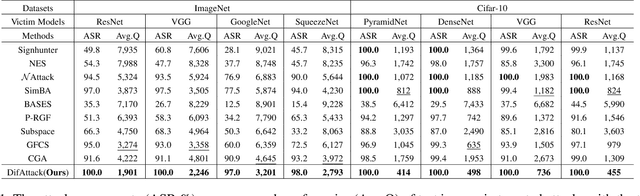
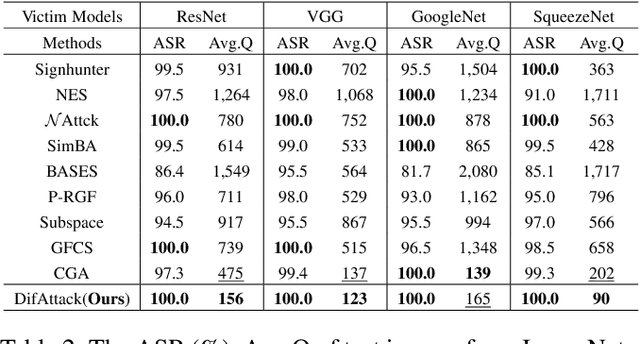
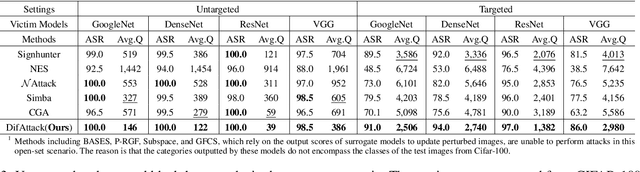
This work investigates efficient score-based black-box adversarial attacks with a high Attack Success Rate (ASR) and good generalizability. We design a novel attack method based on a Disentangled Feature space, called DifAttack, which differs significantly from the existing ones operating over the entire feature space. Specifically, DifAttack firstly disentangles an image's latent feature into an adversarial feature and a visual feature, where the former dominates the adversarial capability of an image, while the latter largely determines its visual appearance. We train an autoencoder for the disentanglement by using pairs of clean images and their Adversarial Examples (AEs) generated from available surrogate models via white-box attack methods. Eventually, DifAttack iteratively optimizes the adversarial feature according to the query feedback from the victim model until a successful AE is generated, while keeping the visual feature unaltered. In addition, due to the avoidance of using surrogate models' gradient information when optimizing AEs for black-box models, our proposed DifAttack inherently possesses better attack capability in the open-set scenario, where the training dataset of the victim model is unknown. Extensive experimental results demonstrate that our method achieves significant improvements in ASR and query efficiency simultaneously, especially in the targeted attack and open-set scenarios. The code will be available at https://github.com/csjunjun/DifAttack.git soon.