 Add to Chrome
 Add to Firefox
 Add to Edge
Mechanism and Stability Analysis of Metabolic Closed-Loop Metaheuristics
Jul 02, 2026
This paper studies the Metabolic Multi-Agent Optimizer (MMAO) at the framework level rather than at the implementation or benchmark level. The central question is whether the metabolic resource loop of private energy, communal budget, role drift, and lifecycle turnover has a framework-level interpretation beyond narrative metaphor. We introduce a generic MMAO state model that abstracts away domain-specific move operators while retaining the resource bookkeeping that defines the framework. Under mild bounded-gain and bounded-spending assumptions, we establish boundedness and nonnegativity properties for private energy, communal budget, role state, and active population size. We then characterize three endogenous behavioral regimes of the loop: contraction under sustained resource deficit, reinvestment under surplus communal accumulation, and search redistribution under heterogeneous marginal returns across agents or subgroups. The analysis is intentionally conservative. It does not claim global convergence of the full adaptive system, universal superiority over specialist optimizers, or a complete stationary characterization of the resulting process. Instead, it identifies which internal regulation properties are generic consequences of the loop and which remain implementation specific. A compact mechanism-validation package on representative continuous and discrete MMAO realizations provides supporting empirical evidence for this reading, but is not intended to replace a full benchmark study. The resulting contribution is therefore a bounded, regenerative, resource-regulated interpretation of MMAO, rather than a complete proof of all adaptive behaviors of the full algorithm family.

MMAO-Cls: Metabolic Multi-Agent Optimization for Joint Feature Selection and Classifier Tuning
Jul 01, 2026This paper studies whether the Metabolic Multi-Agent Optimizer (MMAO) can act as a credible outer-loop optimizer for classification model selection. We propose MMAO-Cls, a mixed-space realization in which each agent jointly encodes a binary feature mask and classifier hyperparameters, while private energy, communal budget, role drift, and lifecycle turnover are mapped to the accuracy-complexity tradeoff of wrapper learning. The implementation is strengthened by deriving feature-budget adaptation from feature-information priors and by regularizing validation reward with both subset compactness and train-validation overfitting gap. We evaluate MMAO-Cls on seven standard tabular benchmarks with three seeds each and compare it against RandomSearch, GA-lite, PSO-lite, and an endogenous no-sharing ablation. On the aggregate validation objective, MMAO-Cls ranks second ($0.9433$) behind GA-lite ($0.9446$). On held-out test performance, it reaches mean score $0.8882$, improving over RandomSearch ($0.8808$) and GA-lite ($0.8857$), remaining close to PSO-lite ($0.8874$) and the no-sharing ablation ($0.8900$), while using the most compact mean held-out feature subset among all compared methods (feature ratio $0.4881$). Pairwise tests show that these margins are not yet statistically significant. The resulting claim is therefore conservative: MMAO-Cls supports classification applicability and compact mixed-space search more clearly than it isolates communal sharing as a decisive standalone advantage.
MMAO-Dyn: A Metabolic Multi-Agent Optimizer for Dynamic Optimization
Jul 01, 2026This paper studies whether the Metabolic Multi-Agent Optimizer (MMAO) can be credibly derived into a dynamic-optimization method without replacing its core metabolic control loop by external adaptation modules. The proposed MMAO-Dyn maps private energy, communal budget, role drift, success feedback, and lifecycle turnover to a nonstationary setting in which environmental changes repeatedly invalidate previously useful local structure. We evaluate MMAO-Dyn on an 18-scenario synthetic dynamic continuous benchmark matrix covering shifted sphere, shifted Ackley, and shifted Rastrigin landscapes at $10D$, $20D$, and $30D$, with two change severities and 12 seeds per scenario. The comparison layer includes a generic MMAO variant without dynamic derivation, dynamic random search, dynamic PSO-lite, dynamic DE-lite, and three endogenous ablations. Across the full 216-run matrix, MMAO-Dyn attains mean offline error $28.07$, improving over Generic-MMAO ($29.36$), Dynamic-PSO-lite ($34.65$), Dynamic-DE-lite ($67.09$), and Dynamic-RandomSearch ($111.37$). The gains are clearest in aggregate robustness on sphere and Rastrigin families and in 10-step post-change recovery relative to the generic backbone, whereas the seed-aligned comparison with Dynamic-PSO-lite remains unfavorable in win-loss count and the \texttt{NoMemoryRefresh} ablation stays very close to the full method. We therefore position MMAO-Dyn as a credible family-expansion result for MMAO: the metabolic loop can generate meaningful dynamic behavior, but the strongest current value lies in recovery-oriented resource redistribution rather than in universal dominance or in a fully optimized submechanism design.
A Large-Scale Empirical Evaluation of MMAO Under Fair-Budget Continuous and Discrete Benchmarks
Jun 30, 2026This paper evaluates the Metabolic Multi-Agent Optimizer (MMAO) under a stricter empirical protocol rather than reintroducing the framework itself. The study asks whether MMAO's closed-loop resource-allocation principle remains credible under broader, more standard, and more explicitly budget-controlled continuous and discrete benchmarks. The main completed matrix covers eight CEC2017 functions at 10D and 30D with 20 seeds each, and five TSPLIB instances with 20 seeds each, together with stronger reproducible baselines including PSO-lite, ES-lite, and an iterated-greedy 2-opt route baseline. We further add trajectory-level diagnostics for communal budget, success rate, role evolution, and population turnover, plus an auxiliary OR-Library multiple-knapsack slice to extend the discrete evidence beyond routing. Under this protocol, MMAO clearly outperforms the external baseline set on the continuous side and on the TSPLIB side, while the ablation variants remain much closer to the full method than the external baselines are. We therefore position MMAO as a benchmark-backed cross-domain adaptive framework whose most clearly validated value is endogenous resource redistribution under evidence pressure, while also noting that the strongest remaining gap is not basic workability but sharper mechanism isolation and broader competition-grade comparison.
Minimal MMAO: A Resource-Closed-Loop Framework for Adaptive Metaheuristic Search
Jun 29, 2026This paper presents the Metabolic Multi-Agent Optimizer (MMAO) as an adaptive metaheuristic built around endogenous resource circulation. The central premise is that search intensity, exploration--exploitation balance, and lifecycle turnover should be induced by a shared metabolic controller rather than by separately attached schedules. We formulate MMAO through bounded private energy, a communal budget, normalized reward, continuous role adaptation, and resource-financed branching and pruning. The method is then instantiated in both continuous and discrete domains and evaluated on a matched small-scale suite including Sphere, Rastrigin, a synthetic Euclidean TSP, and two TSPLIB instances. The results show a consistent pattern: the same metabolic loop remains workable across domains, the discrete realization remains relatively stable under a compact design, and continuous refinement quality is the main cost of keeping the method lean. Taken together, these findings position MMAO as a coherent framework for adaptive heuristic design rather than a loose collection of operators.
MMAO: A Metabolic Multi-Agent Optimizer with Endogenous Resource Allocation for Continuous and Discrete Optimization
Jun 26, 2026Traditional meta-heuristics often rely on fixed population sizes, manually chosen search scales, and externally attached parameter-control modules. This paper presents the \textit{Metabolic Multi-Agent Optimizer} (MMAO), a cross-domain optimization framework in which adaptation is derived endogenously from a private-public metabolic resource loop. Each agent carries internal energy, a continuous role state, motion or structural memory, and local search history, while the population shares a communal resource pool. Fitness improvements are converted into normalized metabolic gains through a robust progress scale and a recent success statistic; the same closed loop then regulates sensing intensity, search amplitude, role drift, branching, pruning, respawning, and elite reinvestment. In the continuous setting, MMAO uses energy-regulated symmetric zero-order probing and role-interpolated motion. In the discrete setting, the same control law is instantiated through structural sensing, local route improvement, guided perturbation, and energy-weighted edge reuse. The paper combines an implementation-faithful formulation with a reproducible experimental study on a CEC2017 subset (10D/30D, 20 seeds) and five TSPLIB instances (100 discrete runs in total). The current evidence supports MMAO primarily as a parameter-light, self-calibrating optimization framework whose main validated originality lies in metabolically endogenous resource allocation across heterogeneous search behaviors, rather than as a universally superior optimizer.
Simultaneously Calibration of Multi Hand-Eye Robot System Based on Graph
May 04, 2023
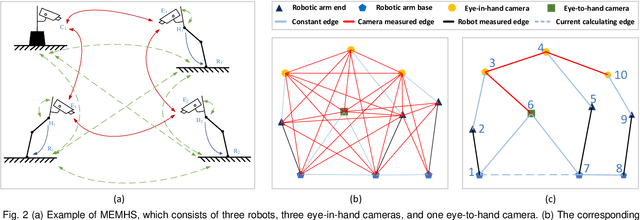
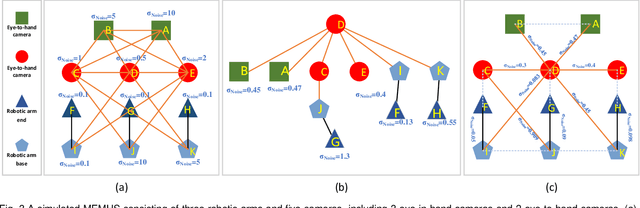
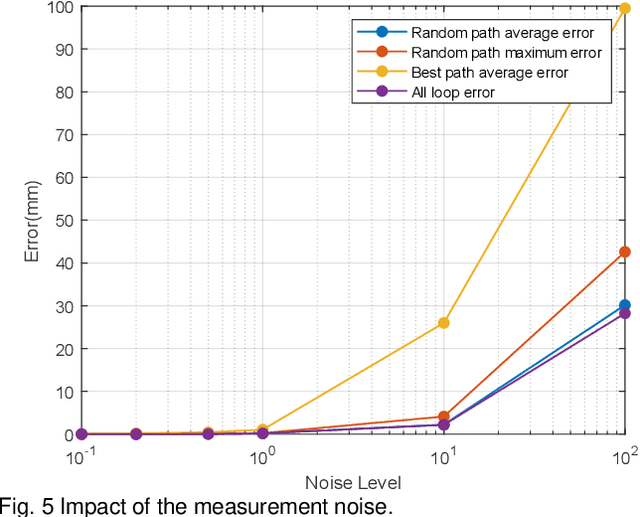
Precise calibration is the basis for the vision-guided robot system to achieve high-precision operations. Systems with multiple eyes (cameras) and multiple hands (robots) are particularly sensitive to calibration errors, such as micro-assembly systems. Most existing methods focus on the calibration of a single unit of the whole system, such as poses between hand and eye, or between two hands. These methods can be used to determine the relative pose between each unit, but the serialized incremental calibration strategy cannot avoid the problem of error accumulation in a large-scale system. Instead of focusing on a single unit, this paper models the multi-eye and multi-hand system calibration problem as a graph and proposes a method based on the minimum spanning tree and graph optimization. This method can automatically plan the serialized optimal calibration strategy in accordance with the system settings to get coarse calibration results initially. Then, with these initial values, the closed-loop constraints are introduced to carry out global optimization. Simulation experiments demonstrate the performance of the proposed algorithm under different noises and various hand-eye configurations. In addition, experiments on real robot systems are presented to further verify the proposed method.
Patch Similarity Aware Data-Free Quantization for Vision Transformers
Mar 04, 2022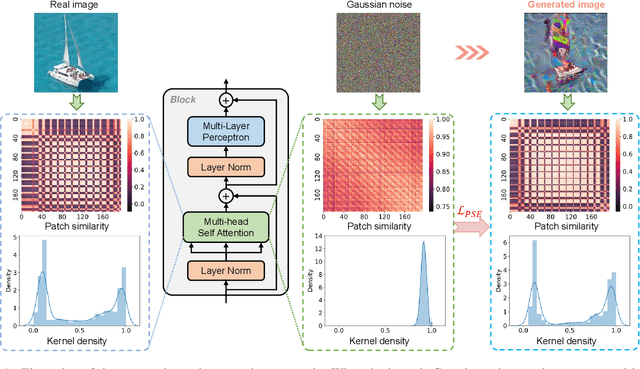
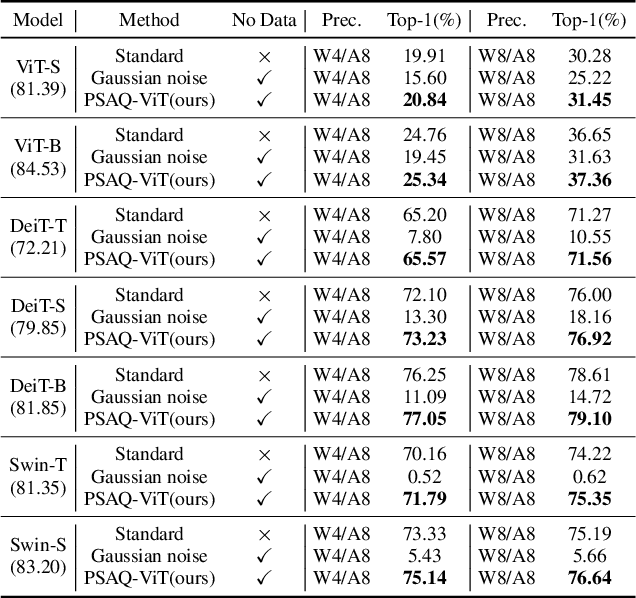
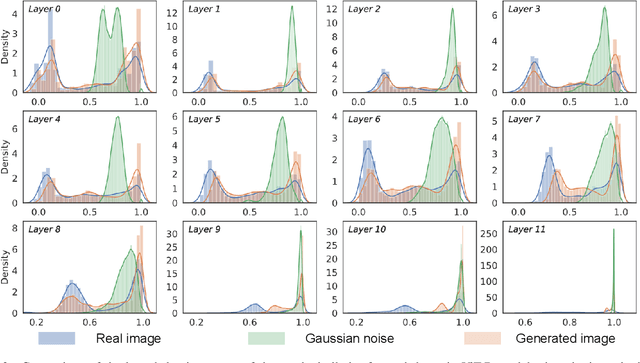
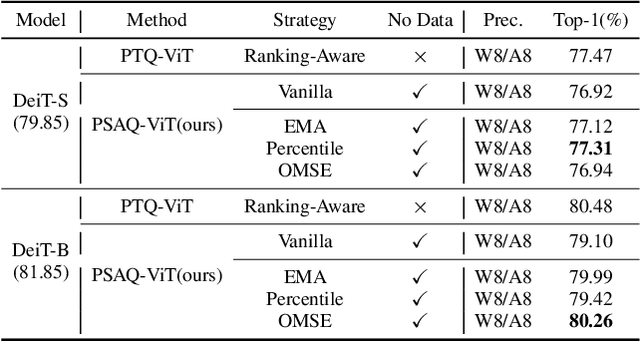
Vision transformers have recently gained great success on various computer vision tasks; nevertheless, their high model complexity makes it challenging to deploy on resource-constrained devices. Quantization is an effective approach to reduce model complexity, and data-free quantization, which can address data privacy and security concerns during model deployment, has received widespread interest. Unfortunately, all existing methods, such as BN regularization, were designed for convolutional neural networks and cannot be applied to vision transformers with significantly different model architectures. In this paper, we propose PSAQ-ViT, a Patch Similarity Aware data-free Quantization framework for Vision Transformers, to enable the generation of "realistic" samples based on the vision transformer's unique properties for calibrating the quantization parameters. Specifically, we analyze the self-attention module's properties and reveal a general difference (patch similarity) in its processing of Gaussian noise and real images. The above insights guide us to design a relative value metric to optimize the Gaussian noise to approximate the real images, which are then utilized to calibrate the quantization parameters. Extensive experiments and ablation studies are conducted on various benchmarks to validate the effectiveness of PSAQ-ViT, which can even outperform the real-data-driven methods.