 Add to Chrome
 Add to Firefox
 Add to Edge
Active Learning for Channel Knowledge Map Construction via Bayesian Inference Diffusion Models
Jun 29, 2026
Channel knowledge maps (CKMs) are regarded as key enablers of environment-aware communications in future wireless networks, as they provide location-specific channel information by establishing an explicit connection between wireless devices and the physical propagation environment. As a representative CKM, the channel gain map (CGM) characterizes the spatial distributions of large-scale fading to support wireless environment awareness and network optimization. Existing CGM construction methods generally lack a well-defined sampling-point acquisition strategy, which may result in a limited number of sampling points being allocated to spatially redundant or highly predictable regions, thereby degrading CGM reconstruction performance in complex propagation environments. In this paper, we propose an active-learning-based diffusion framework for efficient CGM construction. By combining Bayesian inference with the diffusion model, the proposed method estimates epistemic uncertainty without retraining the model. Two uncertainty quantification algorithms are further developed along the reverse diffusion process to generate element-wise epistemic uncertainty maps. Furthermore, an uncertainty-aware sampling strategy is designed to determine new observation locations by jointly considering epistemic uncertainty and spatial distribution uniformity. Experimental results on both static and dynamic CGM datasets demonstrate that the proposed method achieves better reconstruction performance than baseline methods. These results indicate that the proposed method can effectively improve the utilization efficiency of limited sampling points and enhance the accuracy of CGM construction in complex wireless propagation environments.

A sustainable development perspective on urban-scale roof greening priorities and benefits
Apr 21, 2024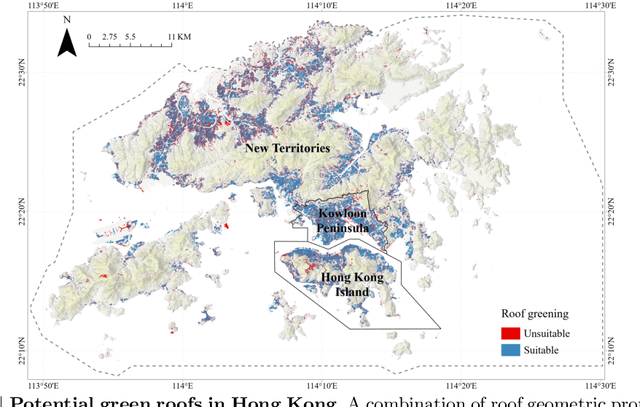
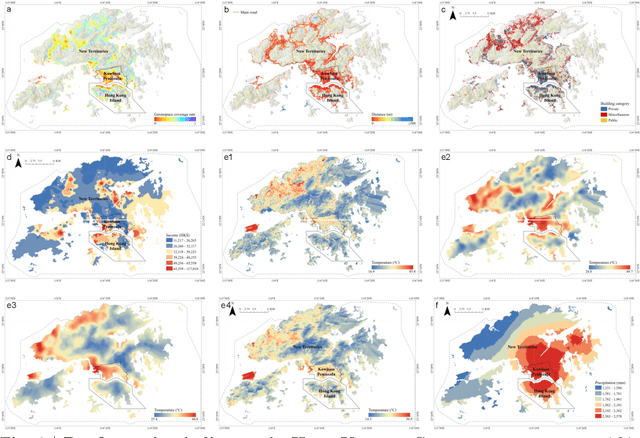
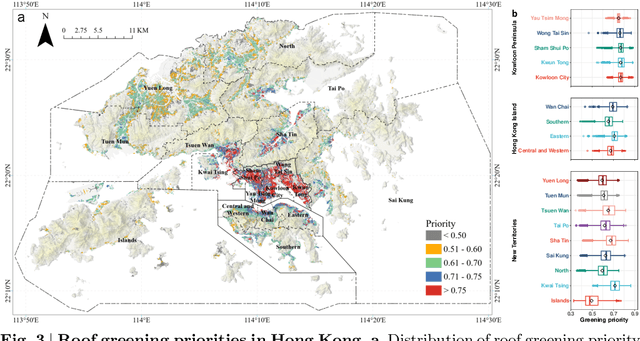
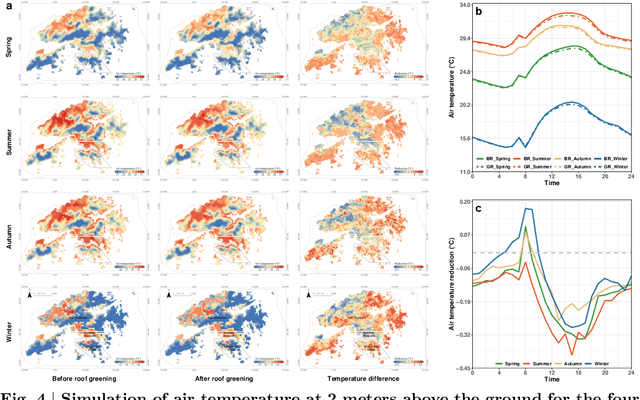
Greenspaces are tightly linked to human well-being. Yet, rapid urbanization has exacerbated greenspace exposure inequality and declining human life quality. Roof greening has been recognized as an effective strategy to mitigate these negative impacts. Understanding priorities and benefits is crucial to promoting green roofs. Here, using geospatial big data, we conduct an urban-scale assessment of roof greening at a single building level in Hong Kong from a sustainable development perspective. We identify that 85.3\% of buildings reveal potential and urgent demand for roof greening. We further find green roofs could increase greenspace exposure by \textasciitilde61\% and produce hundreds of millions (HK\$) in economic benefits annually but play a small role in urban heat mitigation (\textasciitilde0.15\degree{C}) and annual carbon emission offsets (\textasciitilde0.8\%). Our study offers a comprehensive assessment of roof greening, which could provide reference for sustainable development in cities worldwide, from data utilization to solutions and findings.