 Add to Chrome
 Add to Firefox
 Add to Edge
Can Large Language Models Explain Flight Safety Events? A Prior-Guided Semantic LLM-based Approach
Aug 18, 2026
Improving flight safety with flight data requires not only accurate detection of risk events, but more importantly, clear interpretation of their underlying causes at the level of pilot control behavior. Existing explainable AI techniques, such as feature importance maps, often require considerable domain knowledge to translate them into operationally meaningful explanations. Large Language Models (LLMs), which excel at language reasoning, bring a promising solution to this issue. However, applying LLMs in this domain presents key challenges such as modal inconsistency, limited classification ability, scarcity of task-specific data for fine-tuning, and lack of domain knowledge. To overcome these challenges, we propose FlightLLM, a prior-guided semantic LLM-based approach for interpretable flight safety analysis. Specifically, we first perform feature engineering to address modal inconsistency, combining statistical descriptors with physically meaningful flight indicators. This representation is further processed by a Semantic Discretization module, which converts abstract numerical patterns into qualitative descriptions that are more compatible with language reasoning. In addition, since LLMs are not inherently strong classifiers, CatBoost is incorporated as a statistical expert, and its prediction results are injected into the prompt as prior guidance. A contrastive few-shot learning strategy is further adopted to compensate for limited data. Finally, we design structured prompts to embed aviation-specific knowledge into the inference process. Using hard landing, a representative risk event with complex causal mechanisms, as an anchor point, we evaluate FlightLLM on a dataset of 704 real-world A320 flight samples. Experimental results show that the proposed approach achieves competitive classification performance while generating direct and reasonable explanations for event causes.

HMSG: Heterogeneous Graph Neural Network based on Metapath Subgraph Learning
Sep 07, 2021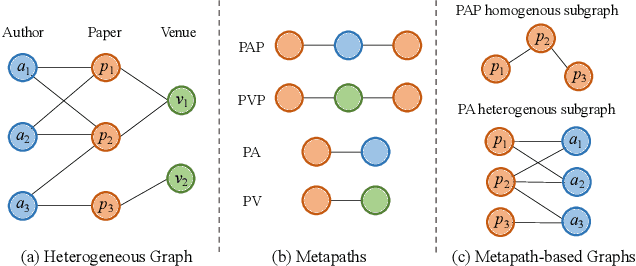
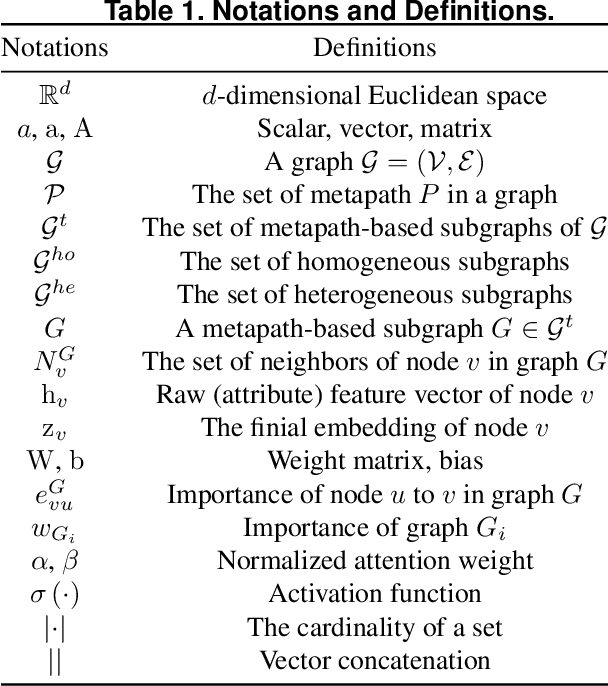
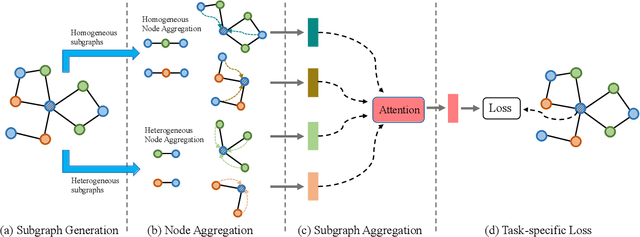
Many real-world data can be represented as heterogeneous graphs with different types of nodes and connections. Heterogeneous graph neural network model aims to embed nodes or subgraphs into low-dimensional vector space for various downstream tasks such as node classification, link prediction, etc. Although several models were proposed recently, they either only aggregate information from the same type of neighbors, or just indiscriminately treat homogeneous and heterogeneous neighbors in the same way. Based on these observations, we propose a new heterogeneous graph neural network model named HMSG to comprehensively capture structural, semantic and attribute information from both homogeneous and heterogeneous neighbors. Specifically, we first decompose the heterogeneous graph into multiple metapath-based homogeneous and heterogeneous subgraphs, and each subgraph associates specific semantic and structural information. Then message aggregation methods are applied to each subgraph independently, so that information can be learned in a more targeted and efficient manner. Through a type-specific attribute transformation, node attributes can also be transferred among different types of nodes. Finally, we fuse information from subgraphs together to get the complete representation. Extensive experiments on several datasets for node classification, node clustering and link prediction tasks show that HMSG achieves the best performance in all evaluation metrics than state-of-the-art baselines.