 Add to Chrome
 Add to Firefox
 Add to Edge
LOLLA: Deep Reinforcement Learning for Closed-Loop Link Adaptation Towards a GPU-Accelerated AI-RAN
Jun 22, 2026
Outer-loop link adaptation (OLLA) is widely deployed in 5G NR to track channel variations, yet its reliance on first-order, single-bit feedback degrades performance significantly under high-mobility and fast-varying channels. This paper presents LOLLA (Learned Outer-Loop Link Adaptation), a deep reinforcement learning framework that replaces the conventional OLLA staircase with a learned, continuous SINR offset conditioned on rich PHY/MAC telemetry inaccessible to OLLA. The offset modulates the SINR-to-MCS lookup table, preserving 3GPP-compliant MCS selection and provably subsuming the conventional OLLA update rule. A Proximal Policy Optimization (PPO) policy trained under a Lagrangian block error rate (BLER) constraint automatically enforces tunable reliability targets from 1% to 15% without manual penalty calibration. The framework is realized as the first closed-loop AI-native control dApp on a GPU-accelerated 5G NR stack, achieving end-to-end control latencies under 500 microseconds. Evaluations under 3GPP TDL channel models demonstrate 15% to 92% throughput gains over OLLA across Doppler frequencies up to 400 Hz, while attaining a Pareto frontier that strictly dominates OLLA across all evaluated reliability targets. The learned policy generalizes to unseen channel models and scales to eight concurrent UEs under shared-resource scheduling. In the uplink formulation, the gNB directly observes decoding outcomes, enabling simulation-to-deployment parity.

Focal-SAM: Focal Sharpness-Aware Minimization for Long-Tailed Classification
May 03, 2025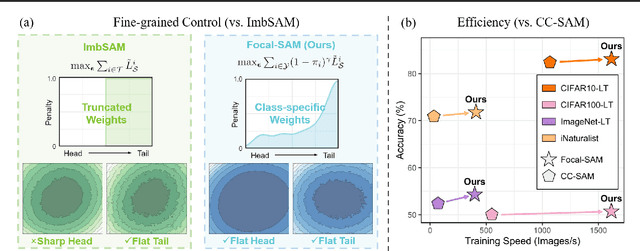

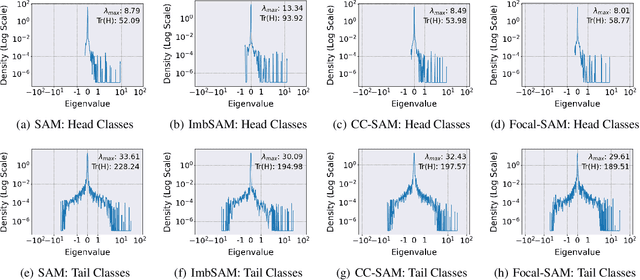
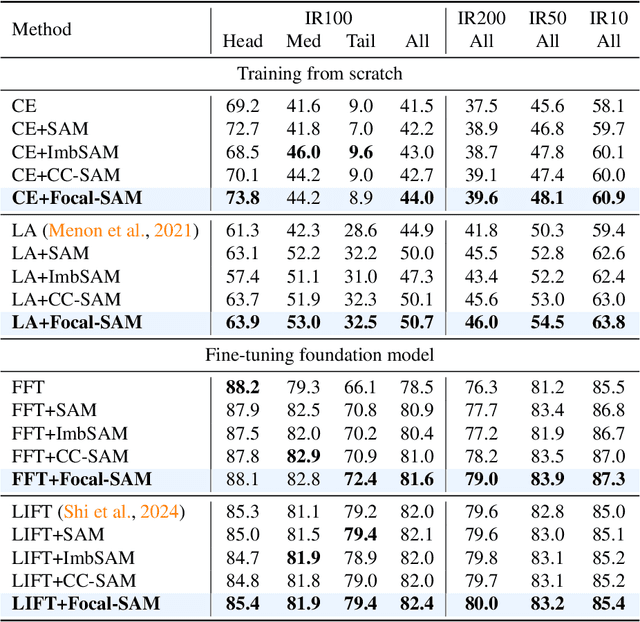
Real-world datasets often follow a long-tailed distribution, making generalization to tail classes difficult. Recent methods resorted to long-tail variants of Sharpness-Aware Minimization (SAM), such as ImbSAM and CC-SAM, to improve generalization by flattening the loss landscape. However, these attempts face a trade-off between computational efficiency and control over the loss landscape. On the one hand, ImbSAM is efficient but offers only coarse control as it excludes head classes from the SAM process. On the other hand, CC-SAM provides fine-grained control through class-dependent perturbations but at the cost of efficiency due to multiple backpropagations. Seeing this dilemma, we introduce Focal-SAM, which assigns different penalties to class-wise sharpness, achieving fine-grained control without extra backpropagations, thus maintaining efficiency. Furthermore, we theoretically analyze Focal-SAM's generalization ability and derive a sharper generalization bound. Extensive experiments on both traditional and foundation models validate the effectiveness of Focal-SAM.