 Add to Chrome
 Add to Firefox
 Add to Edge
Exploring Spatiotemporal Feature Propagation for Video-Level Compressive Spectral Reconstruction: Dataset, Model and Benchmark
Feb 28, 2026
Recently, Spectral Compressive Imaging (SCI) has achieved remarkable success, unlocking significant potential for dynamic spectral vision. However, existing reconstruction methods, primarily image-based, suffer from two limitations: (i) Encoding process masks spatial-spectral features, leading to uncertainty in reconstructing missing information from single compressed measurements, and (ii) The frame-by-frame reconstruction paradigm fails to ensure temporal consistency, which is crucial in the video perception. To address these challenges, this paper seeks to advance spectral reconstruction from the image level to the video level, leveraging the complementary features and temporal continuity across adjacent frames in dynamic scenes. Initially, we construct the first high-quality dynamic hyperspectral image dataset (DynaSpec), comprising 30 sequences obtained through frame-scanning acquisition. Subsequently, we propose the Propagation-Guided Spectral Video Reconstruction Transformer (PG-SVRT), which employs a spatial-then-temporal attention to effectively reconstruct spectral features from abundant video information, while using a bridged token to reduce computational complexity. Finally, we conduct simulation experiments to assess the performance of four SCI systems, and construct a DD-CASSI prototype for real-world data collection and benchmarking. Extensive experiments demonstrate that PG-SVRT achieves superior performance in reconstruction quality, spectral fidelity, and temporal consistency, while maintaining minimal FLOPs. Project page: https://github.com/nju-cite/DynaSpec

Joint RGB-Spectral Decomposition Model Guided Image Enhancement in Mobile Photography
Jul 25, 2024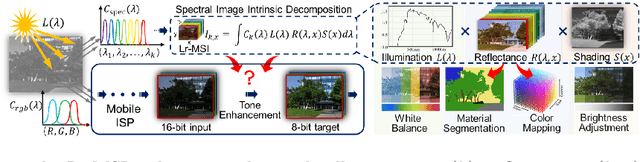
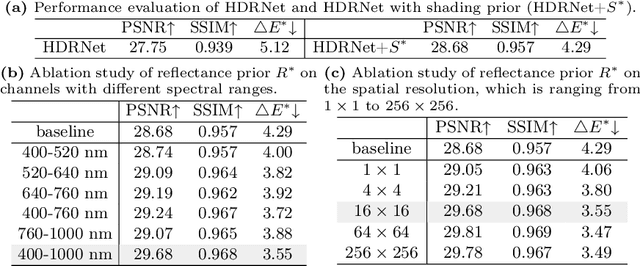
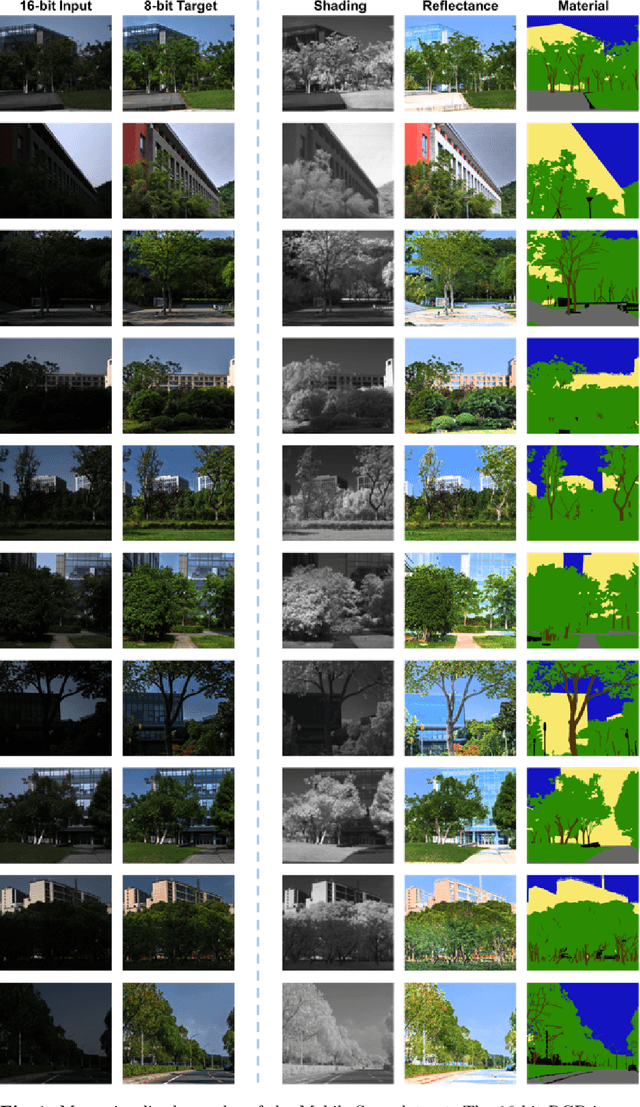
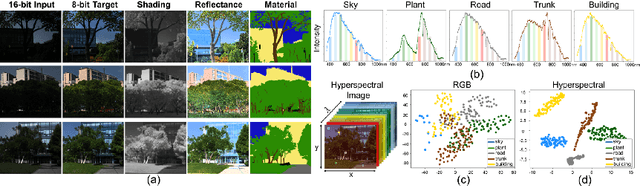
The integration of miniaturized spectrometers into mobile devices offers new avenues for image quality enhancement and facilitates novel downstream tasks. However, the broader application of spectral sensors in mobile photography is hindered by the inherent complexity of spectral images and the constraints of spectral imaging capabilities. To overcome these challenges, we propose a joint RGB-Spectral decomposition model guided enhancement framework, which consists of two steps: joint decomposition and prior-guided enhancement. Firstly, we leverage the complementarity between RGB and Low-resolution Multi-Spectral Images (Lr-MSI) to predict shading, reflectance, and material semantic priors. Subsequently, these priors are seamlessly integrated into the established HDRNet to promote dynamic range enhancement, color mapping, and grid expert learning, respectively. Additionally, we construct a high-quality Mobile-Spec dataset to support our research, and our experiments validate the effectiveness of Lr-MSI in the tone enhancement task. This work aims to establish a solid foundation for advancing spectral vision in mobile photography. The code is available at \url{https://github.com/CalayZhou/JDM-HDRNet}.