 Add to Chrome
 Add to Firefox
 Add to Edge
Data-Centric Benchmarking of Exploit Generation in LLMs: Understanding the Impact of Fine-Tuning
Jun 13, 2026
We study the task of CVE-conditioned exploit generation, where a model drafts proof-of-concept (PoC) exploits given software vulnerability context. We adopt a data-centric approach, constructing a high-quality dataset via multi-stage preprocessing and introducing a scalable evaluation framework with LLM-as-judge and fine-grained rubrics. Under this unified setup, we benchmark 17 large language models across 8 evaluation criteria, providing systematic insights into their zero-shot capabilities. We further show that a compact 8B open-weight model, when fine-tuned on curated data, achieves over 42.5% improvement in exploit quality and rivals some proprietary models when combined with simple test-time rejection strategies. Our results highlight the importance of data quality, structured supervision, and evaluation design for reliable exploit generation, suggesting that these factors can be as critical as model scale in adapting LLMs to cybersecurity tasks.

AutoLab: Can Frontier Models Solve Long-Horizon Auto Research and Engineering Tasks?
Jun 03, 2026Scientific and engineering progress is fundamentally a long-horizon iterative process: proposing changes, running experiments, measuring outcomes, and continuously refining artifacts. Yet existing benchmarks for frontier models primarily evaluate either single-turn responses or short-horizon agent trajectories, failing to capture the challenges of sustained iterative improvement over extended time horizons. To address this gap, we introduce AutoLab, a new benchmark for ultra long-horizon closed-loop optimization. AutoLab consists of 36 realistic, expert-curated tasks spanning four diverse domains: system optimization, puzzle & challenge, model development, and CUDA kernel optimization. Each task begins with a correct but deliberately suboptimal baseline and challenges agents to improve it within a strict wall-clock budget. Evaluating 17 state-of-the-art models reveals the dominant predictor of success is not the quality of an agent's initial attempt, but its persistence in repeatedly benchmarking, editing, and incorporating empirical feedback. While claude-opus-4.6 exhibits strong long-horizon optimization capabilities, most frontier models, including several proprietary ones, either terminate prematurely or exhaust their budgets with minimal progress. These results underscore the importance of time awareness and persistent iteration in autonomous agents. We open-source the full benchmark, evaluation harness, and task artifacts, to accelerate research toward truly capable long-horizon agents.
kRAIG: A Natural Language-Driven Agent for Automated DataOps Pipeline Generation
Mar 19, 2026Modern machine learning systems rely on complex data engineering workflows to extract, transform, and load (ELT) data into production pipelines. However, constructing these pipelines remains time-consuming and requires substantial expertise in data infrastructure and orchestration frameworks. Recent advances in large language model (LLM) agents offer a potential path toward automating these workflows, but existing approaches struggle with under-specified user intent, unreliable tool generation, and limited guarantees of executable outputs. We introduce kRAIG, an AI agent that translates natural language specifications into production-ready Kubeflow Pipelines (KFP). To resolve ambiguity in user intent, we propose ReQuesAct (Reason, Question, Act), an interaction framework that explicitly clarifies intent prior to pipeline synthesis. The system orchestrates end-to-end data movement from diverse sources and generates task-specific transformation components through a retrieval-augmented tool synthesis process. To ensure data quality and safety, kRAIG incorporates LLM-based validation stages that verify pipeline integrity prior to execution. Our framework achieves a 3x improvement in extraction and loading success and a 25 percent increase in transformation accuracy compared to state-of-the-art agentic baselines. These improvements demonstrate that structured agent workflows with explicit intent clarification and validation significantly enhance the reliability and executability of automated data engineering pipelines.
IndustryEQA: Pushing the Frontiers of Embodied Question Answering in Industrial Scenarios
May 27, 2025Existing Embodied Question Answering (EQA) benchmarks primarily focus on household environments, often overlooking safety-critical aspects and reasoning processes pertinent to industrial settings. This drawback limits the evaluation of agent readiness for real-world industrial applications. To bridge this, we introduce IndustryEQA, the first benchmark dedicated to evaluating embodied agent capabilities within safety-critical warehouse scenarios. Built upon the NVIDIA Isaac Sim platform, IndustryEQA provides high-fidelity episodic memory videos featuring diverse industrial assets, dynamic human agents, and carefully designed hazardous situations inspired by real-world safety guidelines. The benchmark includes rich annotations covering six categories: equipment safety, human safety, object recognition, attribute recognition, temporal understanding, and spatial understanding. Besides, it also provides extra reasoning evaluation based on these categories. Specifically, it comprises 971 question-answer pairs generated from small warehouse and 373 pairs from large ones, incorporating scenarios with and without human. We further propose a comprehensive evaluation framework, including various baseline models, to assess their general perception and reasoning abilities in industrial environments. IndustryEQA aims to steer EQA research towards developing more robust, safety-aware, and practically applicable embodied agents for complex industrial environments. Benchmark and codes are available.
MerRec: A Large-scale Multipurpose Mercari Dataset for Consumer-to-Consumer Recommendation Systems
Feb 22, 2024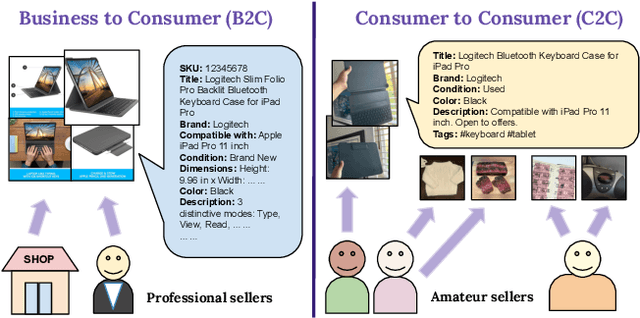
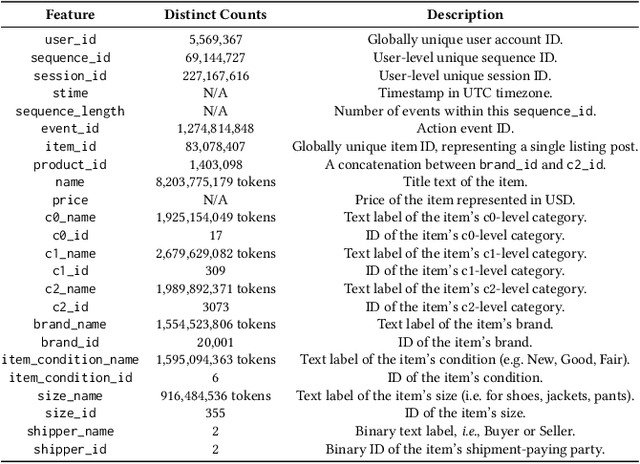
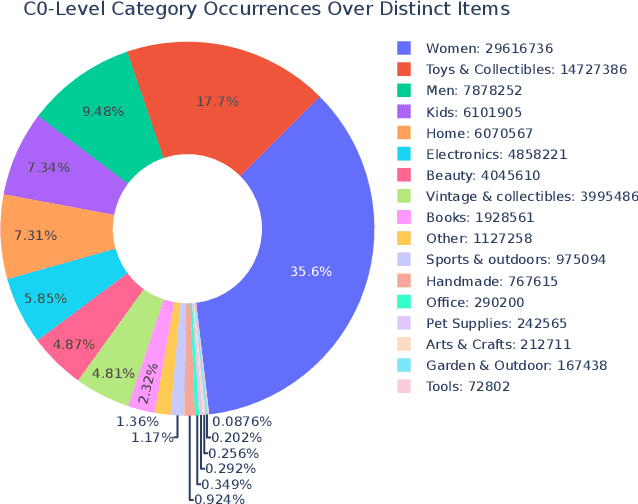
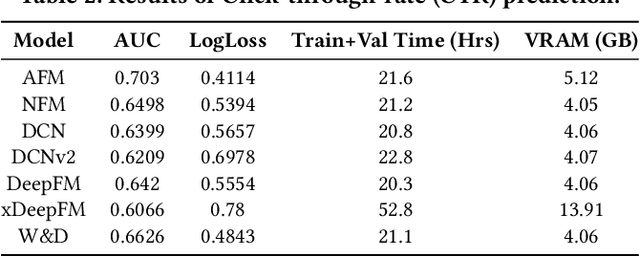
In the evolving e-commerce field, recommendation systems crucially shape user experience and engagement. The rise of Consumer-to-Consumer (C2C) recommendation systems, noted for their flexibility and ease of access for customer vendors, marks a significant trend. However, the academic focus remains largely on Business-to-Consumer (B2C) models, leaving a gap filled by the limited C2C recommendation datasets that lack in item attributes, user diversity, and scale. The intricacy of C2C recommendation systems is further accentuated by the dual roles users assume as both sellers and buyers, introducing a spectrum of less uniform and varied inputs. Addressing this, we introduce MerRec, the first large-scale dataset specifically for C2C recommendations, sourced from the Mercari e-commerce platform, covering millions of users and products over 6 months in 2023. MerRec not only includes standard features such as user_id, item_id, and session_id, but also unique elements like timestamped action types, product taxonomy, and textual product attributes, offering a comprehensive dataset for research. This dataset, extensively evaluated across six recommendation tasks, establishes a new benchmark for the development of advanced recommendation algorithms in real-world scenarios, bridging the gap between academia and industry and propelling the study of C2C recommendations.