 Add to Chrome
 Add to Firefox
 Add to Edge
SCP-NL2TL: Selective Conformal Prediction with Semantic Verification for Natural Language to Temporal Logic Specifications
Aug 05, 2026
Translating natural language instructions into machine-interpretable formal specifications enables robots and autonomous systems to plan, reason, and formally verify their behavior. However, existing translation models typically generate a specification for every input, even when the result is unreliable or fails to capture the user's intent, creating risks in safety-critical applications. Inspired by selective conformal prediction, we propose a selective translation framework that not only generates formal specifications but also determines when they can be trusted. Reliability is scored by two complementary black-box signals, the fidelity of the specification back-translated into natural language and the dispersion of repeated translations under exact semantic equivalence, which fail on different errors and jointly separate incorrect translations more sharply than either alone. Conformal risk control calibrates this score into a decision that accepts a specification or abstains, with a distribution-free bound on the rate at which incorrect specifications are accepted for execution, and a conformal anomaly detector on instruction embeddings screens out-of-distribution inputs before any translation is attempted. The proposed framework is general across formal specification languages, with experiments on Signal Temporal Logic (STL), Linear Temporal Logic (LTL), and geometric Spatio-Temporal Logic (SpaTiaL) demonstrating improved translation reliability, robustness under the evaluated cross-tier shifts, and effective uncertainty-aware abstention. This work establishes a foundation for trustworthy natural language interfaces by enabling AI systems to recognize when generated specifications may not be reliable.

Differentiable SpaTiaL: Symbolic Learning and Reasoning with Geometric Temporal Logic for Manipulation Tasks
Apr 03, 2026Executing complex manipulation in cluttered environments requires satisfying coupled geometric and temporal constraints. Although Spatio-Temporal Logic (SpaTiaL) offers a principled specification framework, its use in gradient-based optimization is limited by non-differentiable geometric operations. Existing differentiable temporal logics focus on the robot's internal state and neglect interactive object-environment relations, while spatial logic approaches that capture such interactions rely on discrete geometry engines that break the computational graph and preclude exact gradient propagation. To overcome this limitation, we propose Differentiable SpaTiaL, a fully tensorized toolbox that constructs smooth, autograd-compatible geometric primitives directly over polygonal sets. To the best of our knowledge, this is the first end-to-end differentiable symbolic spatio-temporal logic toolbox. By analytically deriving differentiable relaxations of key spatial predicates--including signed distance, intersection, containment, and directional relations--we enable an end-to-end differentiable mapping from high-level semantic specifications to low-level geometric configurations, without invoking external discrete solvers. This fully differentiable formulation unlocks two core capabilities: (i) massively parallel trajectory optimization under rigorous spatio-temporal constraints, and (ii) direct learning of spatial logic parameters from demonstrations via backpropagation. Experimental results validate the effectiveness and scalability of the proposed framework.Code Available: https://github.com/plen1lune/DiffSpaTiaL
NL2SpaTiaL: Generating Geometric Spatio-Temporal Logic Specifications from Natural Language for Manipulation Tasks
Dec 15, 2025Spatio-Temporal Logic (SpaTiaL) offers a principled formalism for expressing geometric spatial requirements-an essential component of robotic manipulation, where object locations, neighborhood relations, pose constraints, and interactions directly determine task success. Yet prior works have largely relied on standard temporal logic (TL), which models only robot trajectories and overlooks object-level interactions. Existing datasets built from randomly generated TL formulas paired with natural-language descriptions therefore cover temporal operators but fail to represent the layered spatial relations that manipulation tasks depend on. To address this gap, we introduce a dataset generation framework that synthesizes SpaTiaL specifications and converts them into natural-language descriptions through a deterministic, semantics-preserving back-translation procedure. This pipeline produces the NL2SpaTiaL dataset, aligning natural language with multi-level spatial relations and temporal objectives to reflect the compositional structure of manipulation tasks. Building on this foundation, we propose a translation-verification framework equipped with a language-based semantic checker that ensures the generated SpaTiaL formulas faithfully encode the semantics specified by the input description. Experiments across a suite of manipulation tasks show that SpaTiaL-based representations yield more interpretable, verifiable, and compositional grounding for instruction following. Project website: https://sites.google.com/view/nl2spatial
Bridging Deep Reinforcement Learning and Motion Planning for Model-Free Navigation in Cluttered Environments
Apr 09, 2025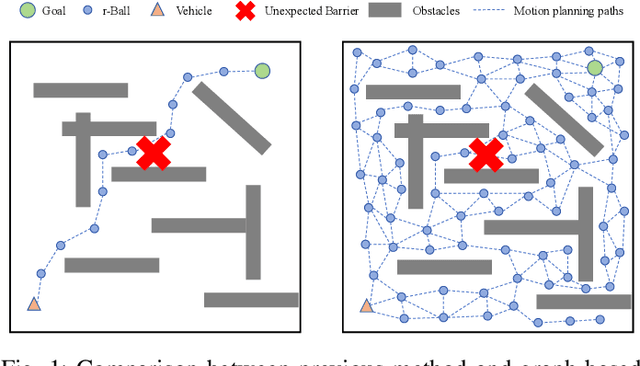
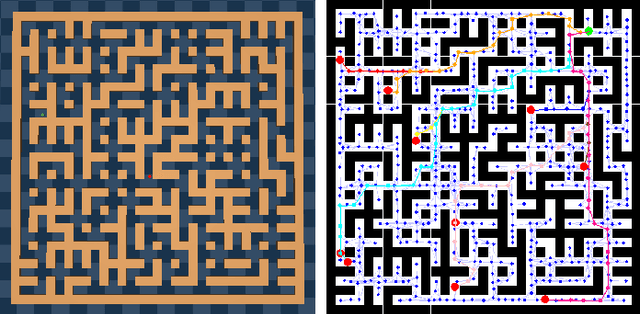
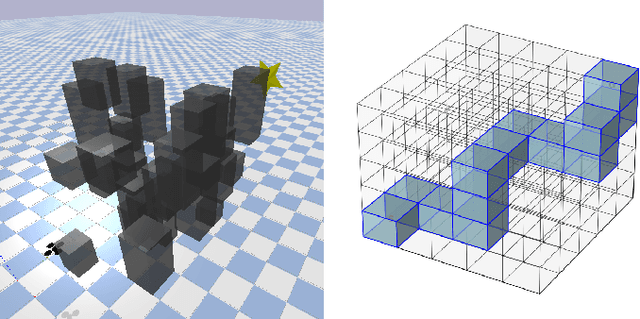
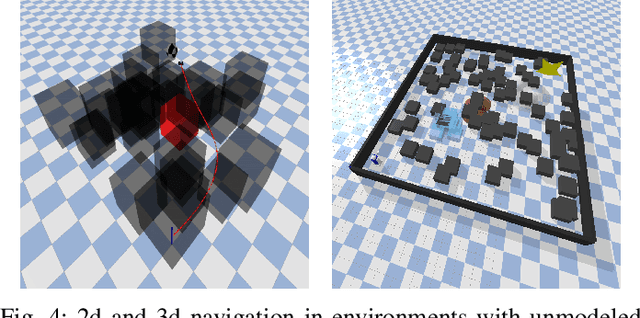
Deep Reinforcement Learning (DRL) has emerged as a powerful model-free paradigm for learning optimal policies. However, in real-world navigation tasks, DRL methods often suffer from insufficient exploration, particularly in cluttered environments with sparse rewards or complex dynamics under system disturbances. To address this challenge, we bridge general graph-based motion planning with DRL, enabling agents to explore cluttered spaces more effectively and achieve desired navigation performance. Specifically, we design a dense reward function grounded in a graph structure that spans the entire state space. This graph provides rich guidance, steering the agent toward optimal strategies. We validate our approach in challenging environments, demonstrating substantial improvements in exploration efficiency and task success rates. The project website is available at: https://plen1lune.github.io/overcome_exploration/