 Add to Chrome
 Add to Firefox
 Add to Edge
Attention-Only White-Box Transformer via LeJEPA-Based Self-Supervised Pretraining
Aug 04, 2026
Existing studies on self-supervised learning for white-box networks typically decouple the derivation of white-box networks via optimization algorithms from self-supervised learning paradigms. In this work, we instead revisit the two components from a joint perspective. The LeJEPA-based self-supervised framework assumes an isotropic Gaussian distribution as the optimal embedding distribution for downstream tasks, which is conceptually equivalent to the expansion term $R(Z)$ in the sparse rate reduction objective guiding white-box Transformer optimization. Building on this observation, we use the LeJEPA self-supervised paradigm to optimize $R(Z)$, and derive the remaining terms $R^{c}(Z\mid U_{[K]})+λ\lVert Z\rVert_{0}$ via the alternating direction method of multipliers (ADMM) into an attention-only Transformer that dispenses with the ISTA structure or MLP layers of the original design. Experimental results demonstrate that our attention-only white-box Transformer achieves classification accuracies of $88.88\%$ on CIFAR-10 and $63.54\%$ on CIFAR-100 at the Base scale under the LeJEPA self-supervised paradigm, while the original white-box Transformer CRATE achieves classification accuracies of $89.18\%$ on CIFAR-10 and $63.56\%$ on CIFAR-100. Our model achieves competitive performance while reducing the parameter count by roughly $31\%$. Beyond the white-box setting, we further investigate standard ViTs and find that replacing all MLP blocks with ReLU activations under knowledge distillation removes approximately 66\% of the parameters while preserving competitive accuracy, motivating further investigation into the potential redundancy of MLP modules in standard ViT architectures.

Interpretable and Sparse Linear Attention with Decoupled Membership-Subspace Modeling via MCR2 Objective
Jan 20, 2026Maximal Coding Rate Reduction (MCR2)-driven white-box transformer, grounded in structured representation learning, unifies interpretability and efficiency, providing a reliable white-box solution for visual modeling. However, in existing designs, tight coupling between "membership matrix" and "subspace matrix U" in MCR2 causes redundant coding under incorrect token projection. To this end, we decouple the functional relationship between the "membership matrix" and "subspaces U" in the MCR2 objective and derive an interpretable sparse linear attention operator from unrolled gradient descent of the optimized objective. Specifically, we propose to directly learn the membership matrix from inputs and subsequently derive sparse subspaces from the fullspace S. Consequently, gradient unrolling of the optimized MCR2 objective yields an interpretable sparse linear attention operator: Decoupled Membership-Subspace Attention (DMSA). Experimental results on visual tasks show that simply replacing the attention module in Token Statistics Transformer (ToST) with DMSA (we refer to as DMST) not only achieves a faster coding reduction rate but also outperforms ToST by 1.08%-1.45% in top-1 accuracy on the ImageNet-1K dataset. Compared with vanilla Transformer architectures, DMST exhibits significantly higher computational efficiency and interpretability.
Dynamic Stochastic Ensemble with Adversarial Robust Lottery Ticket Subnetworks
Oct 06, 2022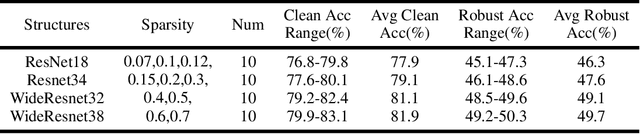
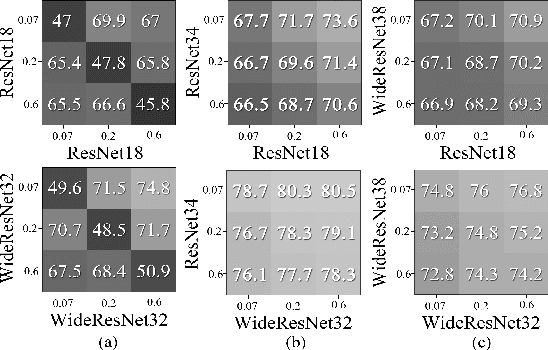
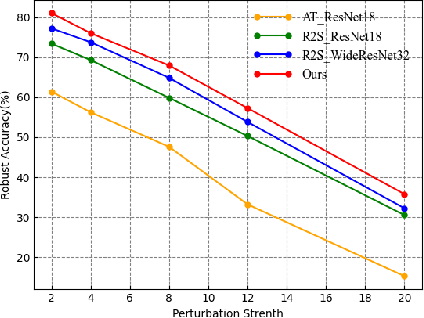
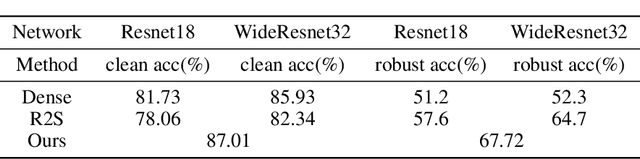
Adversarial attacks are considered the intrinsic vulnerability of CNNs. Defense strategies designed for attacks have been stuck in the adversarial attack-defense arms race, reflecting the imbalance between attack and defense. Dynamic Defense Framework (DDF) recently changed the passive safety status quo based on the stochastic ensemble model. The diversity of subnetworks, an essential concern in the DDF, can be effectively evaluated by the adversarial transferability between different networks. Inspired by the poor adversarial transferability between subnetworks of scratch tickets with various remaining ratios, we propose a method to realize the dynamic stochastic ensemble defense strategy. We discover the adversarial transferable diversity between robust lottery ticket subnetworks drawn from different basic structures and sparsity. The experimental results suggest that our method achieves better robust and clean recognition accuracy by adversarial transferable diversity, which would decrease the reliability of attacks.