 Add to Chrome
 Add to Firefox
 Add to Edge
Small Initialization Matters for Large Language Models
Jun 16, 2026
Large language models provide a tractable system for asking how intelligence itself emerges, rather than only how LLMs can be engineered. Although progress is usually attributed to scale, data and architecture, we show that parameter initialization is a gene-like determinant of training and, in particular, of model capacity. Reducing the initialization scale consistently improves pretraining, with the largest gains on reasoning-demanding tasks. We identify two widely used empirical settings that restrain the advantage of small initialization, and show how relaxing them restores favorable scaling. We further uncover a critical initialization that balances the reasoning and training. Mechanistically, small initialization drives a distinct developmental trajectory: parameters first condense into low-complexity structures and later expand into richer representations, giving concrete form to the idea that compression is intelligence. Token-level analyses show that the gains concentrate on non-trivial, context-constrained predictions rather than all tokens uniformly. These results motivate a simple $γ$-initialization rule: expose initialization rage as an explicit knob and use small initialization by default, an almost cost-free intervention that improves pretraining and strengthens reasoning across model scales.

Scalable Complexity Control Facilitates Reasoning Ability of LLMs
May 29, 2025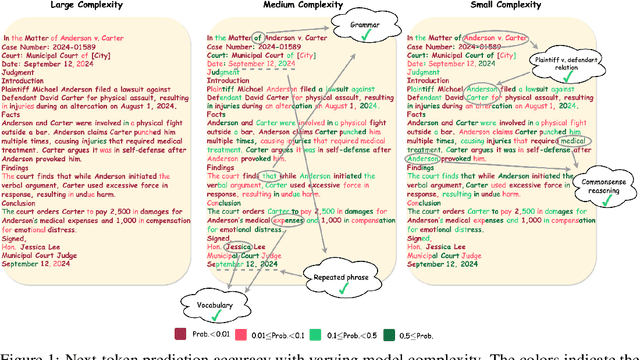
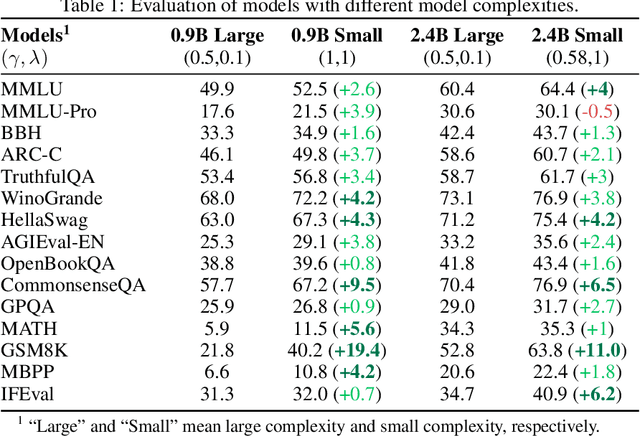
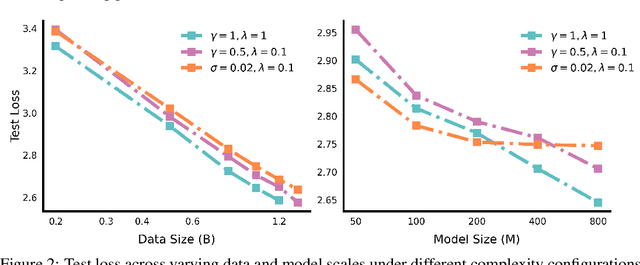
The reasoning ability of large language models (LLMs) has been rapidly advancing in recent years, attracting interest in more fundamental approaches that can reliably enhance their generalizability. This work demonstrates that model complexity control, conveniently implementable by adjusting the initialization rate and weight decay coefficient, improves the scaling law of LLMs consistently over varying model sizes and data sizes. This gain is further illustrated by comparing the benchmark performance of 2.4B models pretrained on 1T tokens with different complexity hyperparameters. Instead of fixing the initialization std, we found that a constant initialization rate (the exponent of std) enables the scaling law to descend faster in both model and data sizes. These results indicate that complexity control is a promising direction for the continual advancement of LLMs.