 Add to Chrome
 Add to Firefox
 Add to Edge
HEART-VIT: Hessian-Guided Efficient Dynamic Attention and Token Pruning in Vision Transformer
Dec 23, 2025
Vision Transformers (ViTs) deliver state-of-the-art accuracy but their quadratic attention cost and redundant computations severely hinder deployment on latency and resource-constrained platforms. Existing pruning approaches treat either tokens or heads in isolation, relying on heuristics or first-order signals, which often sacrifice accuracy or fail to generalize across inputs. We introduce HEART-ViT, a Hessian-guided efficient dynamic attention and token pruning framework for vision transformers, which to the best of our knowledge is the first unified, second-order, input-adaptive framework for ViT optimization. HEART-ViT estimates curvature-weighted sensitivities of both tokens and attention heads using efficient Hessian-vector products, enabling principled pruning decisions under explicit loss budgets.This dual-view sensitivity reveals an important structural insight: token pruning dominates computational savings, while head pruning provides fine-grained redundancy removal, and their combination achieves a superior trade-off. On ImageNet-100 and ImageNet-1K with ViT-B/16 and DeiT-B/16, HEART-ViT achieves up to 49.4 percent FLOPs reduction, 36 percent lower latency, and 46 percent higher throughput, while consistently matching or even surpassing baseline accuracy after fine-tuning, for example 4.7 percent recovery at 40 percent token pruning. Beyond theoretical benchmarks, we deploy HEART-ViT on different edge devices such as AGX Orin, demonstrating that our reductions in FLOPs and latency translate directly into real-world gains in inference speed and energy efficiency. HEART-ViT bridges the gap between theory and practice, delivering the first unified, curvature-driven pruning framework that is both accuracy-preserving and edge-efficient.

CAMP-HiVe: Cyclic Pair Merging based Efficient DNN Pruning with Hessian-Vector Approximation for Resource-Constrained Systems
Nov 09, 2025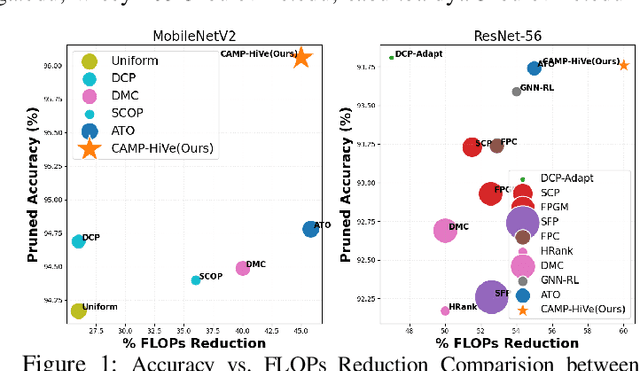
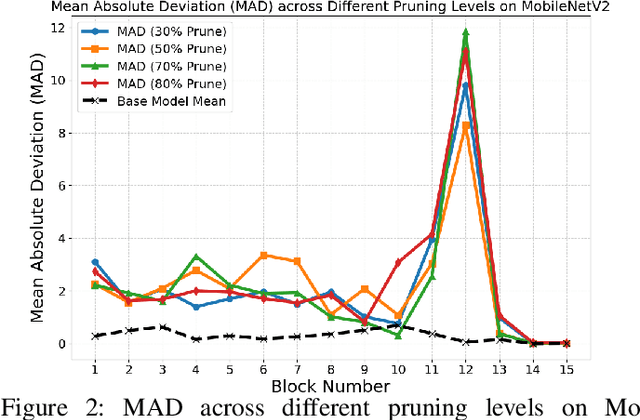
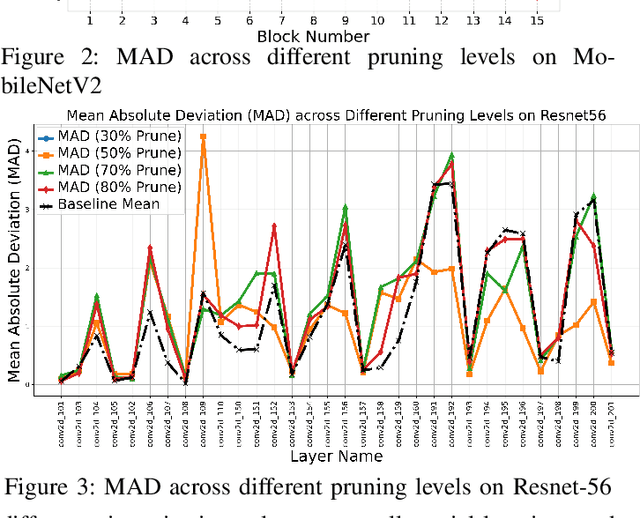
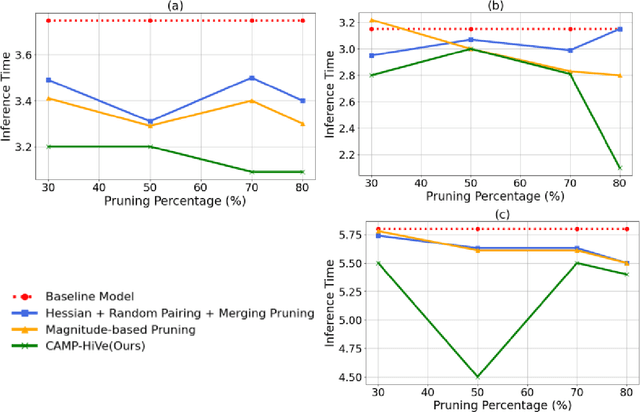
Deep learning algorithms are becoming an essential component of many artificial intelligence (AI) driven applications, many of which run on resource-constrained and energy-constrained systems. For efficient deployment of these algorithms, although different techniques for the compression of neural network models are proposed, neural pruning is one of the fastest and effective methods, which can provide a high compression gain with minimal cost. To harness enhanced performance gain with respect to model complexity, we propose a novel neural network pruning approach utilizing Hessian-vector products that approximate crucial curvature information in the loss function, which significantly reduces the computation demands. By employing a power iteration method, our algorithm effectively identifies and preserves the essential information, ensuring a balanced trade-off between model accuracy and computational efficiency. Herein, we introduce CAMP-HiVe, a cyclic pair merging-based pruning with Hessian Vector approximation by iteratively consolidating weight pairs, combining significant and less significant weights, thus effectively streamlining the model while preserving its performance. This dynamic, adaptive framework allows for real-time adjustment of weight significance, ensuring that only the most critical parameters are retained. Our experimental results demonstrate that our proposed method achieves significant reductions in computational requirements while maintaining high performance across different neural network architectures, e.g., ResNet18, ResNet56, and MobileNetv2, on standard benchmark datasets, e.g., CIFAR10, CIFAR-100, and ImageNet, and it outperforms the existing state-of-the-art neural pruning methods.
Large Language Models on Small Resource-Constrained Systems: Performance Characterization, Analysis and Trade-offs
Dec 19, 2024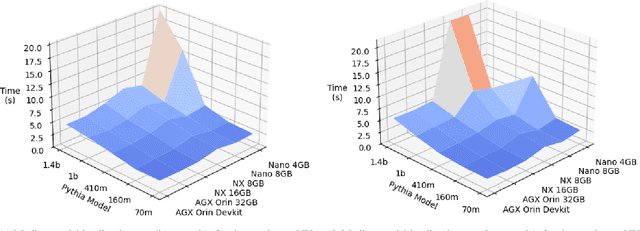
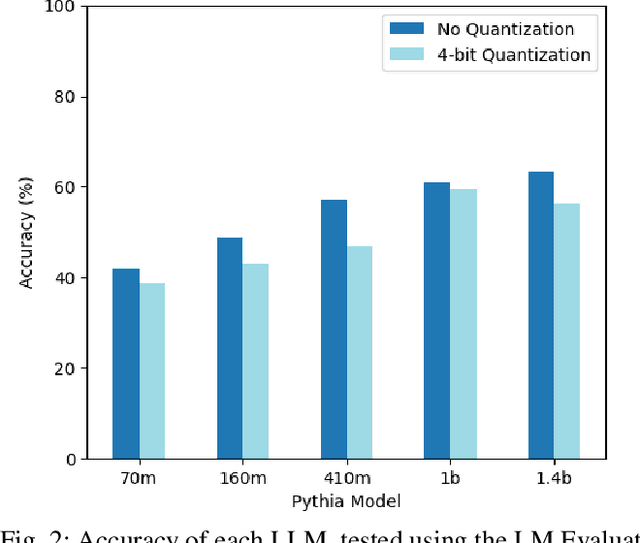
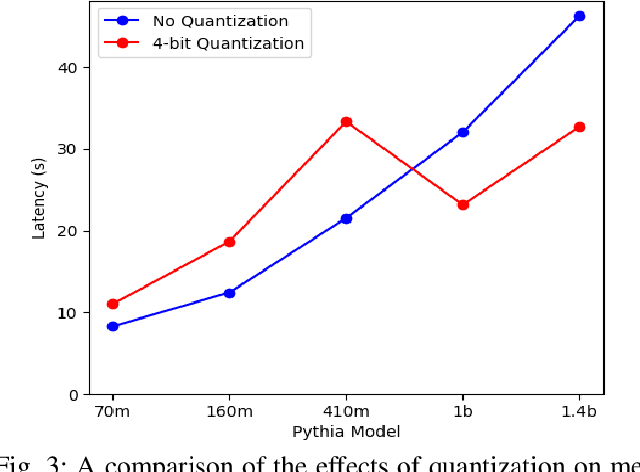
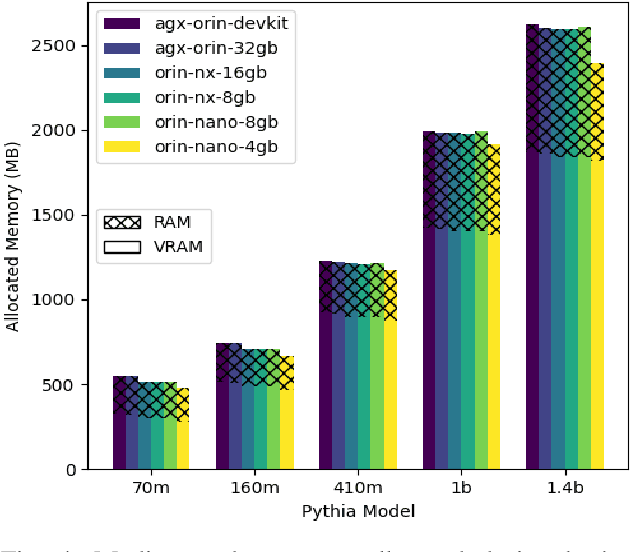
Generative AI like the Large Language Models (LLMs) has become more available for the general consumer in recent years. Publicly available services, e.g., ChatGPT, perform token generation on networked cloud server hardware, effectively removing the hardware entry cost for end users. However, the reliance on network access for these services, privacy and security risks involved, and sometimes the needs of the application make it necessary to run LLMs locally on edge devices. A significant amount of research has been done on optimization of LLMs and other transformer-based models on non-networked, resource-constrained devices, but they typically target older hardware. Our research intends to provide a 'baseline' characterization of more recent commercially available embedded hardware for LLMs, and to provide a simple utility to facilitate batch testing LLMs on recent Jetson hardware. We focus on the latest line of NVIDIA Jetson devices (Jetson Orin), and a set of publicly available LLMs (Pythia) ranging between 70 million and 1.4 billion parameters. Through detailed experimental evaluation with varying software and hardware parameters, we showcase trade-off spaces and optimization choices. Additionally, we design our testing structure to facilitate further research that involves performing batch LLM testing on Jetson hardware.