 Add to Chrome
 Add to Firefox
 Add to Edge
Knowledge Graphs and Reasoning LLMs for Finding Simple Yet Effective Transcriptomic Perturbation Predictors
Jun 07, 2026
Predicting the effect of an unseen gene knockout perturbation on transcriptomic gene expression remains a highly challenging problem for virtual cell models. Recent progress has been made by leveraging biological knowledge graphs to provide a notion of similar perturbation, allowing for improved extrapolation beyond the set of training perturbations. In this work, we demonstrate that the simplest model to leverage these assumptions - a K-nearest neighbour from the knowledge graph - achieves highly competitive performance on this task, and that this can be improved further using LLMs optimised via reinforcement learning (RL) for predictive performance. Specifically, we find that the K-nearest neighbour approach beats almost all methods on out-of-distribution perturbation prediction, and when a reasoning LLM is trained via RL to make changes to the neighbourhood, it obtains equivalent performance to current state of the art methods on the cell lines from Replogle et al. (2022). We also demonstrate that the RL training improves the LLM's performance on the downstream task of differential expression prediction, despite not being trained on this directly. Overall, these findings demonstrate the efficacy of knowledge graphs as model priors, and show early signs that RL can refine LLMs into generalizable tools for predicting complex biological responses.

TxPert: Leveraging Biochemical Relationships for Out-of-Distribution Transcriptomic Perturbation Prediction
May 20, 2025Accurately predicting cellular responses to genetic perturbations is essential for understanding disease mechanisms and designing effective therapies. Yet exhaustively exploring the space of possible perturbations (e.g., multi-gene perturbations or across tissues and cell types) is prohibitively expensive, motivating methods that can generalize to unseen conditions. In this work, we explore how knowledge graphs of gene-gene relationships can improve out-of-distribution (OOD) prediction across three challenging settings: unseen single perturbations; unseen double perturbations; and unseen cell lines. In particular, we present: (i) TxPert, a new state-of-the-art method that leverages multiple biological knowledge networks to predict transcriptional responses under OOD scenarios; (ii) an in-depth analysis demonstrating the impact of graphs, model architecture, and data on performance; and (iii) an expanded benchmarking framework that strengthens evaluation standards for perturbation modeling.
Estimating Unknown Population Sizes Using the Hypergeometric Distribution
Feb 22, 2024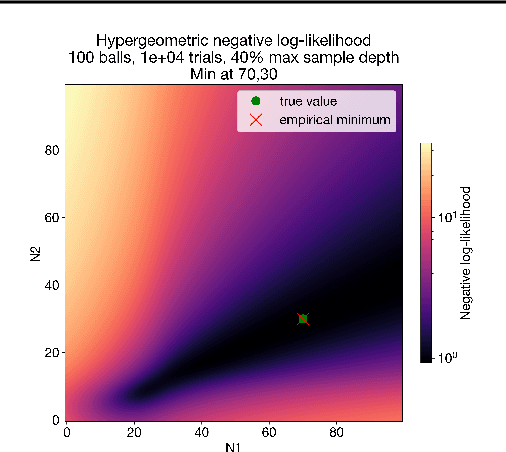
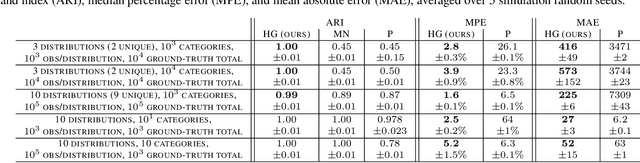
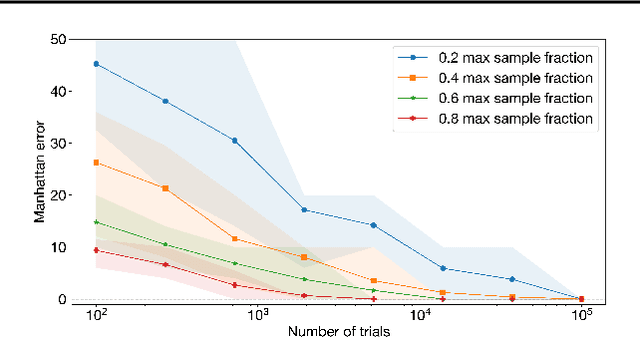
The multivariate hypergeometric distribution describes sampling without replacement from a discrete population of elements divided into multiple categories. Addressing a gap in the literature, we tackle the challenge of estimating discrete distributions when both the total population size and the sizes of its constituent categories are unknown. Here, we propose a novel solution using the hypergeometric likelihood to solve this estimation challenge, even in the presence of severe under-sampling. We develop our approach to account for a data generating process where the ground-truth is a mixture of distributions conditional on a continuous latent variable, such as with collaborative filtering, using the variational autoencoder framework. Empirical data simulation demonstrates that our method outperforms other likelihood functions used to model count data, both in terms of accuracy of population size estimate and in its ability to learn an informative latent space. We demonstrate our method's versatility through applications in NLP, by inferring and estimating the complexity of latent vocabularies in text excerpts, and in biology, by accurately recovering the true number of gene transcripts from sparse single-cell genomics data.