 Add to Chrome
 Add to Firefox
 Add to Edge
Cross-Layer Co-Optimized LSTM Accelerator for Real-Time Gait Analysis
Apr 15, 2026
Long Short-Term Memory (LSTM) neural networks have penetrated healthcare applications where real-time requirements and edge computing capabilities are essential. Gait analysis that detects abnormal steps to prevent patients from falling is a prominent problem for such applications. Given the extremely stringent design requirements in performance, power dissipation, and area, an Application-Specific Integrated Circuit (ASIC) enables an efficient real-time exploitation of LSTMs for gait analysis, achieving high accuracy. To the best of our knowledge, this work presents the first cross-layer co-optimized LSTM accelerator for real-time gait analysis, targeting an ASIC design. We conduct a comprehensive design space exploration from software down to layout design. We carry out a bit-width optimization at the software level with hardware-aware quantization to reduce the hardware complexity, explore various designs at the register-transfer level, and generate alternative layouts to find efficient realizations of the LSTM accelerator in terms of hardware complexity and accuracy. The physical synthesis results show that, using the 65 nm technology, the die size of the accelerator's layout optimized for the highest accuracy is 0.325 mm^2, while the alternative design optimized for hardware complexity with a slightly lower accuracy occupies 15.4% smaller area. Moreover, the designed accelerators achieve accurate gait abnormality detection 4.05x faster than the given application requirement.

Hybrid Protection of Digital FIR Filters
Jan 26, 2023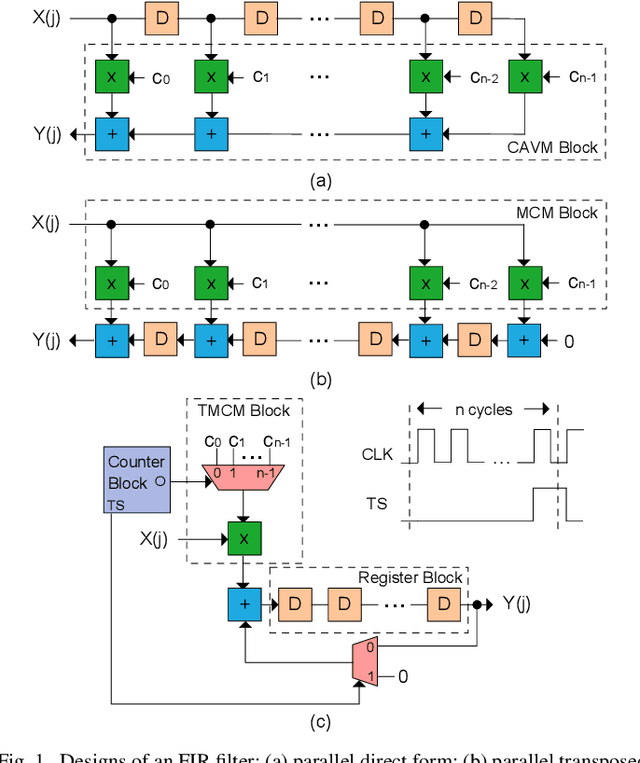
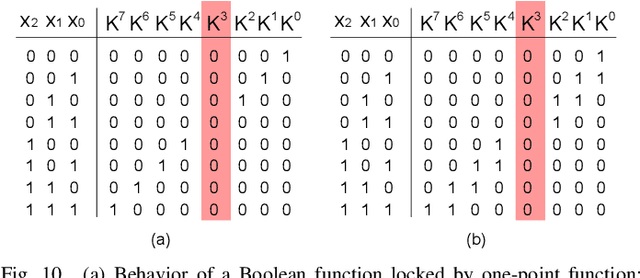
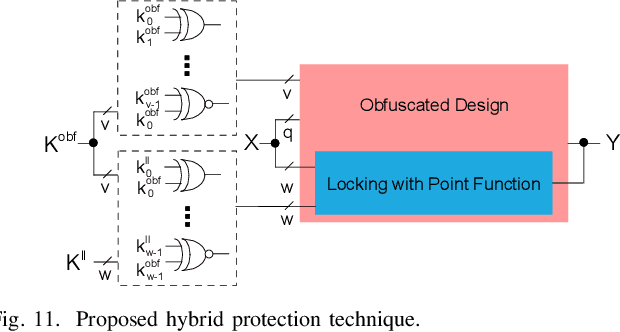
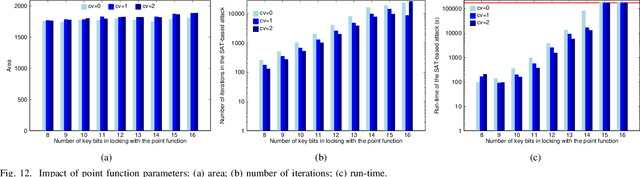
A digital Finite Impulse Response (FIR) filter is a ubiquitous block in digital signal processing applications and its behavior is determined by its coefficients. To protect filter coefficients from an adversary, efficient obfuscation techniques have been proposed, either by hiding them behind decoys or replacing them by key bits. In this article, we initially introduce a query attack that can discover the secret key of such obfuscated FIR filters, which could not be broken by existing prominent attacks. Then, we propose a first of its kind hybrid technique, including both hardware obfuscation and logic locking using a point function for the protection of parallel direct and transposed forms of digital FIR filters. Experimental results show that the hybrid protection technique can lead to FIR filters with higher security while maintaining the hardware complexity competitive or superior to those locked by prominent logic locking methods. It is also shown that the protected multiplier blocks and FIR filters are resilient to existing attacks. The results on different forms and realizations of FIR filters show that the parallel direct form FIR filter has a promising potential for a secure design.
Hardware Obfuscation of Digital FIR Filters
Feb 21, 2022
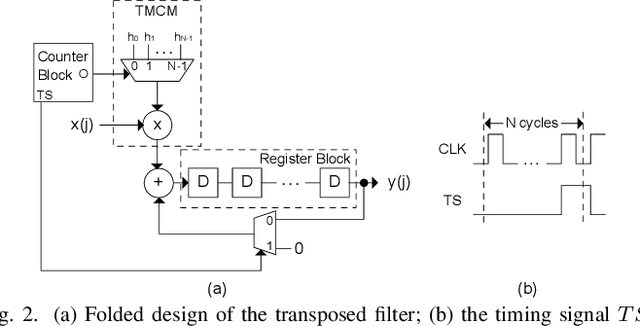


A finite impulse response (FIR) filter is a ubiquitous block in digital signal processing applications. Its characteristics are determined by its coefficients, which are the intellectual property (IP) for its designer. However, in a hardware efficient realization, its coefficients become vulnerable to reverse engineering. This paper presents a filter design technique that can protect this IP, taking into account hardware complexity and ensuring that the filter behaves as specified only when a secret key is provided. To do so, coefficients are hidden among decoys, which are selected beyond possible values of coefficients using three alternative methods. As an attack scenario, an adversary at an untrusted foundry is considered. A reverse engineering technique is developed to find the chosen decoy selection method and explore the potential leakage of coefficients through decoys. An oracle-less attack is also used to find the secret key. Experimental results show that the proposed technique can lead to filter designs with competitive hardware complexity and higher resiliency to attacks with respect to previously proposed methods.