 Add to Chrome
 Add to Firefox
 Add to Edge
Cross-Layer Co-Optimized LSTM Accelerator for Real-Time Gait Analysis
Apr 15, 2026
Long Short-Term Memory (LSTM) neural networks have penetrated healthcare applications where real-time requirements and edge computing capabilities are essential. Gait analysis that detects abnormal steps to prevent patients from falling is a prominent problem for such applications. Given the extremely stringent design requirements in performance, power dissipation, and area, an Application-Specific Integrated Circuit (ASIC) enables an efficient real-time exploitation of LSTMs for gait analysis, achieving high accuracy. To the best of our knowledge, this work presents the first cross-layer co-optimized LSTM accelerator for real-time gait analysis, targeting an ASIC design. We conduct a comprehensive design space exploration from software down to layout design. We carry out a bit-width optimization at the software level with hardware-aware quantization to reduce the hardware complexity, explore various designs at the register-transfer level, and generate alternative layouts to find efficient realizations of the LSTM accelerator in terms of hardware complexity and accuracy. The physical synthesis results show that, using the 65 nm technology, the die size of the accelerator's layout optimized for the highest accuracy is 0.325 mm^2, while the alternative design optimized for hardware complexity with a slightly lower accuracy occupies 15.4% smaller area. Moreover, the designed accelerators achieve accurate gait abnormality detection 4.05x faster than the given application requirement.

Matrix Profile based Anomaly Detection in Streaming Gait Data for Fall Prevention
Jul 18, 2023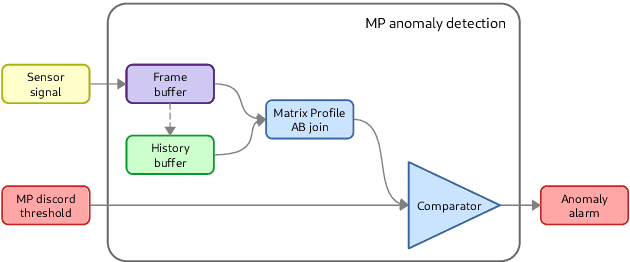
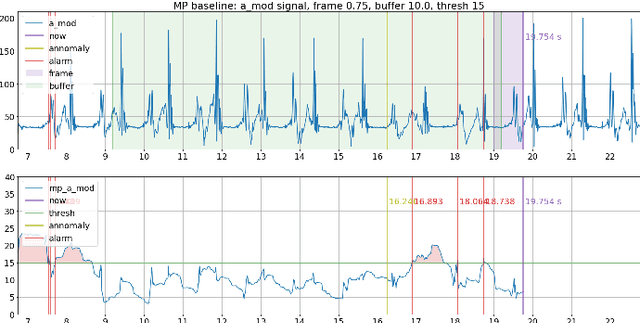
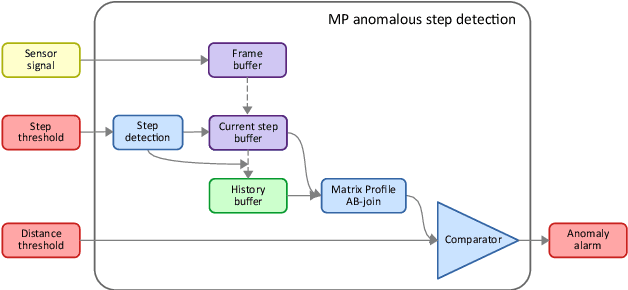
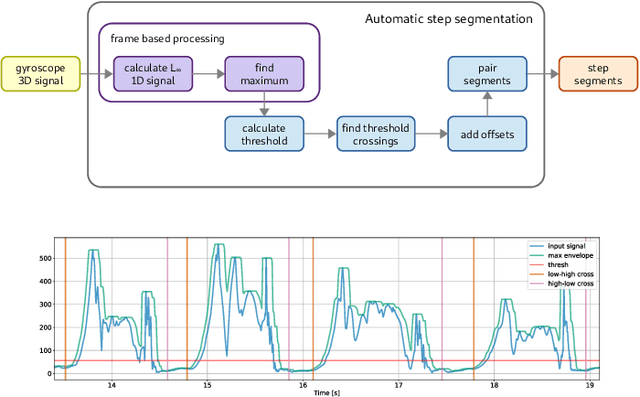
The automatic detection of gait anomalies can lead to systems that can be used for fall detection and prevention. In this paper, we present a gait anomaly detection system based on the Matrix Profile (MP) algorithm. The MP algorithm is exact, parameter free, simple and efficient, making it a perfect candidate for on the edge deployment. We propose a gait anomaly detection system that is able to adapt to an individual's gait pattern and successfully detect anomalous steps with short latency. To evaluate the system we record a small database of enacted anomalous steps. The results show the system outperforms a more complex Neural Network baseline.