 Add to Chrome
 Add to Firefox
 Add to Edge
CheckOne: Lightweight Fault Detection and Mitigation for Vision Transformers
Aug 03, 2026
The wide adoption of Vision Transformers (ViTs) in safety-critical applications raises reliability concerns related to hardware faults. Algorithm-Based Fault Tolerance (ABFT) methods have emerged as lightweight and symmetric protection mechanisms for DNNs. However, they are particularly challenging for ViTs due to their significant computational requirements. This work comprehensively evaluates the reliability of ViTs, emphasizing the need for symmetric protection in their layers. Furthermore, we present CheckOne, a novel, cost-effective method for fault detection and mitigation in ViTs that significantly reduces the computational cost compared to conventional ABFT. Through extensive experiments with multiple ViTs, CheckOne mitigates critical faults by up to $26\times$ and achieves an average 3.8x higher performance than ABFT in ViTs.

CoG-Guided Weight Correction for Fault-Tolerant Deep Neural Networks
Jul 17, 2026Deep Neural Networks (DNNs) used in safety-critical applications are vulnerable to hardware and memory faults that corrupt network weights and degrade reliability. In this paper, we propose a Center of Gravity (CoG) guided weight correction method that restores faulty weights based on their spatial characteristics within each layer. The proposed approach detects and corrects weight faults using distance-aware correction rules, eliminating the need for retraining or architectural modification. The effectiveness of the proposed method in terms of the capability of tolerating hardware faults has been evaluated through performing fault injection at different Bit Error Rates (BERs). Experiments on safety-critical LSTM-based Networks, including StageNet for disease progression tracking and MTFNet for cardiac anomaly detection, demonstrate fault tolerance improvements of up to 230x and 6.41x, respectively, at a BER of 10^{-3}, with negligible accuracy loss. When extended to Convolutional Neural Networks (CNNs), the method achieves up to 49.55x and 20.79x improvements under comparable fault conditions on ResNet-18 and VGG-16, respectively. To the best of our knowledge, this is the first work to apply the CoG concept to neural network weight tensors for enhancing model reliability.
Cross-Layer Co-Optimized LSTM Accelerator for Real-Time Gait Analysis
Apr 15, 2026Long Short-Term Memory (LSTM) neural networks have penetrated healthcare applications where real-time requirements and edge computing capabilities are essential. Gait analysis that detects abnormal steps to prevent patients from falling is a prominent problem for such applications. Given the extremely stringent design requirements in performance, power dissipation, and area, an Application-Specific Integrated Circuit (ASIC) enables an efficient real-time exploitation of LSTMs for gait analysis, achieving high accuracy. To the best of our knowledge, this work presents the first cross-layer co-optimized LSTM accelerator for real-time gait analysis, targeting an ASIC design. We conduct a comprehensive design space exploration from software down to layout design. We carry out a bit-width optimization at the software level with hardware-aware quantization to reduce the hardware complexity, explore various designs at the register-transfer level, and generate alternative layouts to find efficient realizations of the LSTM accelerator in terms of hardware complexity and accuracy. The physical synthesis results show that, using the 65 nm technology, the die size of the accelerator's layout optimized for the highest accuracy is 0.325 mm^2, while the alternative design optimized for hardware complexity with a slightly lower accuracy occupies 15.4% smaller area. Moreover, the designed accelerators achieve accurate gait abnormality detection 4.05x faster than the given application requirement.
DeepVigor+: Scalable and Accurate Semi-Analytical Fault Resilience Analysis for Deep Neural Network
Oct 21, 2024
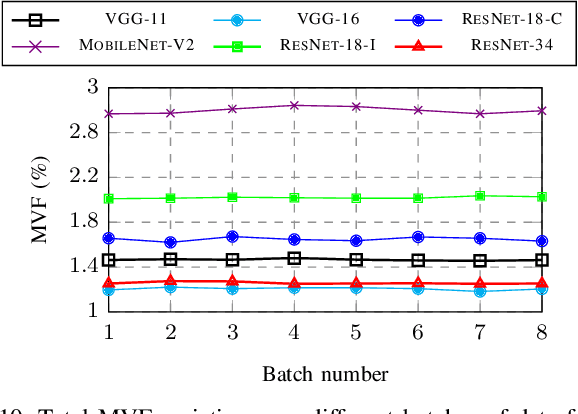

Growing exploitation of Machine Learning (ML) in safety-critical applications necessitates rigorous safety analysis. Hardware reliability assessment is a major concern with respect to measuring the level of safety. Quantifying the reliability of emerging ML models, including Deep Neural Networks (DNNs), is highly complex due to their enormous size in terms of the number of parameters and computations. Conventionally, Fault Injection (FI) is applied to perform a reliability measurement. However, performing FI on modern-day DNNs is prohibitively time-consuming if an acceptable confidence level is to be achieved. In order to speed up FI for large DNNs, statistical FI has been proposed. However, the run-time for the large DNN models is still considerably long. In this work, we introduce DeepVigor+, a scalable, fast and accurate semi-analytical method as an efficient alternative for reliability measurement in DNNs. DeepVigor+ implements a fault propagation analysis model and attempts to acquire Vulnerability Factors (VFs) as reliability metrics in an optimal way. The results indicate that DeepVigor+ obtains VFs for DNN models with an error less than 1\% and 14.9 up to 26.9 times fewer simulations than the best-known state-of-the-art statistical FI enabling an accurate reliability analysis for emerging DNNs within a few minutes.
ProAct: Progressive Training for Hybrid Clipped Activation Function to Enhance Resilience of DNNs
Jun 10, 2024Deep Neural Networks (DNNs) are extensively employed in safety-critical applications where ensuring hardware reliability is a primary concern. To enhance the reliability of DNNs against hardware faults, activation restriction techniques significantly mitigate the fault effects at the DNN structure level, irrespective of accelerator architectures. State-of-the-art methods offer either neuron-wise or layer-wise clipping activation functions. They attempt to determine optimal clipping thresholds using heuristic and learning-based approaches. Layer-wise clipped activation functions cannot preserve DNNs resilience at high bit error rates. On the other hand, neuron-wise clipping activation functions introduce considerable memory overhead due to the addition of parameters, which increases their vulnerability to faults. Moreover, the heuristic-based optimization approach demands numerous fault injections during the search process, resulting in time-consuming threshold identification. On the other hand, learning-based techniques that train thresholds for entire layers concurrently often yield sub-optimal results. In this work, first, we demonstrate that it is not essential to incorporate neuron-wise activation functions throughout all layers in DNNs. Then, we propose a hybrid clipped activation function that integrates neuron-wise and layer-wise methods that apply neuron-wise clipping only in the last layer of DNNs. Additionally, to attain optimal thresholds in the clipping activation function, we introduce ProAct, a progressive training methodology. This approach iteratively trains the thresholds on a layer-by-layer basis, aiming to obtain optimal threshold values in each layer separately.
Cost-Effective Fault Tolerance for CNNs Using Parameter Vulnerability Based Hardening and Pruning
May 17, 2024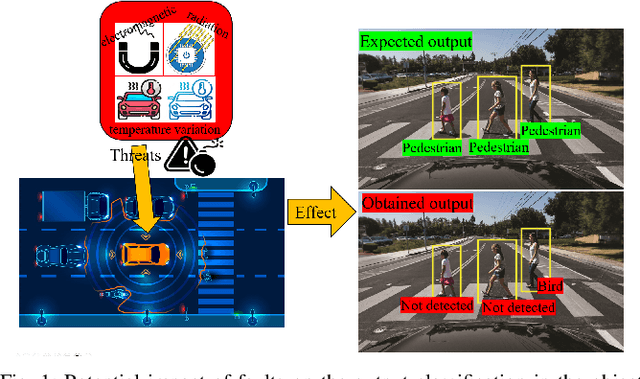
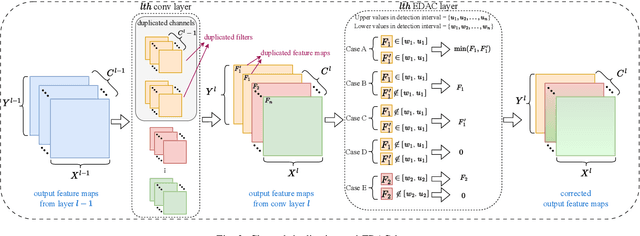
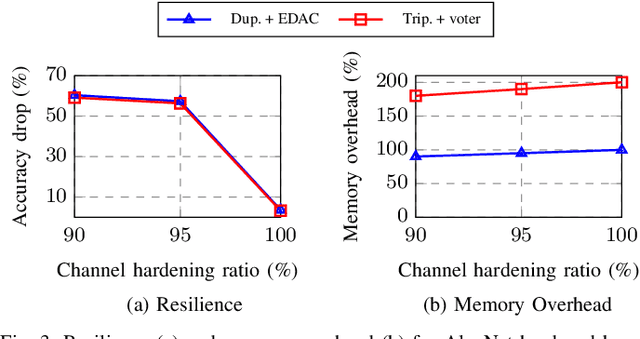
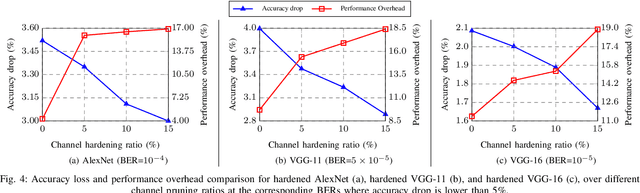
Convolutional Neural Networks (CNNs) have become integral in safety-critical applications, thus raising concerns about their fault tolerance. Conventional hardware-dependent fault tolerance methods, such as Triple Modular Redundancy (TMR), are computationally expensive, imposing a remarkable overhead on CNNs. Whereas fault tolerance techniques can be applied either at the hardware level or at the model levels, the latter provides more flexibility without sacrificing generality. This paper introduces a model-level hardening approach for CNNs by integrating error correction directly into the neural networks. The approach is hardware-agnostic and does not require any changes to the underlying accelerator device. Analyzing the vulnerability of parameters enables the duplication of selective filters/neurons so that their output channels are effectively corrected with an efficient and robust correction layer. The proposed method demonstrates fault resilience nearly equivalent to TMR-based correction but with significantly reduced overhead. Nevertheless, there exists an inherent overhead to the baseline CNNs. To tackle this issue, a cost-effective parameter vulnerability based pruning technique is proposed that outperforms the conventional pruning method, yielding smaller networks with a negligible accuracy loss. Remarkably, the hardened pruned CNNs perform up to 24\% faster than the hardened un-pruned ones.
SAFFIRA: a Framework for Assessing the Reliability of Systolic-Array-Based DNN Accelerators
Mar 05, 2024


Systolic array has emerged as a prominent architecture for Deep Neural Network (DNN) hardware accelerators, providing high-throughput and low-latency performance essential for deploying DNNs across diverse applications. However, when used in safety-critical applications, reliability assessment is mandatory to guarantee the correct behavior of DNN accelerators. While fault injection stands out as a well-established practical and robust method for reliability assessment, it is still a very time-consuming process. This paper addresses the time efficiency issue by introducing a novel hierarchical software-based hardware-aware fault injection strategy tailored for systolic array-based DNN accelerators.
AdAM: Adaptive Fault-Tolerant Approximate Multiplier for Edge DNN Accelerators
Mar 05, 2024In this paper, we propose an architecture of a novel adaptive fault-tolerant approximate multiplier tailored for ASIC-based DNN accelerators.
Exploration of Activation Fault Reliability in Quantized Systolic Array-Based DNN Accelerators
Jan 17, 2024The stringent requirements for the Deep Neural Networks (DNNs) accelerator's reliability stand along with the need for reducing the computational burden on the hardware platforms, i.e. reducing the energy consumption and execution time as well as increasing the efficiency of DNN accelerators. Moreover, the growing demand for specialized DNN accelerators with tailored requirements, particularly for safety-critical applications, necessitates a comprehensive design space exploration to enable the development of efficient and robust accelerators that meet those requirements. Therefore, the trade-off between hardware performance, i.e. area and delay, and the reliability of the DNN accelerator implementation becomes critical and requires tools for analysis. This paper presents a comprehensive methodology for exploring and enabling a holistic assessment of the trilateral impact of quantization on model accuracy, activation fault reliability, and hardware efficiency. A fully automated framework is introduced that is capable of applying various quantization-aware techniques, fault injection, and hardware implementation, thus enabling the measurement of hardware parameters. Moreover, this paper proposes a novel lightweight protection technique integrated within the framework to ensure the dependable deployment of the final systolic-array-based FPGA implementation. The experiments on established benchmarks demonstrate the analysis flow and the profound implications of quantization on reliability, hardware performance, and network accuracy, particularly concerning the transient faults in the network's activations.
Enhancing Fault Resilience of QNNs by Selective Neuron Splitting
Jun 16, 2023The superior performance of Deep Neural Networks (DNNs) has led to their application in various aspects of human life. Safety-critical applications are no exception and impose rigorous reliability requirements on DNNs. Quantized Neural Networks (QNNs) have emerged to tackle the complexity of DNN accelerators, however, they are more prone to reliability issues. In this paper, a recent analytical resilience assessment method is adapted for QNNs to identify critical neurons based on a Neuron Vulnerability Factor (NVF). Thereafter, a novel method for splitting the critical neurons is proposed that enables the design of a Lightweight Correction Unit (LCU) in the accelerator without redesigning its computational part. The method is validated by experiments on different QNNs and datasets. The results demonstrate that the proposed method for correcting the faults has a twice smaller overhead than a selective Triple Modular Redundancy (TMR) while achieving a similar level of fault resiliency.