 Add to Chrome
 Add to Firefox
 Add to Edge
FLaRA: Predicting Future Latent Representations for Accident Anticipation
Jun 12, 2026
Anticipating traffic accidents from dashcam videos is a critical challenge in intelligent transportation systems. Existing methods typically map visual context directly to a collision probability without explicitly modeling the future evolution of the driving scene. In this paper we propose FLaRA (Predicting Future Latent Representations for Accident Anticipation), a novel predictive architecture that shifts this paradigm by forecasting future latent representations for accident anticipation. Building upon the Video Joint-Embedding Predictive Architecture (V-JEPA2), our model conditions a predictor network on observed context frames to predict the forthcoming latent features of the scene. A classifier then operates on these predicted future representations rather than only on past observations. To ensure these forecasts remain grounded in realistic future dynamics, we introduce a joint training objective that simultaneously optimizes an auxiliary feature-level reconstruction loss and a cross-entropy classification loss. Extensive evaluations on the Nexar dataset, alongside cross-domain validations on the DAD, DADA-2000, and DoTA benchmarks, demonstrate that our approach achieves state-of-the-art performance while maintaining realistic early warning capabilities.

VZCrash: A Large-Scale IMU Dataset of Ego-Vehicle Crashes
Jun 04, 2026We introduce VZCrash, the largest publicly available dataset of real-world vehicle collision data featuring Inertial Measurement Unit (IMU) telemetry. The dataset contains more than 31,000 validated crashes and 158,000 negative samples, including hard cases and distractors. Each sample includes acceleration and angular velocity at 100 Hz, and GPS speed at 1 Hz. Events in VZCrash were captured by devices installed on a fleet of 73,010 commercial vehicles of different sizes driving in the United States over the span of several years. We also present an extensive experimental study enabled by the volume of the dataset. We first benchmark several different approaches, from a simple threshold-based heuristic to state-of-the-art deep learning models. Then, we present an experiment demonstrating the importance of scaling data to train high-quality crash detection models, and we show that scale is especially important when these models need to be deployed into a real-world environment.
RendBEV: Semantic Novel View Synthesis for Self-Supervised Bird's Eye View Segmentation
Feb 20, 2025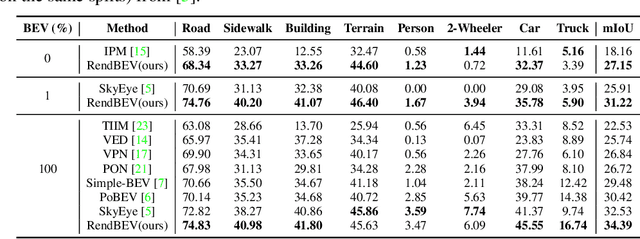
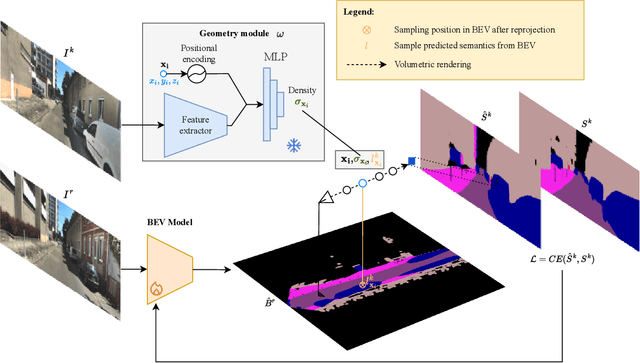
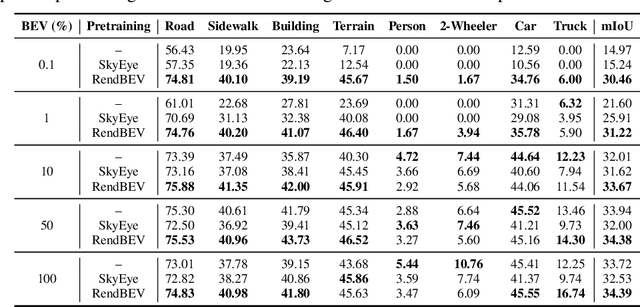
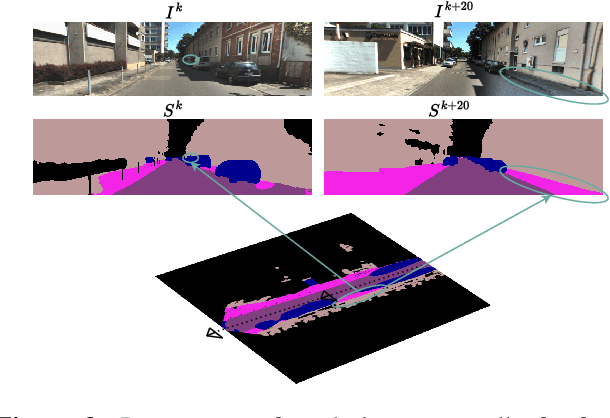
Bird's Eye View (BEV) semantic maps have recently garnered a lot of attention as a useful representation of the environment to tackle assisted and autonomous driving tasks. However, most of the existing work focuses on the fully supervised setting, training networks on large annotated datasets. In this work, we present RendBEV, a new method for the self-supervised training of BEV semantic segmentation networks, leveraging differentiable volumetric rendering to receive supervision from semantic perspective views computed by a 2D semantic segmentation model. Our method enables zero-shot BEV semantic segmentation, and already delivers competitive results in this challenging setting. When used as pretraining to then fine-tune on labeled BEV ground-truth, our method significantly boosts performance in low-annotation regimes, and sets a new state of the art when fine-tuning on all available labels.
A New Dataset for Monocular Depth Estimation Under Viewpoint Shifts
Sep 27, 2024


Monocular depth estimation is a critical task for autonomous driving and many other computer vision applications. While significant progress has been made in this field, the effects of viewpoint shifts on depth estimation models remain largely underexplored. This paper introduces a novel dataset and evaluation methodology to quantify the impact of different camera positions and orientations on monocular depth estimation performance. We propose a ground truth strategy based on homography estimation and object detection, eliminating the need for expensive lidar sensors. We collect a diverse dataset of road scenes from multiple viewpoints and use it to assess the robustness of a modern depth estimation model to geometric shifts. After assessing the validity of our strategy on a public dataset, we provide valuable insights into the limitations of current models and highlight the importance of considering viewpoint variations in real-world applications.