 Add to Chrome
 Add to Firefox
 Add to Edge
SEMASIA: A Large-Scale Dataset of Semantically Structured Latent Representations
May 10, 2026
Latent representations learned by neural networks often exhibit semantic structure, where concept similarity is reflected by geometric proximity in embedding space. However, comparing such spaces across models remains difficult: changes in architecture, pretraining data, objective, or random seed can yield embeddings with similar content but incompatible geometry. This latent space alignment problem is central to interpretability, transfer and multimodal learning, federated systems, and semantic communication; however, progress remains limited by the lack of large-scale, model-diverse, and metadata-rich benchmarks. To address this gap, we introduce SEMASIA, a large-scale collection of latent representations extracted from approximately 1,700 pretrained vision models across eight standard image-classification benchmarks. SEMASIA pairs embeddings with structured metadata describing architectures, training regimes, pretraining sources, and model scale. We demonstrate three applications of the resource. First, we analyze the conceptual organization of individual latent spaces, showing consistent prototype-like clustering and hierarchical semantic neighborhoods across models and datasets. Second, we benchmark supervised alignment mappings between latent spaces using reconstruction error and downstream task performance. Third, we perform a large-scale regression analysis of how pretraining-data complexity, specialization, transfer learning, augmentation, and model scale relate to geometric and probing properties of embeddings. By coupling representational scale with standardized metadata, SEMASIA provides a reproducible foundation for studying latent geometry, evaluating alignment methods, and developing next-generation heterogeneous and interoperable AI systems.

Learning Dirac Spectral Transforms for Topological Signals
Feb 16, 2026The Dirac operator provides a unified framework for processing signals defined over different order topological domains, such as node and edge signals. Its eigenmodes define a spectral representation that inherently captures cross-domain interactions, in contrast to conventional Hodge-Laplacian eigenmodes that operate within a single topological dimension. In this paper, we compare the two alternatives in terms of the distortion/sparsity trade-off and we show how an overcomplete basis built concatenating the two dictionaries can provide better performance with respect to each approach. Then, we propose a parameterized nonredundant transform whose eigenmodes incorporate a mode-specific mass parameter that captures the interplay between node and edge modes. Interestingly, we show that learning the mass parameters from data makes the proposed transform able to achieve the best distortion-sparsity tradeoff with respect to both complete and overcomplete bases.
Learning Sheaf Laplacian Optimizing Restriction Maps
Jan 31, 2025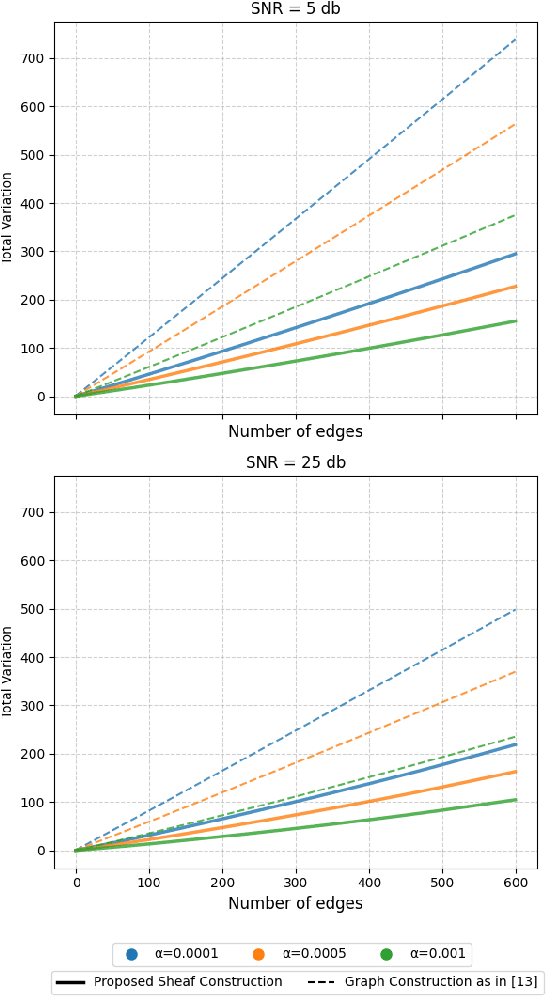
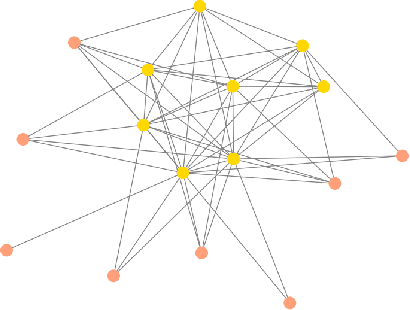
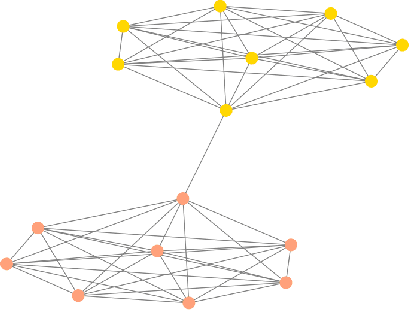
The aim of this paper is to propose a novel framework to infer the sheaf Laplacian, including the topology of a graph and the restriction maps, from a set of data observed over the nodes of a graph. The proposed method is based on sheaf theory, which represents an important generalization of graph signal processing. The learning problem aims to find the sheaf Laplacian that minimizes the total variation of the observed data, where the variation over each edge is also locally minimized by optimizing the associated restriction maps. Compared to alternative methods based on semidefinite programming, our solution is significantly more numerically efficient, as all its fundamental steps are resolved in closed form. The method is numerically tested on data consisting of vectors defined over subspaces of varying dimensions at each node. We demonstrate how the resulting graph is influenced by two key factors: the cross-correlation and the dimensionality difference of the data residing on the graph's nodes.