 Add to Chrome
 Add to Firefox
 Add to Edge
Generation of Diverse and Functional Robot Designs using Superquadrics Parametrisation and Quality-Diversity
Jun 09, 2026
Generative design of robots requires navigating a vast search-space, encompassing physical configurations and behavioural parameters. Evolutionary Algorithms (EAs) have shown promising results, but often converge prematurely to a small set of sub-optimal designs. Most EAs fail to maintain sufficient diversity in the population that would allow the discovery of distinct functional robots. To counter premature convergence, we introduce a superquadrics-based representation (SQs) for robot bodies. SQs are interpretable, compact and computationally efficient mathematical representations of 3D geometrical shapes that can be tuned to specific design-spaces. To encourage morphological diversity, we combine this representation with a quality-diversity (QD) algorithm (MAP-Elites). We compare SQs and Compositional Pattern Producing Networks representations as generators of morphologies, combining them with standard EAs and MAP-Elites. In two test environments, we find that using SQs to generate morphology in conjunction with the MAP-Elites algorithm reaches the highest QD-score across both environments, maximising diversity of design and functionality of generated robots. The findings highlight the benefits of using a compact and interpretable geometric representation for exploring a complex design-space and suggest that combining SQs with an explicit diversity mechanism increases the quality and number of designs generated.

The Surprising Creativity of Digital Evolution: A Collection of Anecdotes from the Evolutionary Computation and Artificial Life Research Communities
Aug 14, 2018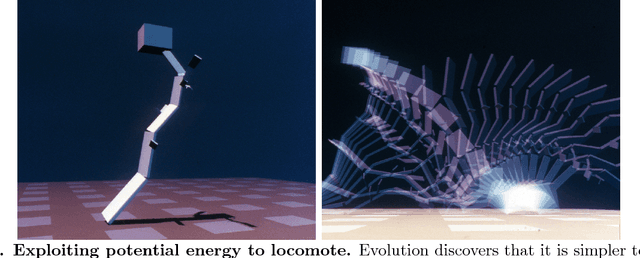
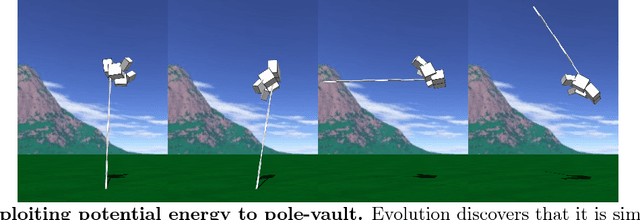

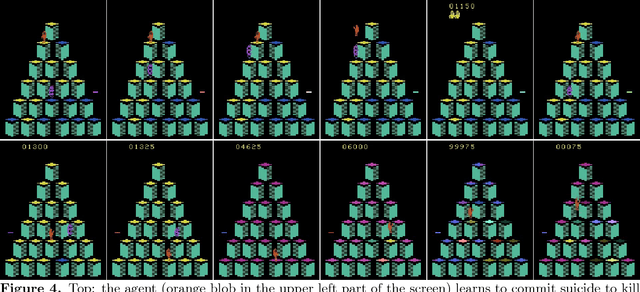
Biological evolution provides a creative fount of complex and subtle adaptations, often surprising the scientists who discover them. However, because evolution is an algorithmic process that transcends the substrate in which it occurs, evolution's creativity is not limited to nature. Indeed, many researchers in the field of digital evolution have observed their evolving algorithms and organisms subverting their intentions, exposing unrecognized bugs in their code, producing unexpected adaptations, or exhibiting outcomes uncannily convergent with ones in nature. Such stories routinely reveal creativity by evolution in these digital worlds, but they rarely fit into the standard scientific narrative. Instead they are often treated as mere obstacles to be overcome, rather than results that warrant study in their own right. The stories themselves are traded among researchers through oral tradition, but that mode of information transmission is inefficient and prone to error and outright loss. Moreover, the fact that these stories tend to be shared only among practitioners means that many natural scientists do not realize how interesting and lifelike digital organisms are and how natural their evolution can be. To our knowledge, no collection of such anecdotes has been published before. This paper is the crowd-sourced product of researchers in the fields of artificial life and evolutionary computation who have provided first-hand accounts of such cases. It thus serves as a written, fact-checked collection of scientifically important and even entertaining stories. In doing so we also present here substantial evidence that the existence and importance of evolutionary surprises extends beyond the natural world, and may indeed be a universal property of all complex evolving systems.