 Add to Chrome
 Add to Firefox
 Add to Edge
Generation of Diverse and Functional Robot Designs using Superquadrics Parametrisation and Quality-Diversity
Jun 09, 2026
Generative design of robots requires navigating a vast search-space, encompassing physical configurations and behavioural parameters. Evolutionary Algorithms (EAs) have shown promising results, but often converge prematurely to a small set of sub-optimal designs. Most EAs fail to maintain sufficient diversity in the population that would allow the discovery of distinct functional robots. To counter premature convergence, we introduce a superquadrics-based representation (SQs) for robot bodies. SQs are interpretable, compact and computationally efficient mathematical representations of 3D geometrical shapes that can be tuned to specific design-spaces. To encourage morphological diversity, we combine this representation with a quality-diversity (QD) algorithm (MAP-Elites). We compare SQs and Compositional Pattern Producing Networks representations as generators of morphologies, combining them with standard EAs and MAP-Elites. In two test environments, we find that using SQs to generate morphology in conjunction with the MAP-Elites algorithm reaches the highest QD-score across both environments, maximising diversity of design and functionality of generated robots. The findings highlight the benefits of using a compact and interpretable geometric representation for exploring a complex design-space and suggest that combining SQs with an explicit diversity mechanism increases the quality and number of designs generated.

S-RASTER: Contraction Clustering for Evolving Data Streams
Nov 21, 2019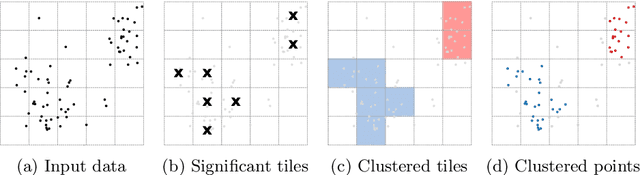
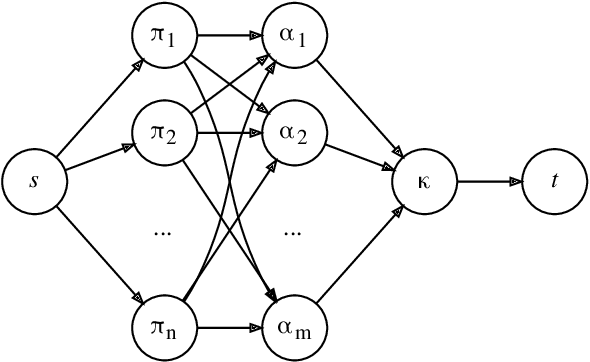
Contraction Clustering (RASTER) is a very fast algorithm for density-based clustering, which requires only a single pass. It can process arbitrary amounts of data in linear time and in constant memory, quickly identifying approximate clusters. It also exhibits good scalability in the presence of multiple CPU cores. Yet, RASTER is limited to batch processing. In contrast, S-RASTER is an adaptation of RASTER to the stream processing paradigm that is able to identify clusters in evolving data streams. This algorithm retains the main benefits of its parent algorithm, i.e. single-pass linear time cost and constant memory requirements for each discrete time step in the sliding window. The sliding window is efficiently pruned, and clustering is still performed in linear time. Like RASTER, S-RASTER trades off an often negligible amount of precision for speed. It is therefore very well suited to real-world scenarios where clustering does not happen continually but only periodically. We describe the algorithm, including a discussion of implementation details.
Contraction Clustering : A Very Fast Big Data Algorithm for Sequential and Parallel Density-Based Clustering in Linear Time, Constant Memory, and a Single Pass
Jul 08, 2019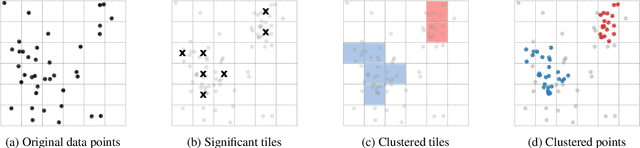
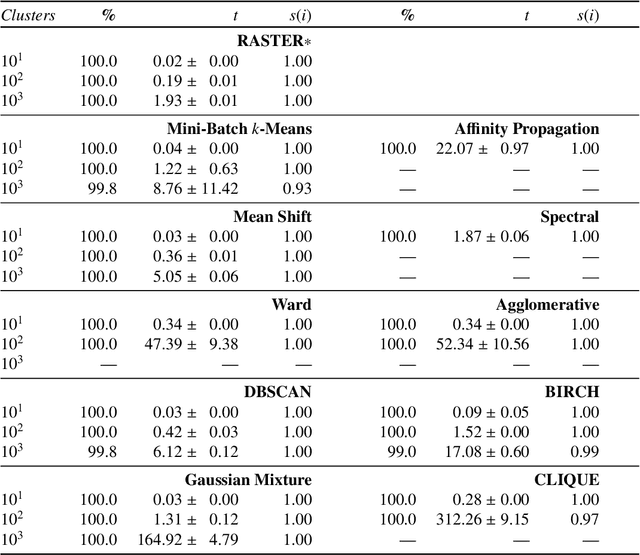
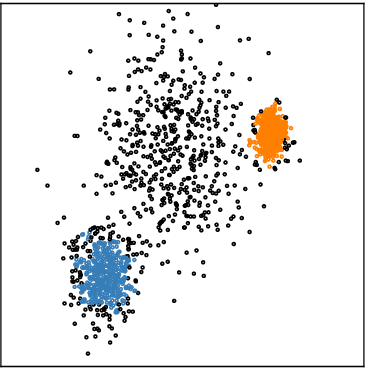
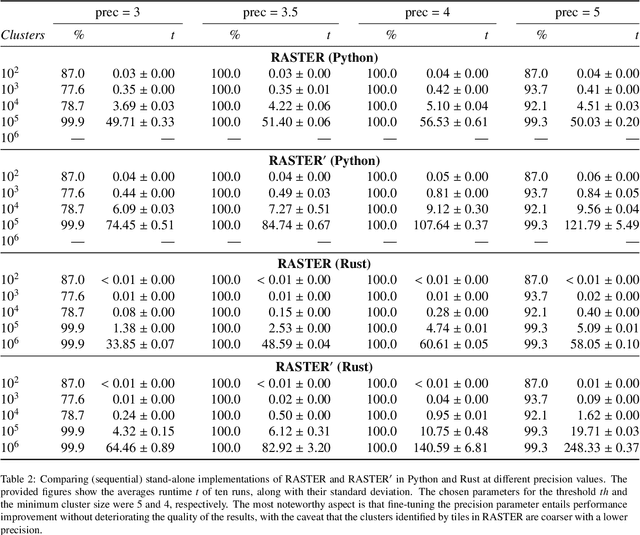
Clustering is an essential data mining tool for analyzing and grouping similar objects. In big data applications, however, many clustering algorithms are infeasible due to their high memory requirements and/or unfavorable runtime complexity. In contrast, Contraction Clustering (RASTER) is a single-pass algorithm for identifying density-based clusters with linear time complexity. Due to its favorable runtime and the fact that its memory requirements are constant, this algorithm is highly suitable for big data applications where the amount of data to be processed is huge. It consists of two steps: (1) a contraction step which projects objects onto tiles and (2) an agglomeration step which groups tiles into clusters. This algorithm is extremely fast in both sequential and parallel execution. In single-threaded execution on a contemporary workstation, an implementation in Rust processes a batch of 500 million points with 1 million clusters in less than 50 seconds. The speedup due to parallelization is significant, amounting to a factor of around 4 on an 8-core machine.