 Add to Chrome
 Add to Firefox
 Add to Edge
RadPRISM: Schema-stratified radiology-report supervision for concept-disentangled image representations and visual grounding
Jul 31, 2026
Vision-language pretraining learns rich medical image representations from radiology reports, but previous model variants commonly operate within a single shared embedding space, so concept-level structure and interpretability must be recovered post hoc, limiting model transparency and, hence, clinical utility. We introduce RadPRISM, which makes a clinician-defined radiology schema a designated stratification axis: an on-premise large language model extracts per-concept text spans from free-text reports, and each clinical concept is aligned in its own dedicated visual subspace, turning concept stratification into direct, top-level alignment supervision. Instantiated on chest radiographs with a 19-concept schema over $203{,}602$ examinations from an internal multi-year archive, RadPRISM improved internal dataset zero-shot classification from $0.717$ (95% CI, $0.710-0.723$) to $0.868$ (95% CI, $0.863-0.872$) macro AUROC over a matched global-alignment baseline, performed on par with the purpose-built CARZero reference in external zero-shot classification while substantially outperforming it (up to 4.3-fold) in pointing-game visual grounding. In addition, a radiologist reader study demonstrated concept-stratified retrieval ability ($0.78$ macro retrieval correctness rate within rank 3), surfacing disentangled descriptive findings that report-level retrieval and fixed-label vocabularies cannot express. RadPRISM yields discriminative, spatially faithful, natively concept-stratified representations shaped by and transparently inspectable by clinicians.

NOVA: A Benchmark for Anomaly Localization and Clinical Reasoning in Brain MRI
May 20, 2025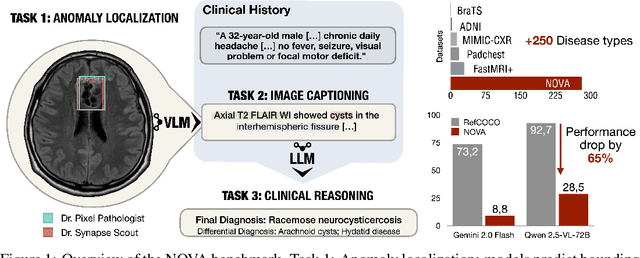

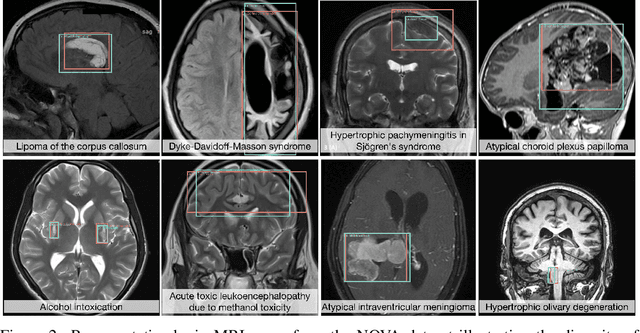

In many real-world applications, deployed models encounter inputs that differ from the data seen during training. Out-of-distribution detection identifies whether an input stems from an unseen distribution, while open-world recognition flags such inputs to ensure the system remains robust as ever-emerging, previously $unknown$ categories appear and must be addressed without retraining. Foundation and vision-language models are pre-trained on large and diverse datasets with the expectation of broad generalization across domains, including medical imaging. However, benchmarking these models on test sets with only a few common outlier types silently collapses the evaluation back to a closed-set problem, masking failures on rare or truly novel conditions encountered in clinical use. We therefore present $NOVA$, a challenging, real-life $evaluation-only$ benchmark of $\sim$900 brain MRI scans that span 281 rare pathologies and heterogeneous acquisition protocols. Each case includes rich clinical narratives and double-blinded expert bounding-box annotations. Together, these enable joint assessment of anomaly localisation, visual captioning, and diagnostic reasoning. Because NOVA is never used for training, it serves as an $extreme$ stress-test of out-of-distribution generalisation: models must bridge a distribution gap both in sample appearance and in semantic space. Baseline results with leading vision-language models (GPT-4o, Gemini 2.0 Flash, and Qwen2.5-VL-72B) reveal substantial performance drops across all tasks, establishing NOVA as a rigorous testbed for advancing models that can detect, localize, and reason about truly unknown anomalies.