 Add to Chrome
 Add to Firefox
 Add to Edge
RadPRISM: Schema-stratified radiology-report supervision for concept-disentangled image representations and visual grounding
Jul 31, 2026
Vision-language pretraining learns rich medical image representations from radiology reports, but previous model variants commonly operate within a single shared embedding space, so concept-level structure and interpretability must be recovered post hoc, limiting model transparency and, hence, clinical utility. We introduce RadPRISM, which makes a clinician-defined radiology schema a designated stratification axis: an on-premise large language model extracts per-concept text spans from free-text reports, and each clinical concept is aligned in its own dedicated visual subspace, turning concept stratification into direct, top-level alignment supervision. Instantiated on chest radiographs with a 19-concept schema over $203{,}602$ examinations from an internal multi-year archive, RadPRISM improved internal dataset zero-shot classification from $0.717$ (95% CI, $0.710-0.723$) to $0.868$ (95% CI, $0.863-0.872$) macro AUROC over a matched global-alignment baseline, performed on par with the purpose-built CARZero reference in external zero-shot classification while substantially outperforming it (up to 4.3-fold) in pointing-game visual grounding. In addition, a radiologist reader study demonstrated concept-stratified retrieval ability ($0.78$ macro retrieval correctness rate within rank 3), surfacing disentangled descriptive findings that report-level retrieval and fixed-label vocabularies cannot express. RadPRISM yields discriminative, spatially faithful, natively concept-stratified representations shaped by and transparently inspectable by clinicians.

Routine laboratory trajectories encode the onset of organ-level complications in cancer
Jun 07, 2026Routine laboratory panels drawn during cancer treatment constitute longitudinal physiological recordings of organ function, yet their temporal structure is discarded by single-timepoint prognostic tools. A transformer trained on 2,777,595 laboratory measurements from 3,905 patients with multiple myeloma or ovarian cancer predicted the two-year onset of 162 treatment-associated complications, including therapy-related myelodysplastic syndromes, spanning eight clinical categories, achieving 1.5- to 6.1-fold enrichment above prevalence at the group level. It matched or outperformed non-sequential baselines across grouped endpoints (AUROC gains up to +0.11), demonstrating that longitudinal laboratory trajectories capture evolving complication-specific physiology inaccessible from isolated measurements. Predictions generalised across both cancers, divergence concentrating in disease-specific complications, and biomarker masking recovered signatures consistent with established pathophysiology. External validation on MIMIC-IV and MMRF CoMMpass confirmed transferability across independent healthcare systems (AUROC up to 0.85). Routine oncological laboratory data encode organ deterioration weeks to months before clinical onset, enabling complication-specific surveillance without additional testing infrastructure.
Agentic clinical reasoning over longitudinal myeloma records: a retrospective evaluation against expert consensus
Apr 27, 2026Multiple myeloma is managed through sequential lines of therapy over years to decades, with each decision depending on cumulative disease history distributed across dozens to hundreds of heterogeneous clinical documents. Whether LLM-based systems can synthesise this evidence at a level approaching expert agreement has not been established. A retrospective evaluation was conducted on longitudinal clinical records of 811 myeloma patients treated at a tertiary centre (2001-2026), covering 44,962 documents and 1,334,677 laboratory values, with external validation on MIMIC-IV. An agentic reasoning system was compared against single-pass retrieval-augmented generation (RAG), iterative RAG, and full-context input on 469 patient-question pairs from 48 templates at three complexity levels. Reference labels came from double annotation by four oncologists with senior haematologist adjudication. Iterative RAG and full-context input converged on a shared ceiling (75.4% vs 75.8%, p = 1.00). The agentic system reached 79.6% concordance (95% CI 76.4-82.8), exceeding both baselines (+3.8 and +4.2 pp; p = 0.006 and 0.007). Gains rose with question complexity, reaching +9.4 pp on criteria-based synthesis (p = 0.032), and with record length, reaching +13.5 pp in the top decile (n = 10). The system error rate (12.2%) was comparable to expert disagreement (13.6%), but severity was inverted: 57.8% of system errors were clinically significant versus 18.8% of expert disagreements. Agentic reasoning was the only approach to exceed the shared ceiling, with gains concentrated on the most complex questions and longest records. The greater clinical consequence of residual system errors indicates that prospective evaluation in routine care is required before these findings translate into patient benefit.
Deformable Image Registration of Dark-Field Chest Radiographs for Local Lung Signal Change Assessment
Jan 18, 2025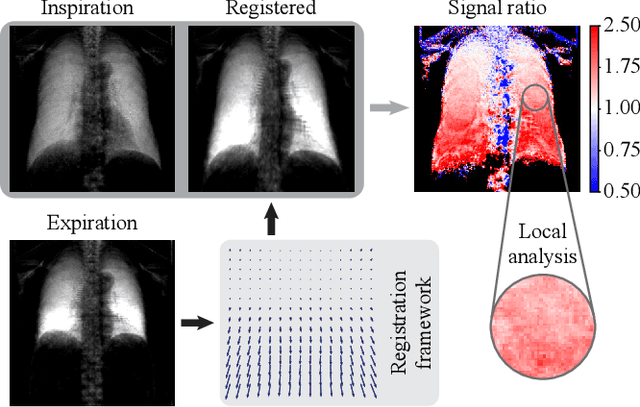
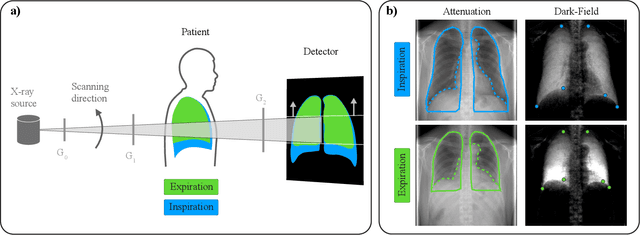
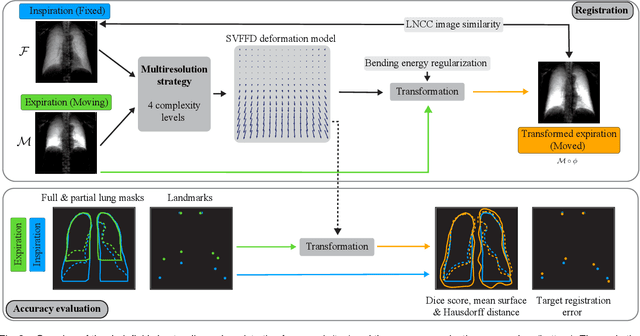
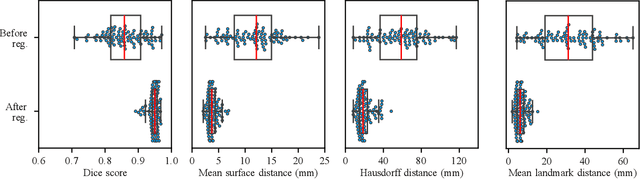
Dark-field radiography of the human chest has been demonstrated to have promising potential for the analysis of the lung microstructure and the diagnosis of respiratory diseases. However, previous studies of dark-field chest radiographs evaluated the lung signal only in the inspiratory breathing state. Our work aims to add a new perspective to these previous assessments by locally comparing dark-field lung information between different respiratory states. To this end, we discuss suitable image registration methods for dark-field chest radiographs to enable consistent spatial alignment of the lung in distinct breathing states. Utilizing full inspiration and expiration scans from a clinical chronic obstructive pulmonary disease study, we assess the performance of the proposed registration framework and outline applicable evaluation approaches. Our regional characterization of lung dark-field signal changes between the breathing states provides a proof-of-principle that dynamic radiography-based lung function assessment approaches may benefit from considering registered dark-field images in addition to standard plain chest radiographs.