 Add to Chrome
 Add to Firefox
 Add to Edge
Predictive Control with Indirect Adaptive Laws for Payload Transportation by Quadrupedal Robots
Mar 09, 2026
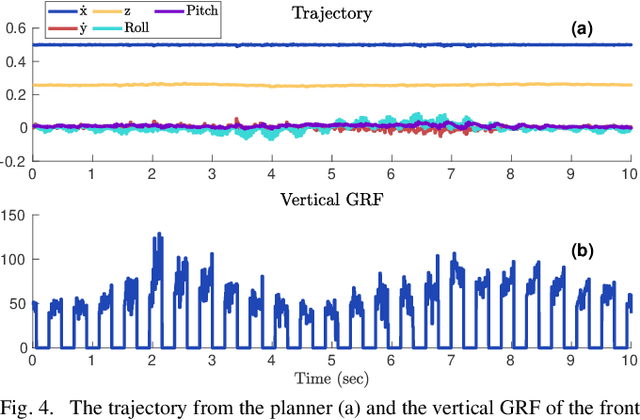
This paper formally develops a novel hierarchical planning and control framework for robust payload transportation by quadrupedal robots, integrating a model predictive control (MPC) algorithm with a gradient-descent-based adaptive updating law. At the framework's high level, an indirect adaptive law estimates the unknown parameters of the reduced-order (template) locomotion model under varying payloads. These estimated parameters feed into an MPC algorithm for real-time trajectory planning, incorporating a convex stability criterion within the MPC constraints to ensure the stability of the template model's estimation error. The optimal reduced-order trajectories generated by the high-level adaptive MPC (AMPC) are then passed to a low-level nonlinear whole-body controller (WBC) for tracking. Extensive numerical investigations validate the framework's capabilities, showcasing the robot's proficiency in transporting unmodeled, unknown static payloads up to 109% in experiments on flat terrains and 91% on rough experimental terrains. The robot also successfully manages dynamic payloads with 73% of its mass on rough terrains. Performance comparisons with a normal MPC and an L1 MPC indicate a significant improvement. Furthermore, comprehensive hardware experiments conducted in indoor and outdoor environments confirm the method's efficacy on rough terrains despite uncertainties such as payload variations, push disturbances, and obstacles.
* 8 pages, 6 figures. Published in IEEE Robotics and Automation Letters

Distributed Data-Driven Predictive Control for Multi-Agent Collaborative Legged Locomotion
Nov 13, 2022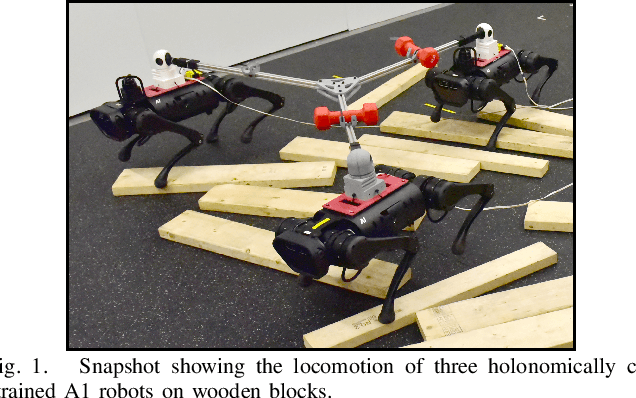
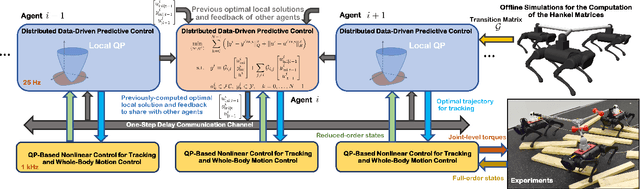

The aim of this work is to define a planner that enables robust legged locomotion for complex multi-agent systems consisting of several holonomically constrained quadrupeds. To this end, we employ a methodology based on behavioral systems theory to model the sophisticated and high-dimensional structure induced by the holonomic constraints. The resulting model is then used in tandem with distributed control techniques such that the computational burden is shared across agents while the coupling between agents is preserved. Finally, this distributed model is framed in the context of a predictive controller, resulting in a robustly stable method for trajectory planning. This methodology is tested in simulation with up to five agents and is further experimentally validated on three A1 quadrupedal robots subject to various uncertainties, including payloads, rough terrain, and push disturbances.