 Add to Chrome
 Add to Firefox
 Add to Edge
Towards Practical Multimodal Hospital Outbreak Detection
Mar 20, 2026
Rapid identification of outbreaks in hospitals is essential for controlling pathogens with epidemic potential. Although whole genome sequencing (WGS) remains the gold standard in outbreak investigations, its substantial costs and turnaround times limit its feasibility for routine surveillance, especially in less-equipped facilities. We explore three modalities as rapid alternatives: matrix-assisted laser desorption ionization-time of flight (MALDI-TOF) mass spectrometry, antimicrobial resistance (AR) patterns, and electronic health records (EHR). We present a machine learning approach that learns discriminative features from these modalities to support outbreak detection. Multi-species evaluation shows that the integration of these modalities can boost outbreak detection performance. We also propose a tiered surveillance paradigm that can reduce the need for WGS through these alternative modalities. Further analysis of EHR information identifies potentially high-risk contamination routes linked to specific clinical procedures, notably those involving invasive equipment and high-frequency workflows, providing infection prevention teams with actionable targets for proactive risk mitigation

Exploring the Utility of MALDI-TOF Mass Spectrometry and Antimicrobial Resistance in Hospital Outbreak Detection
Feb 17, 2026Accurate and timely identification of hospital outbreak clusters is crucial for preventing the spread of infections that have epidemic potential. While assessing pathogen similarity through whole genome sequencing (WGS) is considered the gold standard for outbreak detection, its high cost and lengthy turnaround time preclude routine implementation in clinical laboratories. We explore the utility of two rapid and cost-effective alternatives to WGS, matrix-assisted laser desorption ionization-time of flight (MALDI-TOF) mass spectrometry and antimicrobial resistance (AR) patterns. We develop a machine learning framework that extracts informative representations from MALDI-TOF spectra and AR patterns for outbreak detection and explore their fusion. Through multi-species analyses, we demonstrate that in some cases MALDI-TOF and AR have the potential to reduce reliance on WGS, enabling more accessible and rapid outbreak surveillance.
Multimodal Structure Preservation Learning
Oct 29, 2024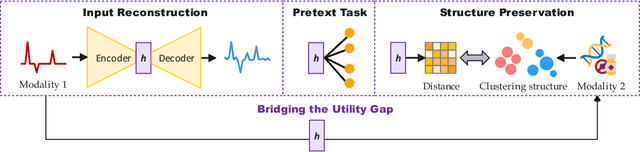
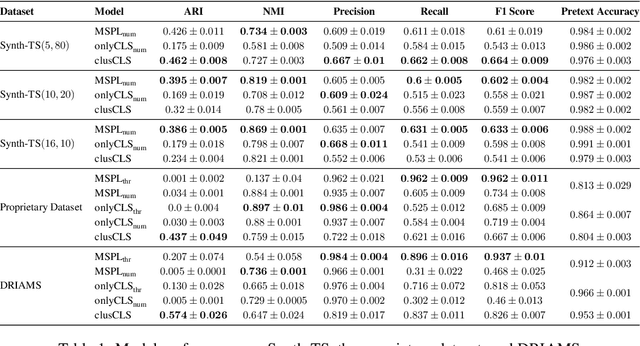

When selecting data to build machine learning models in practical applications, factors such as availability, acquisition cost, and discriminatory power are crucial considerations. Different data modalities often capture unique aspects of the underlying phenomenon, making their utilities complementary. On the other hand, some sources of data host structural information that is key to their value. Hence, the utility of one data type can sometimes be enhanced by matching the structure of another. We propose Multimodal Structure Preservation Learning (MSPL) as a novel method of learning data representations that leverages the clustering structure provided by one data modality to enhance the utility of data from another modality. We demonstrate the effectiveness of MSPL in uncovering latent structures in synthetic time series data and recovering clusters from whole genome sequencing and antimicrobial resistance data using mass spectrometry data in support of epidemiology applications. The results show that MSPL can imbue the learned features with external structures and help reap the beneficial synergies occurring across disparate data modalities.