 Add to Chrome
 Add to Firefox
 Add to Edge
Kill it with FIRE: On Leveraging Latent Space Directions for Runtime Backdoor Mitigation in Deep Neural Networks
Feb 11, 2026
Machine learning models are increasingly present in our everyday lives; as a result, they become targets of adversarial attackers seeking to manipulate the systems we interact with. A well-known vulnerability is a backdoor introduced into a neural network by poisoned training data or a malicious training process. Backdoors can be used to induce unwanted behavior by including a certain trigger in the input. Existing mitigations filter training data, modify the model, or perform expensive input modifications on samples. If a vulnerable model has already been deployed, however, those strategies are either ineffective or inefficient. To address this gap, we propose our inference-time backdoor mitigation approach called FIRE (Feature-space Inference-time REpair). We hypothesize that a trigger induces structured and repeatable changes in the model's internal representation. We view the trigger as directions in the latent spaces between layers that can be applied in reverse to correct the inference mechanism. Therefore, we turn the backdoored model against itself by manipulating its latent representations and moving a poisoned sample's features along the backdoor directions to neutralize the trigger. Our evaluation shows that FIRE has low computational overhead and outperforms current runtime mitigations on image benchmarks across various attacks, datasets, and network architectures.

VUDENC: Vulnerability Detection with Deep Learning on a Natural Codebase for Python
Jan 20, 2022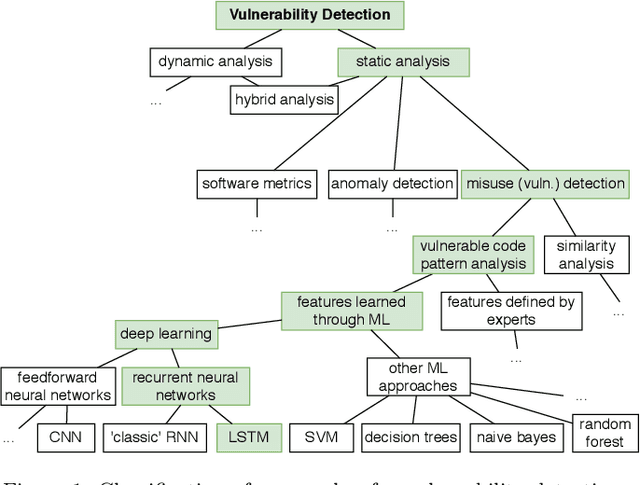


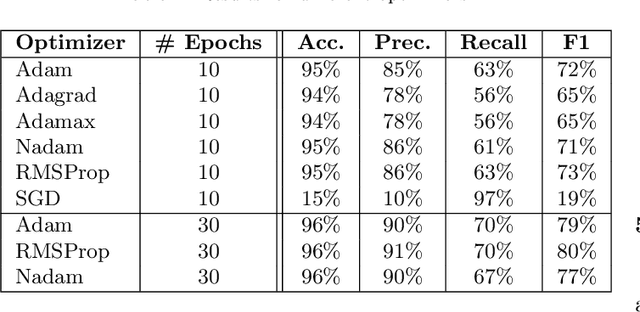
Context: Identifying potential vulnerable code is important to improve the security of our software systems. However, the manual detection of software vulnerabilities requires expert knowledge and is time-consuming, and must be supported by automated techniques. Objective: Such automated vulnerability detection techniques should achieve a high accuracy, point developers directly to the vulnerable code fragments, scale to real-world software, generalize across the boundaries of a specific software project, and require no or only moderate setup or configuration effort. Method: In this article, we present VUDENC (Vulnerability Detection with Deep Learning on a Natural Codebase), a deep learning-based vulnerability detection tool that automatically learns features of vulnerable code from a large and real-world Python codebase. VUDENC applies a word2vec model to identify semantically similar code tokens and to provide a vector representation. A network of long-short-term memory cells (LSTM) is then used to classify vulnerable code token sequences at a fine-grained level, highlight the specific areas in the source code that are likely to contain vulnerabilities, and provide confidence levels for its predictions. Results: To evaluate VUDENC, we used 1,009 vulnerability-fixing commits from different GitHub repositories that contain seven different types of vulnerabilities (SQL injection, XSS, Command injection, XSRF, Remote code execution, Path disclosure, Open redirect) for training. In the experimental evaluation, VUDENC achieves a recall of 78%-87%, a precision of 82%-96%, and an F1 score of 80%-90%. VUDENC's code, the datasets for the vulnerabilities, and the Python corpus for the word2vec model are available for reproduction. Conclusions: Our experimental results suggest...
* Accepted Manuscript