 Add to Chrome
 Add to Firefox
 Add to Edge
Robostral Navigate
Jul 24, 2026
Deploying navigation systems at scale requires a recipe that minimizes sensor assumptions, generalizes across robot embodiments, and trains efficiently. Yet, today's best systems depend on depth sensors, multi-camera rigs, or pre-built maps, limiting the hardware they support and increasing deployment cost. We introduce Robostral Navigate, an 8B vision-language model built around this scalability objective. The model consumes only a stream of monocular RGB images - the most ubiquitous sensor across robotic platforms and predicts waypoints by pointing to the next target location in the current camera view. Operating purely in image space, rather than robot-specific coordinates, makes the policy naturally robust to changes in camera intrinsics and scene scale, enabling deployment across wheeled, legged, and aerial robots without recalibration. We generate 2.4 million trajectories across 350k simulated scenes to reduce the reliance on real-world data collection and scale easily. We further introduce a prefix-caching training recipe that packs entire episodes into single training sequences, reducing training tokens by 22x and cutting training time from months to days. A tree-based attention mask prevents conditioning on previous ground-truth actions, encouraging visually grounded action prediction, and reinforcement learning is used to further improve exploration and recovery capabilities. On the Room-to-Room and Room-Across-Room in Continuous Environments (R2R-CE and RxR-CE) benchmarks, Robostral Navigate sets a new state of the art. On R2R-CE, it achieves a 77.4% success rate, surpassing the best monocular method by 10.5 points and the strongest depth- or multi-camera system by 5.3 points despite using only a single RGB camera. On RxR-CE, it reaches 75.1% success rate, outperforming all monocular baselines.

REFA: Real-time Egocentric Facial Animations for Virtual Reality
Jan 07, 2026We present a novel system for real-time tracking of facial expressions using egocentric views captured from a set of infrared cameras embedded in a virtual reality (VR) headset. Our technology facilitates any user to accurately drive the facial expressions of virtual characters in a non-intrusive manner and without the need of a lengthy calibration step. At the core of our system is a distillation based approach to train a machine learning model on heterogeneous data and labels coming form multiple sources, \eg synthetic and real images. As part of our dataset, we collected 18k diverse subjects using a lightweight capture setup consisting of a mobile phone and a custom VR headset with extra cameras. To process this data, we developed a robust differentiable rendering pipeline enabling us to automatically extract facial expression labels. Our system opens up new avenues for communication and expression in virtual environments, with applications in video conferencing, gaming, entertainment, and remote collaboration.
AvatarPoser: Articulated Full-Body Pose Tracking from Sparse Motion Sensing
Jul 27, 2022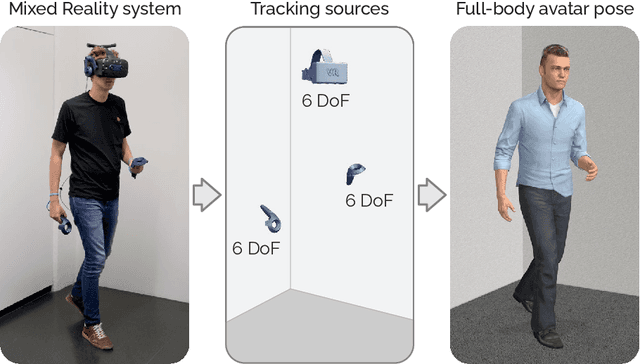
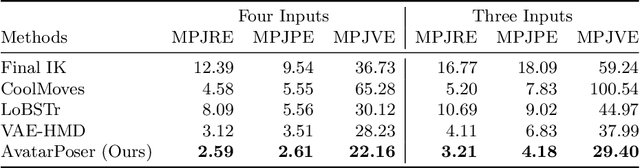
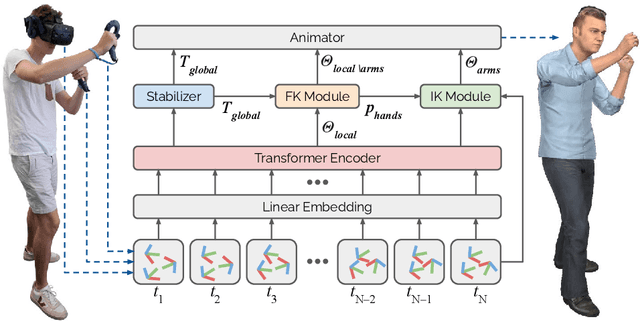
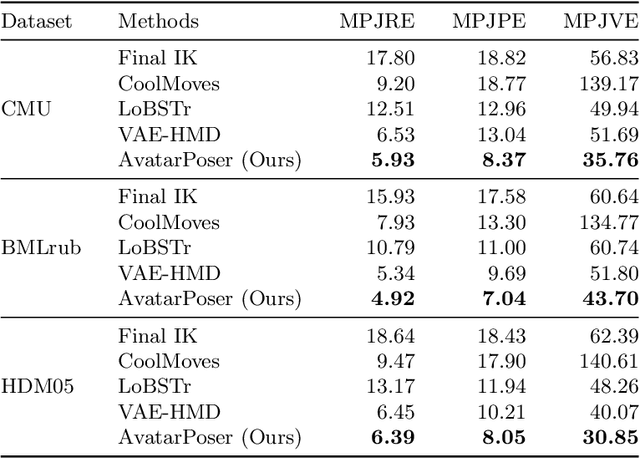
Today's Mixed Reality head-mounted displays track the user's head pose in world space as well as the user's hands for interaction in both Augmented Reality and Virtual Reality scenarios. While this is adequate to support user input, it unfortunately limits users' virtual representations to just their upper bodies. Current systems thus resort to floating avatars, whose limitation is particularly evident in collaborative settings. To estimate full-body poses from the sparse input sources, prior work has incorporated additional trackers and sensors at the pelvis or lower body, which increases setup complexity and limits practical application in mobile settings. In this paper, we present AvatarPoser, the first learning-based method that predicts full-body poses in world coordinates using only motion input from the user's head and hands. Our method builds on a Transformer encoder to extract deep features from the input signals and decouples global motion from the learned local joint orientations to guide pose estimation. To obtain accurate full-body motions that resemble motion capture animations, we refine the arm joints' positions using an optimization routine with inverse kinematics to match the original tracking input. In our evaluation, AvatarPoser achieved new state-of-the-art results in evaluations on large motion capture datasets (AMASS). At the same time, our method's inference speed supports real-time operation, providing a practical interface to support holistic avatar control and representation for Metaverse applications.