 Add to Chrome
 Add to Firefox
 Add to Edge
Meanings and Measurements: Multi-Agent Probabilistic Grounding for Vision-Language Navigation
Mar 19, 2026
Robots collaborating with humans must convert natural language goals into actionable, physically grounded decisions. For example, executing a command such as "go two meters to the right of the fridge" requires grounding semantic references, spatial relations, and metric constraints within a 3D scene. While recent vision language models (VLMs) demonstrate strong semantic grounding capabilities, they are not explicitly designed to reason about metric constraints in physically defined spaces. In this work, we empirically demonstrate that state-of-the-art VLM-based grounding approaches struggle with complex metric-semantic language queries. To address this limitation, we propose MAPG (Multi-Agent Probabilistic Grounding), an agentic framework that decomposes language queries into structured subcomponents and queries a VLM to ground each component. MAPG then probabilistically composes these grounded outputs to produce metrically consistent, actionable decisions in 3D space. We evaluate MAPG on the HM-EQA benchmark and show consistent performance improvements over strong baselines. Furthermore, we introduce a new benchmark, MAPG-Bench, specifically designed to evaluate metric-semantic goal grounding, addressing a gap in existing language grounding evaluations. We also present a real-world robot demonstration showing that MAPG transfers beyond simulation when a structured scene representation is available.

Generating Semantic Adversarial Examples with Differentiable Rendering
Oct 02, 2019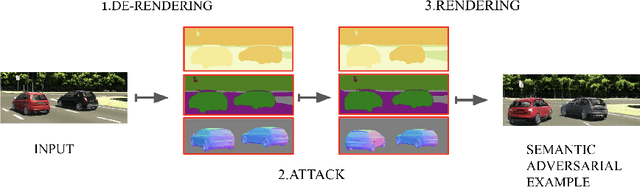

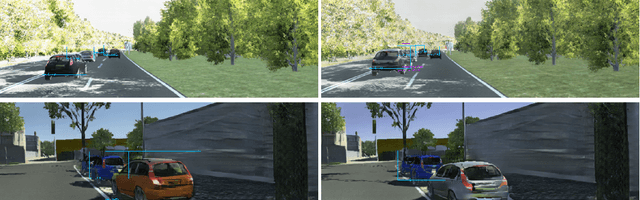

Machine learning (ML) algorithms, especially deep neural networks, have demonstrated success in several domains. However, several types of attacks have raised concerns about deploying ML in safety-critical domains, such as autonomous driving and security. An attacker perturbs a data point slightly in the concrete feature space (e.g., pixel space) and causes the ML algorithm to produce incorrect output (e.g. a perturbed stop sign is classified as a yield sign). These perturbed data points are called adversarial examples, and there are numerous algorithms in the literature for constructing adversarial examples and defending against them. In this paper we explore semantic adversarial examples (SAEs) where an attacker creates perturbations in the semantic space representing the environment that produces input for the ML model. For example, an attacker can change the background of the image to be cloudier to cause misclassification. We present an algorithm for constructing SAEs that uses recent advances in differential rendering and inverse graphics.