 Add to Chrome
 Add to Firefox
 Add to Edge
PolyAlign: Conditional Human-Distribution Alignment
Jun 11, 2026
Post-training methods such as supervised fine-tuning (SFT) and preference optimization typically align language models toward a single global assistant behavior. While effective for improving average helpfulness, this can suppress the natural variation of human responses across languages, tasks, and dialogue settings. We study this problem as conditional human-distribution alignment: models should match the human response distribution appropriate to the current interaction context, rather than a universal response style. We introduce PolyAlign, a distribution-aware alignment framework that organizes bilingual interaction data into bucket-specific human reference distributions defined by language, interaction track, response family, and length. PolyAlign combines Bucket-Aware SFT, which balances optimization across heterogeneous buckets, with Human-Distribution Preference Optimization (HDPO), which regularizes preference learning using critic-estimated distance to bucket-specific human support. Across a bilingual evaluation suite covering English and Chinese single- and multi-turn settings, PolyAlign improves conditional naturalness and distributional faithfulness while preserving competitive task utility. The results suggest that post-training should move beyond global alignment objectives toward interaction-aware alignment with human response distributions.

AURORA: Adaptive Unified Representation for Robust Ultrasound Analysis
Mar 19, 2026Ultrasound images vary widely across scanners, operators, and anatomical targets, which often causes models trained in one setting to generalize poorly to new hospitals and clinical conditions. The Foundation Model Challenge for Ultrasound Image Analysis (FMC-UIA) reflects this difficulty by requiring a single model to handle multiple tasks, including segmentation, detection, classification, and landmark regression across diverse organs and datasets. We propose a unified multi-task framework based on a transformer visual encoder from the Qwen3-VL family. Intermediate token features are projected into spatial feature maps and fused using a lightweight multi-scale feature pyramid, enabling both pixel-level predictions and global reasoning within a shared representation. Each task is handled by a small task-specific prediction head, while training uses task-aware sampling and selective loss balancing to manage heterogeneous supervision and reduce task imbalance. Our method is designed to be simple to optimize and adaptable across a wide range of ultrasound analysis tasks. The performance improved from 67% to 85% on the validation set and achieved an average score of 81.84% on the official test set across all tasks. The code is publicly available at: https://github.com/saitejalekkala33/FMCUIA-ISBI.git
AGIC: Attention-Guided Image Captioning to Improve Caption Relevance
Aug 09, 2025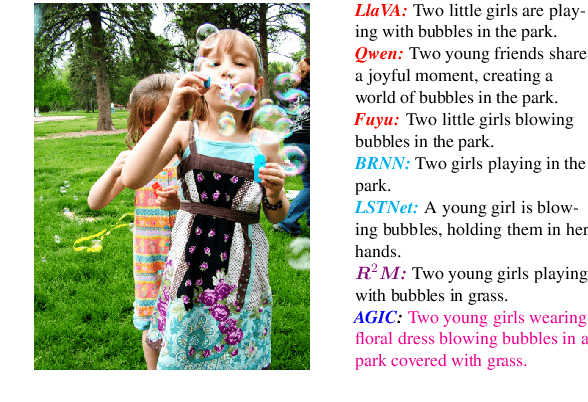
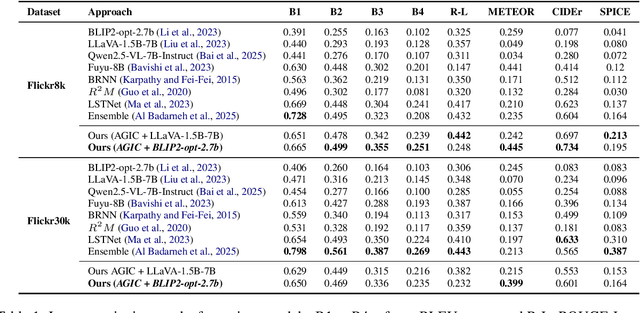
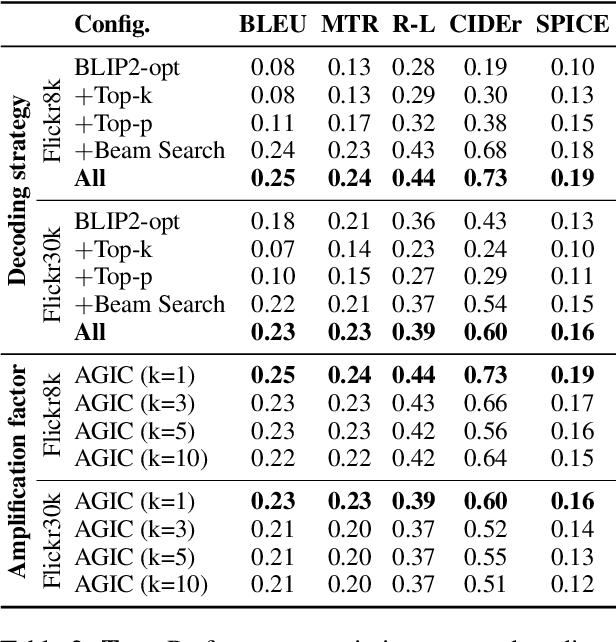
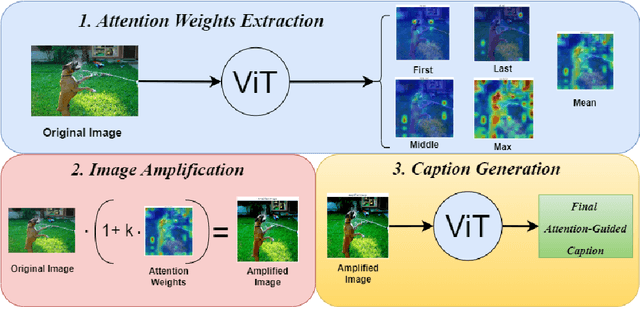
Despite significant progress in image captioning, generating accurate and descriptive captions remains a long-standing challenge. In this study, we propose Attention-Guided Image Captioning (AGIC), which amplifies salient visual regions directly in the feature space to guide caption generation. We further introduce a hybrid decoding strategy that combines deterministic and probabilistic sampling to balance fluency and diversity. To evaluate AGIC, we conduct extensive experiments on the Flickr8k and Flickr30k datasets. The results show that AGIC matches or surpasses several state-of-the-art models while achieving faster inference. Moreover, AGIC demonstrates strong performance across multiple evaluation metrics, offering a scalable and interpretable solution for image captioning.