 Add to Chrome
 Add to Firefox
 Add to Edge
MMCM: Multimodality-aware Metric using Clustering-based Modes for Probabilistic Human Motion Prediction
Nov 19, 2025
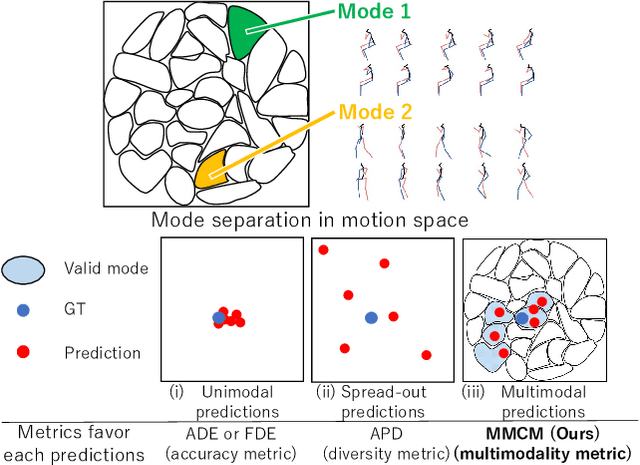
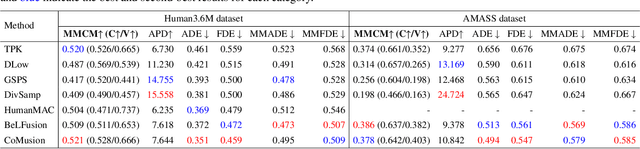
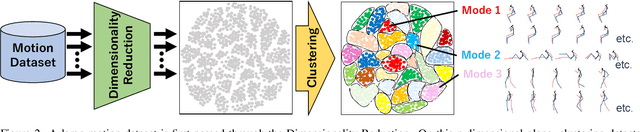
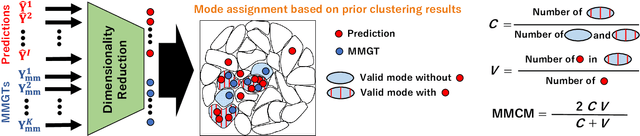
This paper proposes a novel metric for Human Motion Prediction (HMP). Since a single past sequence can lead to multiple possible futures, a probabilistic HMP method predicts such multiple motions. While a single motion predicted by a deterministic method is evaluated only with the difference from its ground truth motion, multiple predicted motions should also be evaluated based on their distribution. For this evaluation, this paper focuses on the following two criteria. \textbf{(a) Coverage}: motions should be distributed among multiple motion modes to cover diverse possibilities. \textbf{(b) Validity}: motions should be kinematically valid as future motions observable from a given past motion. However, existing metrics simply appreciate widely distributed motions even if these motions are observed in a single mode and kinematically invalid. To resolve these disadvantages, this paper proposes a Multimodality-aware Metric using Clustering-based Modes (MMCM). For (a) coverage, MMCM divides a motion space into several clusters, each of which is regarded as a mode. These modes are used to explicitly evaluate whether predicted motions are distributed among multiple modes. For (b) validity, MMCM identifies valid modes by collecting possible future motions from a motion dataset. Our experiments validate that our clustering yields sensible mode definitions and that MMCM accurately scores multimodal predictions. Code: https://github.com/placerkyo/MMCM

Burst Super-Resolution with Diffusion Models for Improving Perceptual Quality
Apr 08, 2024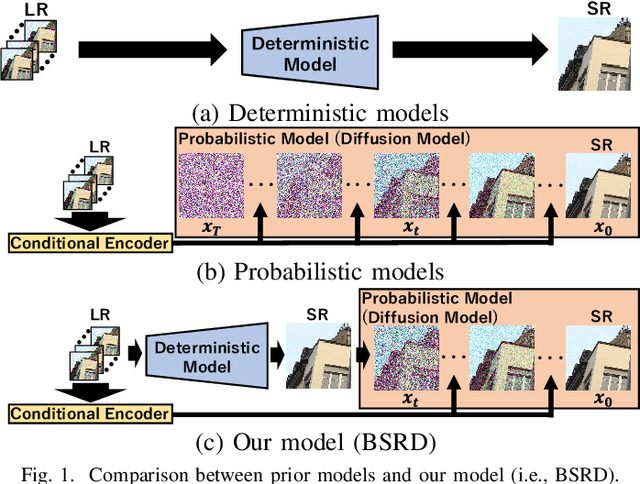
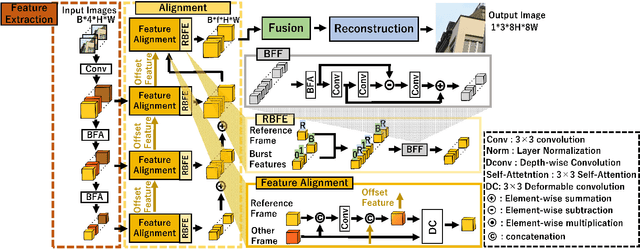
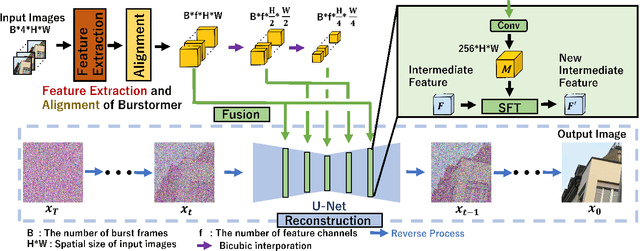
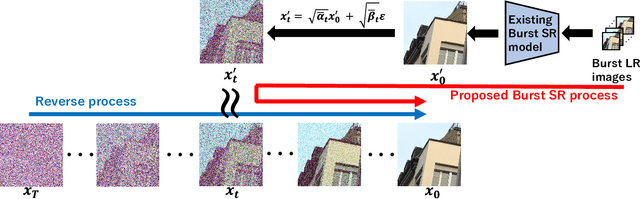
While burst LR images are useful for improving the SR image quality compared with a single LR image, prior SR networks accepting the burst LR images are trained in a deterministic manner, which is known to produce a blurry SR image. In addition, it is difficult to perfectly align the burst LR images, making the SR image more blurry. Since such blurry images are perceptually degraded, we aim to reconstruct the sharp high-fidelity boundaries. Such high-fidelity images can be reconstructed by diffusion models. However, prior SR methods using the diffusion model are not properly optimized for the burst SR task. Specifically, the reverse process starting from a random sample is not optimized for image enhancement and restoration methods, including burst SR. In our proposed method, on the other hand, burst LR features are used to reconstruct the initial burst SR image that is fed into an intermediate step in the diffusion model. This reverse process from the intermediate step 1) skips diffusion steps for reconstructing the global structure of the image and 2) focuses on steps for refining detailed textures. Our experimental results demonstrate that our method can improve the scores of the perceptual quality metrics. Code: https://github.com/placerkyo/BSRD