 Add to Chrome
 Add to Firefox
 Add to Edge
A Constraint Programming Approach for $n$-Day Lookahead Playoff Clinching
May 13, 2026
In professional sports, a team has clinched the playoffs if they are guaranteed a postseason spot, regardless of the outcomes of any remaining games. As the season progresses, sports fans and other stakeholders are interested in precisely when, and under what conditions, their team will clinch the playoffs. In this paper, we investigate playoff clinching in the context of the National Hockey League (NHL), where it is computationally challenging to produce clinching scenarios due, in part, to complex tie-breakers. We present an algorithm that determines under which combinations of game outcomes in the next $n$ days a team will clinch the playoffs (i.e., "$n$-day lookahead clinching"). Our approach is a custom tree search which employs various preprocessing techniques, pruning strategies, and node ordering heuristics to efficiently explore the space of possible outcomes. The tree search leverages a constraint programming (CP)-based subroutine for inference that determines if a team has clinched the playoffs for some snapshot in time of the regular season (i.e., "0-day lookahead clinching"). This CP subroutine aims to find a counter-example in which the team being evaluated is eliminated, taking into account qualification rules and the NHL's extensive list of tie-breakers. We validate the efficacy of our algorithm using hundreds of scenarios based on public NHL data for the seasons 2021-22 through 2024-25. The methods introduced can be readily extended to other metrics of interest, including mathematical proof of playoff elimination, clinching the President's Trophy, as well as clinching (or being eliminated from clinching) any other seed in the standings.

Comparing and Integrating Constraint Programming and Temporal Planning for Quantum Circuit Compilation
Mar 19, 2018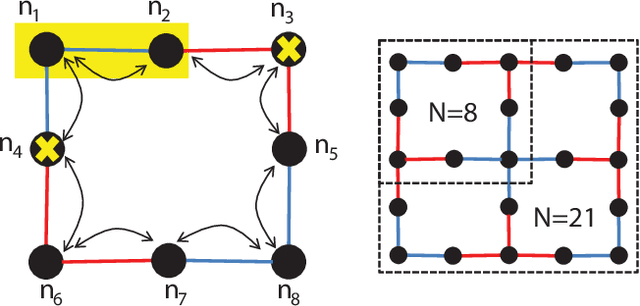
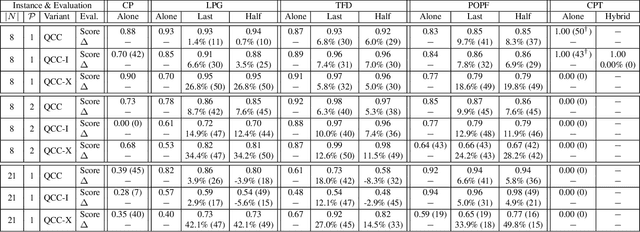
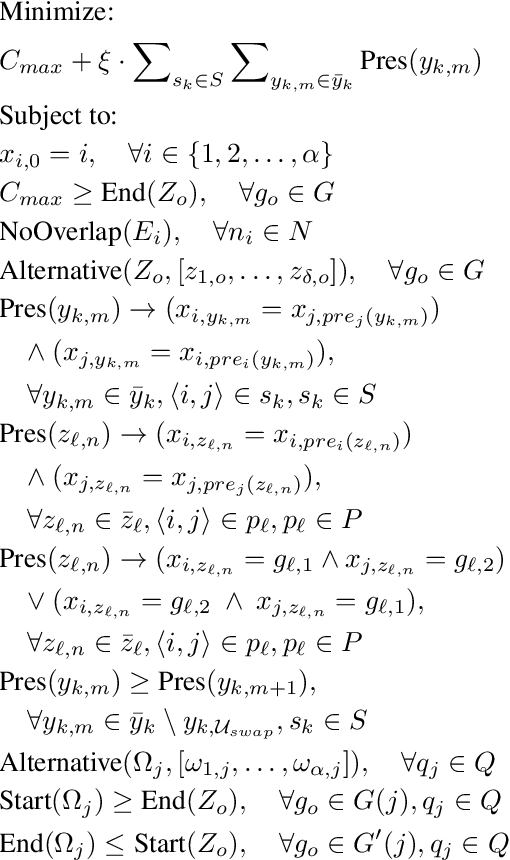
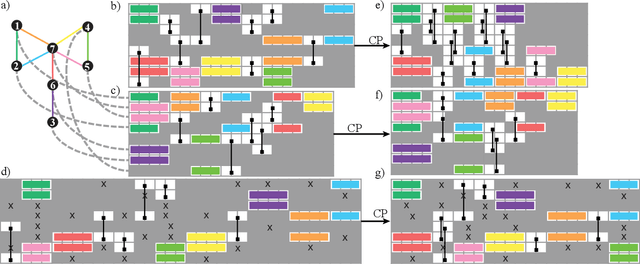
Recently, the makespan-minimization problem of compiling a general class of quantum algorithms into near-term quantum processors has been introduced to the AI community. The research demonstrated that temporal planning is a strong approach for a class of quantum circuit compilation (QCC) problems. In this paper, we explore the use of constraint programming (CP) as an alternative and complementary approach to temporal planning. We extend previous work by introducing two new problem variations that incorporate important characteristics identified by the quantum computing community. We apply temporal planning and CP to the baseline and extended QCC problems as both stand-alone and hybrid approaches. Our hybrid methods use solutions found by temporal planning to warm start CP, leveraging the ability of the former to find satisficing solutions to problems with a high degree of task optionality, an area that CP typically struggles with. The CP model, benefiting from inferred bounds on planning horizon length and task counts provided by the warm start, is then used to find higher quality solutions. Our empirical evaluation indicates that while stand-alone CP is only competitive for the smallest problems, CP in our hybridization with temporal planning out-performs stand-alone temporal planning in the majority of problem classes.