 Add to Chrome
 Add to Firefox
 Add to Edge
A Constraint Programming Approach for $n$-Day Lookahead Playoff Clinching
May 13, 2026
In professional sports, a team has clinched the playoffs if they are guaranteed a postseason spot, regardless of the outcomes of any remaining games. As the season progresses, sports fans and other stakeholders are interested in precisely when, and under what conditions, their team will clinch the playoffs. In this paper, we investigate playoff clinching in the context of the National Hockey League (NHL), where it is computationally challenging to produce clinching scenarios due, in part, to complex tie-breakers. We present an algorithm that determines under which combinations of game outcomes in the next $n$ days a team will clinch the playoffs (i.e., "$n$-day lookahead clinching"). Our approach is a custom tree search which employs various preprocessing techniques, pruning strategies, and node ordering heuristics to efficiently explore the space of possible outcomes. The tree search leverages a constraint programming (CP)-based subroutine for inference that determines if a team has clinched the playoffs for some snapshot in time of the regular season (i.e., "0-day lookahead clinching"). This CP subroutine aims to find a counter-example in which the team being evaluated is eliminated, taking into account qualification rules and the NHL's extensive list of tie-breakers. We validate the efficacy of our algorithm using hundreds of scenarios based on public NHL data for the seasons 2021-22 through 2024-25. The methods introduced can be readily extended to other metrics of interest, including mathematical proof of playoff elimination, clinching the President's Trophy, as well as clinching (or being eliminated from clinching) any other seed in the standings.

Scalable iterative pruning of large language and vision models using block coordinate descent
Nov 26, 2024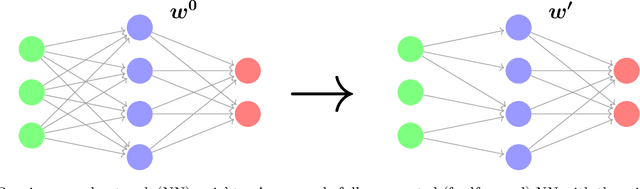
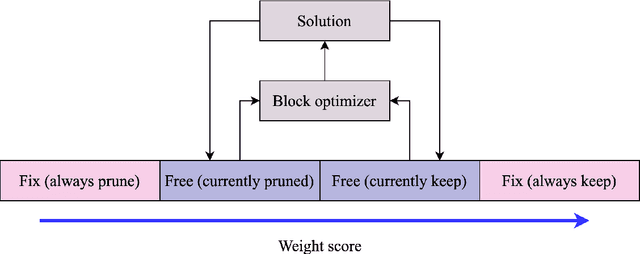
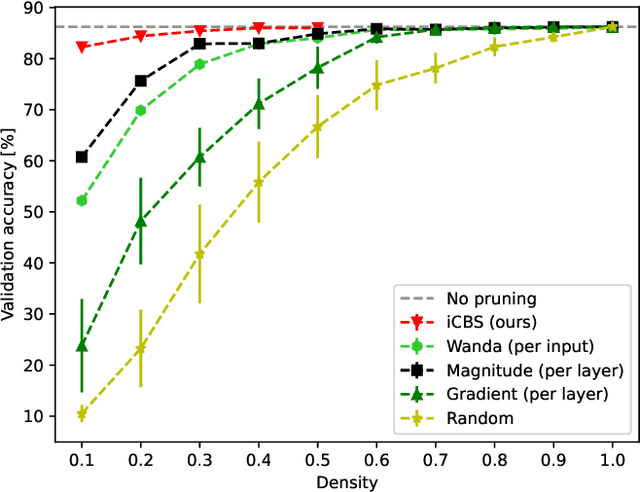
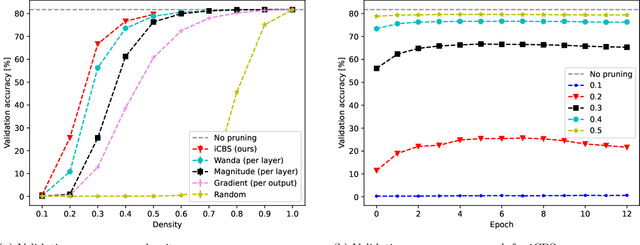
Pruning neural networks, which involves removing a fraction of their weights, can often maintain high accuracy while significantly reducing model complexity, at least up to a certain limit. We present a neural network pruning technique that builds upon the Combinatorial Brain Surgeon, but solves an optimization problem over a subset of the network weights in an iterative, block-wise manner using block coordinate descent. The iterative, block-based nature of this pruning technique, which we dub ``iterative Combinatorial Brain Surgeon'' (iCBS) allows for scalability to very large models, including large language models (LLMs), that may not be feasible with a one-shot combinatorial optimization approach. When applied to large models like Mistral and DeiT, iCBS achieves higher performance metrics at the same density levels compared to existing pruning methods such as Wanda. This demonstrates the effectiveness of this iterative, block-wise pruning method in compressing and optimizing the performance of large deep learning models, even while optimizing over only a small fraction of the weights. Moreover, our approach allows for a quality-time (or cost) tradeoff that is not available when using a one-shot pruning technique alone. The block-wise formulation of the optimization problem enables the use of hardware accelerators, potentially offsetting the increased computational costs compared to one-shot pruning methods like Wanda. In particular, the optimization problem solved for each block is quantum-amenable in that it could, in principle, be solved by a quantum computer.
Explainable AI using expressive Boolean formulas
Jun 06, 2023


We propose and implement an interpretable machine learning classification model for Explainable AI (XAI) based on expressive Boolean formulas. Potential applications include credit scoring and diagnosis of medical conditions. The Boolean formula defines a rule with tunable complexity (or interpretability), according to which input data are classified. Such a formula can include any operator that can be applied to one or more Boolean variables, thus providing higher expressivity compared to more rigid rule-based and tree-based approaches. The classifier is trained using native local optimization techniques, efficiently searching the space of feasible formulas. Shallow rules can be determined by fast Integer Linear Programming (ILP) or Quadratic Unconstrained Binary Optimization (QUBO) solvers, potentially powered by special purpose hardware or quantum devices. We combine the expressivity and efficiency of the native local optimizer with the fast operation of these devices by executing non-local moves that optimize over subtrees of the full Boolean formula. We provide extensive numerical benchmarking results featuring several baselines on well-known public datasets. Based on the results, we find that the native local rule classifier is generally competitive with the other classifiers. The addition of non-local moves achieves similar results with fewer iterations, and therefore using specialized or quantum hardware could lead to a speedup by fast proposal of non-local moves.