 Add to Chrome
 Add to Firefox
 Add to Edge
Human AI Construction of Bayesian Networks for Operational Decision Support -- A Virtual Survey Approach
Jul 13, 2026
Bayesian Belief Networks (BBNs) are powerful tools for decision-making under uncertainty. However, building their structures and estimating parameters are difficult. Currently, researchers must choose between relying on expert judgement or using large datasets to learn the structure and parameters of the network. We propose a new methodology using Large Language Models to bridge the gap between expert opinion and data-driven learning. This approach uses a panel of AI agents to estimate probabilities based on specific personas and context. We then apply a trimmed-mean rule to remove noise from these responses. We develop a six step BBN framework and illustrate it to model customer intention to consult a doctor in an alternative healthcare system. The model reveals that while self efficacy appears to be a major factor, its actual causal impact is small. In contrast, subjective norms have a much stronger effect in modelling customers' intention. The most effective strategy is to improve both confidence and community norms simultaneously.

On the benefit of parameter-driven approaches for the modeling and the prediction of Satisfied User Ratio for compressed video
Jun 20, 2022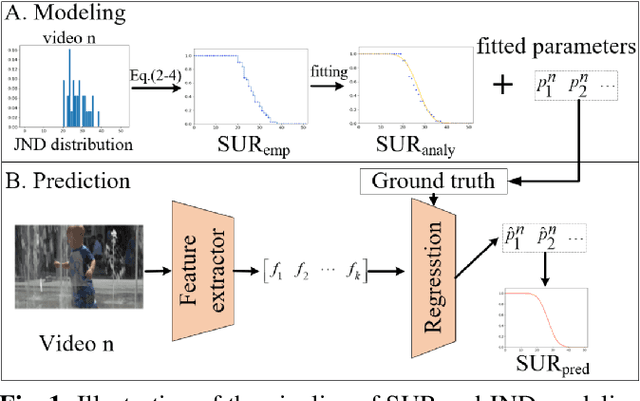
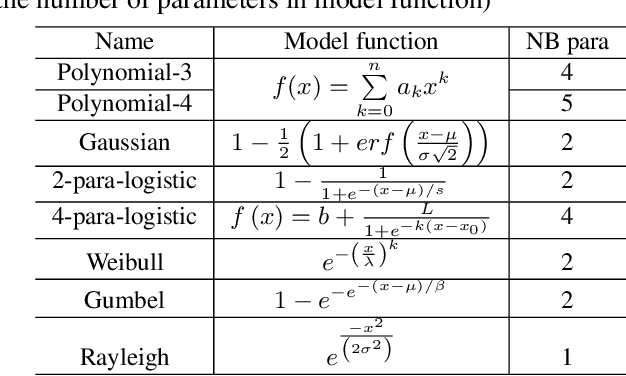
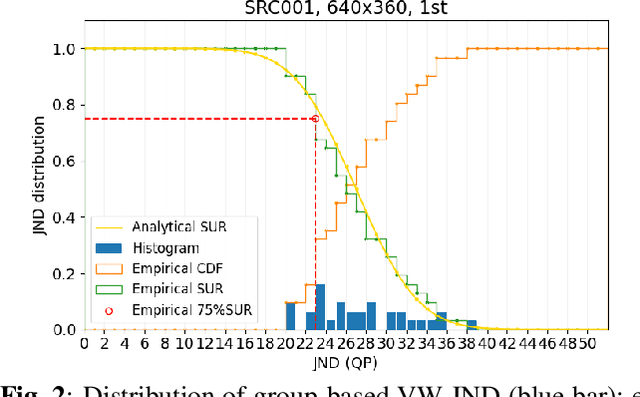
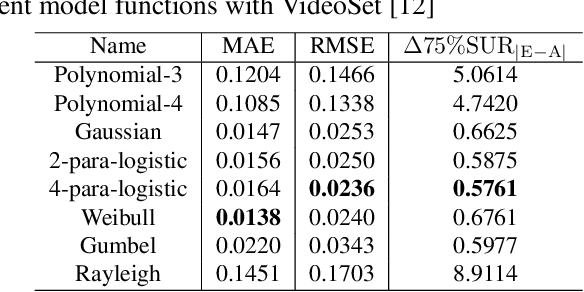
The human eye cannot perceive small pixel changes in images or videos until a certain threshold of distortion. In the context of video compression, Just Noticeable Difference (JND) is the smallest distortion level from which the human eye can perceive the difference between reference video and the distorted/compressed one. Satisfied-User-Ratio (SUR) curve is the complementary cumulative distribution function of the individual JNDs of a viewer group. However, most of the previous works predict each point in SUR curve by using features both from source video and from compressed videos with assumption that the group-based JND annotations follow Gaussian distribution, which is neither practical nor accurate. In this work, we firstly compared various common functions for SUR curve modeling. Afterwards, we proposed a novel parameter-driven method to predict the video-wise SUR from video features. Besides, we compared the prediction results of source-only features based (SRC-based) models and source plus compressed videos features (SRC+PVS-based) models.