 Add to Chrome
 Add to Firefox
 Add to Edge
MUFASA: A Multi-Layer Framework for Slot Attention
Feb 07, 2026
Unsupervised object-centric learning (OCL) decomposes visual scenes into distinct entities. Slot attention is a popular approach that represents individual objects as latent vectors, called slots. Current methods obtain these slot representations solely from the last layer of a pre-trained vision transformer (ViT), ignoring valuable, semantically rich information encoded across the other layers. To better utilize this latent semantic information, we introduce MUFASA, a lightweight plug-and-play framework for slot attention-based approaches to unsupervised object segmentation. Our model computes slot attention across multiple feature layers of the ViT encoder, fully leveraging their semantic richness. We propose a fusion strategy to aggregate slots obtained on multiple layers into a unified object-centric representation. Integrating MUFASA into existing OCL methods improves their segmentation results across multiple datasets, setting a new state of the art while simultaneously improving training convergence with only minor inference overhead.

Evaluating Object-Centric Models beyond Object Discovery
Feb 07, 2026Object-centric learning (OCL) aims to learn structured scene representations that support compositional generalization and robustness to out-of-distribution (OOD) data. However, OCL models are often not evaluated regarding these goals. Instead, most prior work focuses on evaluating OCL models solely through object discovery and simple reasoning tasks, such as probing the representation via image classification. We identify two limitations in existing benchmarks: (1) They provide limited insights on the representation usefulness of OCL models, and (2) localization and representation usefulness are assessed using disjoint metrics. To address (1), we use instruction-tuned VLMs as evaluators, enabling scalable benchmarking across diverse VQA datasets to measure how well VLMs leverage OCL representations for complex reasoning tasks. To address (2), we introduce a unified evaluation task and metric that jointly assess localization (where) and representation usefulness (what), thereby eliminating inconsistencies introduced by disjoint evaluation. Finally, we include a simple multi-feature reconstruction baseline as a reference point.
Guided Latent Slot Diffusion for Object-Centric Learning
Jul 25, 2024Slot attention aims to decompose an input image into a set of meaningful object files (slots). These latent object representations enable various downstream tasks. Yet, these slots often bind to object parts, not objects themselves, especially for real-world datasets. To address this, we introduce Guided Latent Slot Diffusion - GLASS, an object-centric model that uses generated captions as a guiding signal to better align slots with objects. Our key insight is to learn the slot-attention module in the space of generated images. This allows us to repurpose the pre-trained diffusion decoder model, which reconstructs the images from the slots, as a semantic mask generator based on the generated captions. GLASS learns an object-level representation suitable for multiple tasks simultaneously, e.g., segmentation, image generation, and property prediction, outperforming previous methods. For object discovery, GLASS achieves approx. a +35% and +10% relative improvement for mIoU over the previous state-of-the-art (SOTA) method on the VOC and COCO datasets, respectively, and establishes a new SOTA FID score for conditional image generation amongst slot-attention-based methods. For the segmentation task, GLASS surpasses SOTA weakly-supervised and language-based segmentation models, which were specifically designed for the task.
Is Synthetic Data all We Need? Benchmarking the Robustness of Models Trained with Synthetic Images
May 30, 2024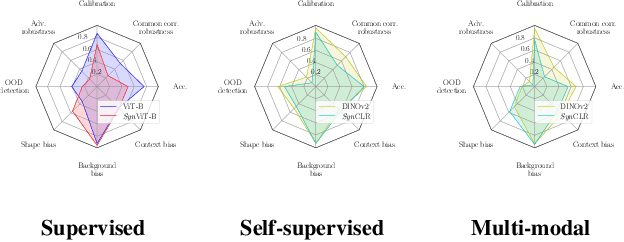

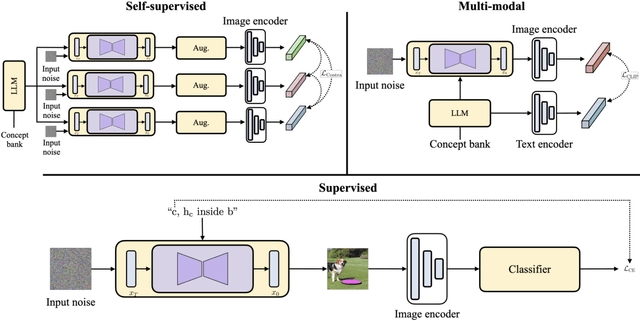

A long-standing challenge in developing machine learning approaches has been the lack of high-quality labeled data. Recently, models trained with purely synthetic data, here termed synthetic clones, generated using large-scale pre-trained diffusion models have shown promising results in overcoming this annotation bottleneck. As these synthetic clone models progress, they are likely to be deployed in challenging real-world settings, yet their suitability remains understudied. Our work addresses this gap by providing the first benchmark for three classes of synthetic clone models, namely supervised, self-supervised, and multi-modal ones, across a range of robustness measures. We show that existing synthetic self-supervised and multi-modal clones are comparable to or outperform state-of-the-art real-image baselines for a range of robustness metrics - shape bias, background bias, calibration, etc. However, we also find that synthetic clones are much more susceptible to adversarial and real-world noise than models trained with real data. To address this, we find that combining both real and synthetic data further increases the robustness, and that the choice of prompt used for generating synthetic images plays an important part in the robustness of synthetic clones.
$S^2$-Flow: Joint Semantic and Style Editing of Facial Images
Nov 22, 2022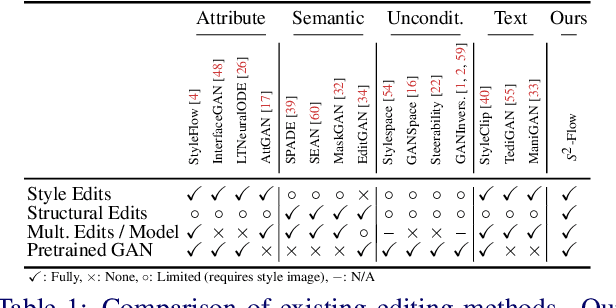
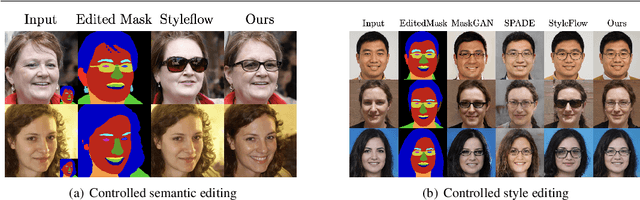
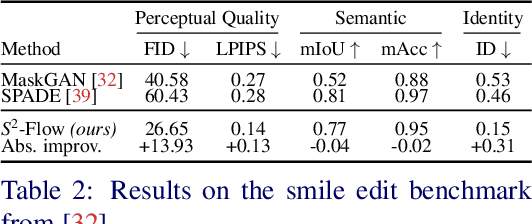
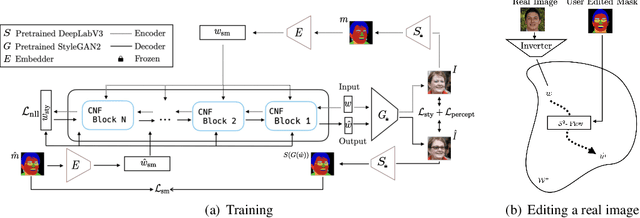
The high-quality images yielded by generative adversarial networks (GANs) have motivated investigations into their application for image editing. However, GANs are often limited in the control they provide for performing specific edits. One of the principal challenges is the entangled latent space of GANs, which is not directly suitable for performing independent and detailed edits. Recent editing methods allow for either controlled style edits or controlled semantic edits. In addition, methods that use semantic masks to edit images have difficulty preserving the identity and are unable to perform controlled style edits. We propose a method to disentangle a GAN$\text{'}$s latent space into semantic and style spaces, enabling controlled semantic and style edits for face images independently within the same framework. To achieve this, we design an encoder-decoder based network architecture ($S^2$-Flow), which incorporates two proposed inductive biases. We show the suitability of $S^2$-Flow quantitatively and qualitatively by performing various semantic and style edits.
Submodular Batch Selection for Training Deep Neural Networks
Jun 20, 2019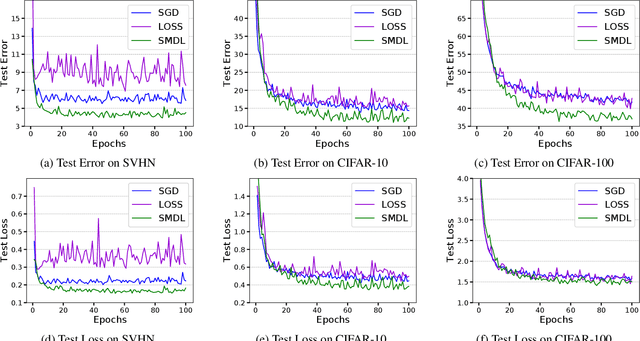
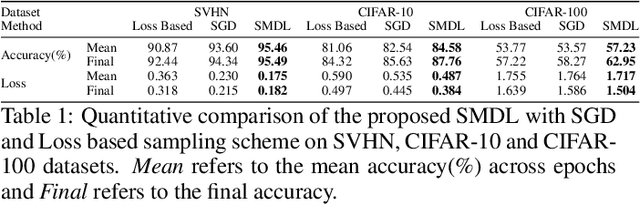
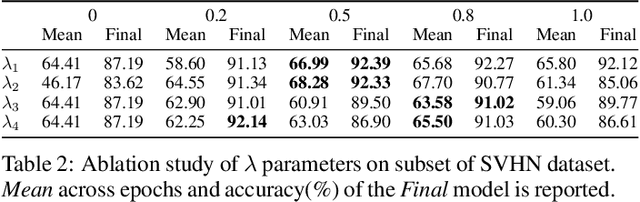
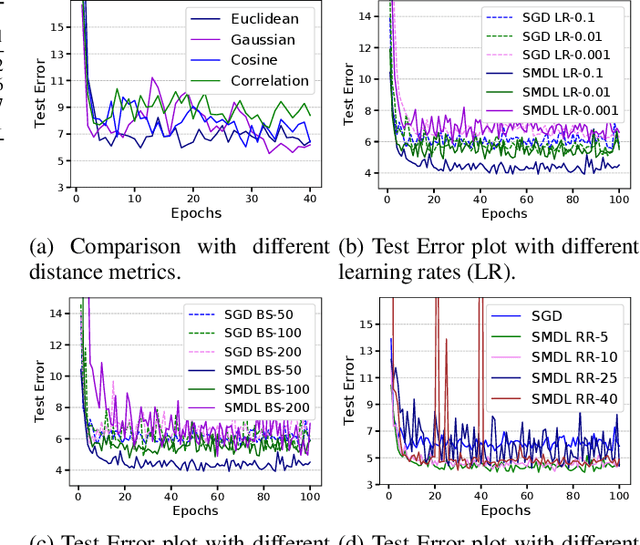
Mini-batch gradient descent based methods are the de facto algorithms for training neural network architectures today. We introduce a mini-batch selection strategy based on submodular function maximization. Our novel submodular formulation captures the informativeness of each sample and diversity of the whole subset. We design an efficient, greedy algorithm which can give high-quality solutions to this NP-hard combinatorial optimization problem. Our extensive experiments on standard datasets show that the deep models trained using the proposed batch selection strategy provide better generalization than Stochastic Gradient Descent as well as a popular baseline sampling strategy across different learning rates, batch sizes, and distance metrics.