 Add to Chrome
 Add to Firefox
 Add to Edge
The Open Ant: A Robot Platform for Reinforcement Learning Research
Jul 20, 2026
Reinforcement learning (RL) research has demonstrated success in both physical and simulated domains; however, the predominant methodology remains rooted in simulations. The predominance of simulations makes translating research to physical reality uncertain for both algorithms and researchers. We propose a physical platform that is designed to simplify the transition. In this paper, we present the Open Ant: a physical variant of the commonly used Gymnasium Ant environment, along with a simulation. We demonstrate that competent walking policies can be learned from scratch in approximately one hour directly from the physical robot's experience for two substantially different RL algorithms: SARSA($λ$) and Soft Actor-Critic (SAC). Separately, we show policies that were learned in simulation transfer to reality. We also examine how well the platform supports a nimble experimental ecosystem. Specifically, we observe the speed with which new users from diverse backgrounds achieve their first success with the platform, and how easily the platform can be repaired and updated when hardware issues arise. Both the hardware design and software are available as open-source on GitHub for ease of customization. In summary, we advocate for the use of the Open Ant for RL researchers who frequently use simulated environments, so they can more easily include robot experiments in their evaluations.
* Published in the Reinforcement Learning Conference

Extending Differential Temporal Difference Methods for Episodic Problems
May 06, 2026Differential temporal difference (TD) methods are value-based reinforcement learning algorithms that have been proposed for infinite-horizon problems. They rely on reward centering, where each reward is centered by the average reward. This keeps the return bounded and removes a value function's state-independent offset. However, reward centering can alter the optimal policy in episodic problems, limiting its applicability. Motivated by recent works that emphasize the role of normalization in streaming deep reinforcement learning, we study reward centering in episodic problems and propose a generalization of differential TD. We prove that this generalization maintains the ordering of policies in the presence of termination, and thus extends differential TD to episodic problems. We show equivalence with a form of linear TD, thereby inheriting theoretical guarantees that have been shown for those algorithms. We then extend several streaming reinforcement learning algorithms to their differential counterparts. Across a range of base algorithms and environments, we empirically validate that reward centering can improve sample efficiency in episodic problems.
Intentional Updates for Streaming Reinforcement Learning
Apr 21, 2026In gradient-based learning, a step size chosen in parameter units does not produce a predictable per-step change in function output. This often leads to instability in the streaming setting (i.e., batch size=1), where stochasticity is not averaged out and update magnitudes can momentarily become arbitrarily big or small. Instead, we propose intentional updates: first specify the intended outcome of an update and then solve for the step size that approximately achieves it. This strategy has precedent in online supervised linear regression via Normalized Least Mean Squares algorithm, which selects a step size to yield a specified change in the function output proportional to the current error. We extend this principle to streaming deep reinforcement learning by defining appropriate intended outcomes: Intentional TD aims for a fixed fractional reduction of the TD error, and Intentional Policy Gradient aims for a bounded per-step change in the policy, limiting local KL divergence. We propose practical algorithms combining eligibility traces and diagonal scaling. Empirically, these methods yield state-of-the-art streaming performance, frequently performing on par with batch and replay-buffer approaches.
An Idiosyncrasy of Time-discretization in Reinforcement Learning
Jun 21, 2024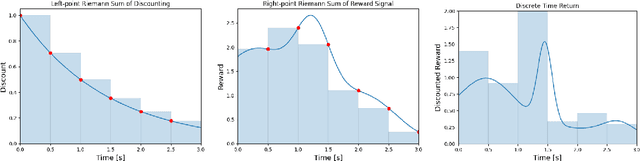
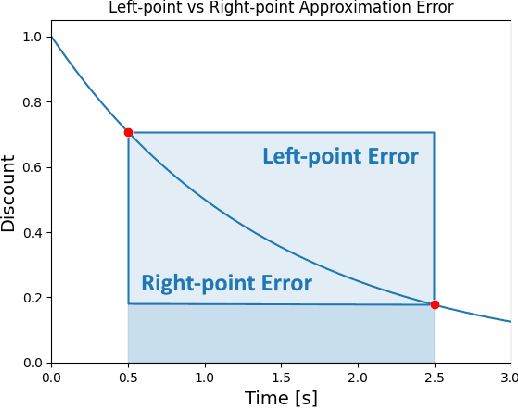
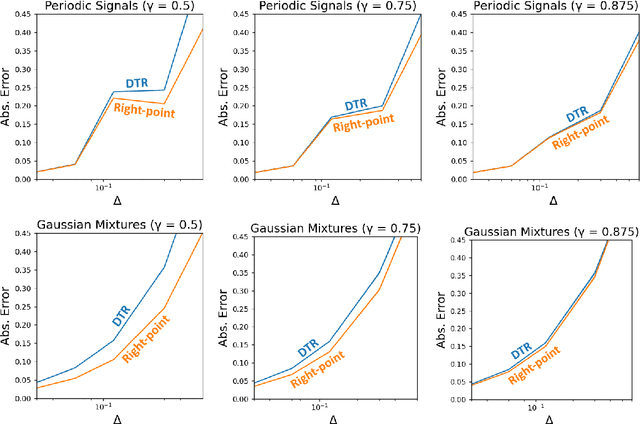
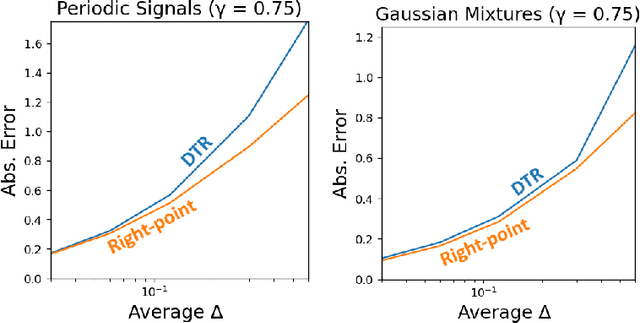
Many reinforcement learning algorithms are built on an assumption that an agent interacts with an environment over fixed-duration, discrete time steps. However, physical systems are continuous in time, requiring a choice of time-discretization granularity when digitally controlling them. Furthermore, such systems do not wait for decisions to be made before advancing the environment state, necessitating the study of how the choice of discretization may affect a reinforcement learning algorithm. In this work, we consider the relationship between the definitions of the continuous-time and discrete-time returns. Specifically, we acknowledge an idiosyncrasy with naively applying a discrete-time algorithm to a discretized continuous-time environment, and note how a simple modification can better align the return definitions. This observation is of practical consideration when dealing with environments where time-discretization granularity is a choice, or situations where such granularity is inherently stochastic.