 Add to Chrome
 Add to Firefox
 Add to Edge
TokEye: Fast Signal Extraction for Fluctuating Time Series via Offline Self-Supervised Learning From Fusion Diagnostics to Bioacoustics
Feb 26, 2026
Next-generation fusion facilities like ITER face a "data deluge," generating petabytes of multi-diagnostic signals daily that challenge manual analysis. We present a "signals-first" self-supervised framework for the automated extraction of coherent and transient modes from high-noise time-frequency data across a variety of sensors. We also develop a general-purpose method and tool for extracting coherent, quasi-coherent, and transient modes for fluctuation measurements in tokamaks by employing non-linear optimal techniques in multichannel signal processing with a fast neural network surrogate on fast magnetics, electron cyclotron emission, CO2 interferometers, and beam emission spectroscopy measurements from DIII-D. Results are tested on data from DIII-D, TJ-II, and non-fusion spectrograms. With an inference latency of 0.5 seconds, this framework enables real-time mode identification and large-scale automated database generation for advanced plasma control. Repository is in https://github.com/PlasmaControl/TokEye.

Laplace-Approximated Neural Additive Models: Improving Interpretability with Bayesian Inference
May 26, 2023
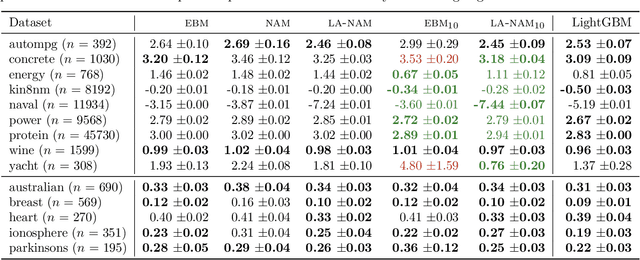
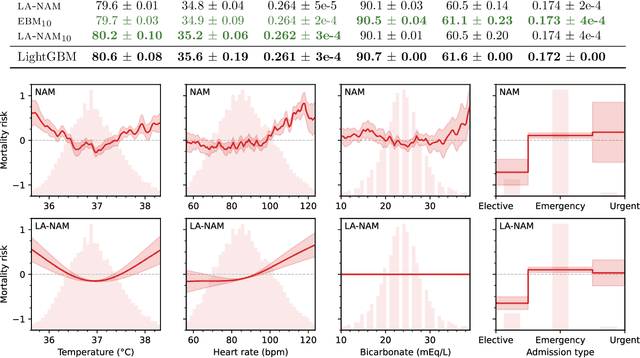
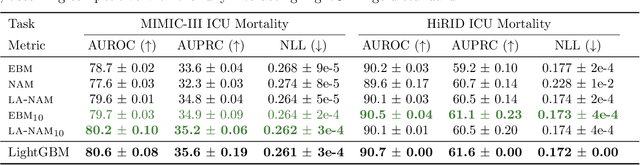
Deep neural networks (DNNs) have found successful applications in many fields, but their black-box nature hinders interpretability. This is addressed by the neural additive model (NAM), in which the network is divided into additive sub-networks, thus making apparent the interaction between input features and predictions. In this paper, we approach the additive structure from a Bayesian perspective and develop a practical Laplace approximation. This enhances interpretability in three primary ways: a) It provides credible intervals for the recovered feature interactions by estimating function-space uncertainty of the sub-networks; b) it yields a tractable estimate of the marginal likelihood, which can be used to perform an implicit selection of features through an empirical Bayes procedure; and c) it can be used to rank feature pairs as candidates for second-order interactions in fine-tuned interaction models. We show empirically that our proposed Laplace-approximated NAM (LA-NAM) improves performance and interpretability on tabular regression and classification datasets and challenging real-world medical tasks.