 Add to Chrome
 Add to Firefox
 Add to Edge
Quantum-Native Maximum Likelihood Detection in Random Access Channel with Overloaded MIMO
May 19, 2026
In this paper, we propose a quantum-native formulation of maximum likelihood detection (MLD) for overloaded multiple-input multiple-output (MIMO) systems in a random access channel, where numerous user terminals share the same channel resource and asynchronously transmit signals. Classical linear detectors suffer from significant performance degradation in this scenario, whereas the exhaustive-search MLD achieves the optimal performance but incurs an exponential computational complexity. To overcome this trade-off, we formulate the MLD as a binary optimization problem and solve it via Grover adaptive search (GAS) -- a quantum exhaustive search algorithm offering quadratic speedup in fault-tolerant quantum computing. We then introduce a search space reduction technique to substantially decrease the required computational resources. In addition, we investigate efficient parameter settings for GAS through probability analysis to improve convergence performance. We demonstrate that the proposed detector achieves the optimal detection performance while reducing the required Grover rotation count to reach the solution by up to approximately 65% compared with the conventional GAS, showing its potential as a viable solution for future quantum-accelerated wireless systems.

Fast Mining and Dynamic Time-to-Event Prediction over Multi-sensor Data Streams
Jan 08, 2026Given real-time sensor data streams obtained from machines, how can we continuously predict when a machine failure will occur? This work aims to continuously forecast the timing of future events by analyzing multi-sensor data streams. A key characteristic of real-world data streams is their dynamic nature, where the underlying patterns evolve over time. To address this, we present TimeCast, a dynamic prediction framework designed to adapt to these changes and provide accurate, real-time predictions of future event time. Our proposed method has the following properties: (a) Dynamic: it identifies the distinct time-evolving patterns (i.e., stages) and learns individual models for each, enabling us to make adaptive predictions based on pattern shifts. (b) Practical: it finds meaningful stages that capture time-varying interdependencies between multiple sensors and improve prediction performance; (c) Scalable: our algorithm scales linearly with the input size and enables online model updates on data streams. Extensive experiments on real datasets demonstrate that TimeCast provides higher prediction accuracy than state-of-the-art methods while finding dynamic changes in data streams with a great reduction in computational time.
Fast and Multi-aspect Mining of Complex Time-stamped Event Streams
Mar 07, 2023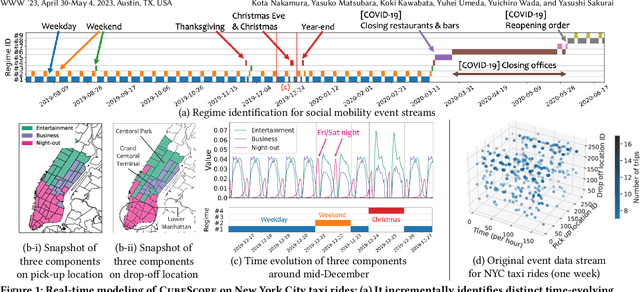
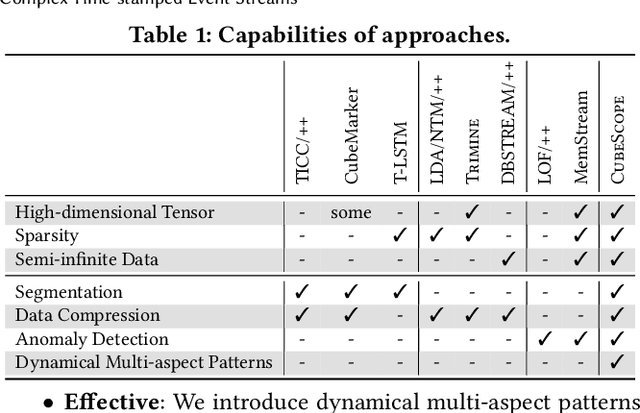
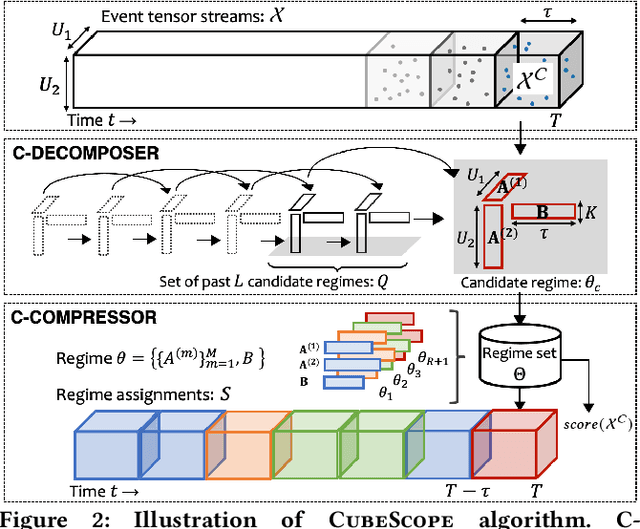

Given a huge, online stream of time-evolving events with multiple attributes, such as online shopping logs: (item, price, brand, time), and local mobility activities: (pick-up and drop-off locations, time), how can we summarize large, dynamic high-order tensor streams? How can we see any hidden patterns, rules, and anomalies? Our answer is to focus on two types of patterns, i.e., ''regimes'' and ''components'', for which we present CubeScope, an efficient and effective method over high-order tensor streams. Specifically, it identifies any sudden discontinuity and recognizes distinct dynamical patterns, ''regimes'' (e.g., weekday/weekend/holiday patterns). In each regime, it also performs multi-way summarization for all attributes (e.g., item, price, brand, and time) and discovers hidden ''components'' representing latent groups (e.g., item/brand groups) and their relationship. Thanks to its concise but effective summarization, CubeScope can also detect the sudden appearance of anomalies and identify the types of anomalies that occur in practice. Our proposed method has the following properties: (a) Effective: it captures dynamical multi-aspect patterns, i.e., regimes and components, and statistically summarizes all the events; (b) General: it is practical for successful application to data compression, pattern discovery, and anomaly detection on various types of tensor streams; (c) Scalable: our algorithm does not depend on the length of the data stream and its dimensionality. Extensive experiments on real datasets demonstrate that CubeScope finds meaningful patterns and anomalies correctly, and consistently outperforms the state-of-the-art methods as regards accuracy and execution speed.