 Add to Chrome
 Add to Firefox
 Add to Edge
Learning Long-term Motion Embeddings for Efficient Kinematics Generation
Apr 13, 2026
Understanding and predicting motion is a fundamental component of visual intelligence. Although modern video models exhibit strong comprehension of scene dynamics, exploring multiple possible futures through full video synthesis remains prohibitively inefficient. We model scene dynamics orders of magnitude more efficiently by directly operating on a long-term motion embedding that is learned from large-scale trajectories obtained from tracker models. This enables efficient generation of long, realistic motions that fulfill goals specified via text prompts or spatial pokes. To achieve this, we first learn a highly compressed motion embedding with a temporal compression factor of 64x. In this space, we train a conditional flow-matching model to generate motion latents conditioned on task descriptions. The resulting motion distributions outperform those of both state-of-the-art video models and specialized task-specific approaches.

CleanDIFT: Diffusion Features without Noise
Dec 04, 2024


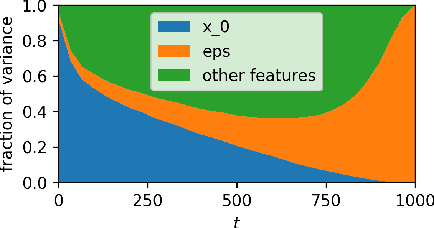
Internal features from large-scale pre-trained diffusion models have recently been established as powerful semantic descriptors for a wide range of downstream tasks. Works that use these features generally need to add noise to images before passing them through the model to obtain the semantic features, as the models do not offer the most useful features when given images with little to no noise. We show that this noise has a critical impact on the usefulness of these features that cannot be remedied by ensembling with different random noises. We address this issue by introducing a lightweight, unsupervised fine-tuning method that enables diffusion backbones to provide high-quality, noise-free semantic features. We show that these features readily outperform previous diffusion features by a wide margin in a wide variety of extraction setups and downstream tasks, offering better performance than even ensemble-based methods at a fraction of the cost.