 Add to Chrome
 Add to Firefox
 Add to Edge
Off-Policy Evaluation for Ranking Policies under Deterministic Logging Policies
Mar 23, 2026
Off-Policy Evaluation (OPE) is an important practical problem in algorithmic ranking systems, where the goal is to estimate the expected performance of a new ranking policy using only offline logged data collected under a different, logging policy. Existing estimators, such as the ranking-wise and position-wise inverse propensity score (IPS) estimators, require the data collection policy to be sufficiently stochastic and suffer from severe bias when the logging policy is fully deterministic. In this paper, we propose novel estimators, Click-based Inverse Propensity Score (CIPS), exploiting the intrinsic stochasticity of user click behavior to address this challenge. Unlike existing methods that rely on the stochasticity of the logging policy, our approach uses click probability as a new form of importance weighting, enabling low-bias OPE even under deterministic logging policies where existing methods incur substantial bias. We provide theoretical analyses of the bias and variance properties of the proposed estimators and show, through synthetic and real-world experiments, that our estimators achieve significantly lower bias compared to strong baselines, for a range of experimental settings with completely deterministic logging policies.

Off-Policy Learning with Limited Supply
Mar 19, 2026We study off-policy learning (OPL) in contextual bandits, which plays a key role in a wide range of real-world applications such as recommendation systems and online advertising. Typical OPL in contextual bandits assumes an unconstrained environment where a policy can select the same item infinitely. However, in many practical applications, including coupon allocation and e-commerce, limited supply constrains items through budget limits on distributed coupons or inventory restrictions on products. In these settings, greedily selecting the item with the highest expected reward for the current user may lead to early depletion of that item, making it unavailable for future users who could potentially generate higher expected rewards. As a result, OPL methods that are optimal in unconstrained settings may become suboptimal in limited supply settings. To address the issue, we provide a theoretical analysis showing that conventional greedy OPL approaches may fail to maximize the policy performance, and demonstrate that policies with superior performance must exist in limited supply settings. Based on this insight, we introduce a novel method called Off-Policy learning with Limited Supply (OPLS). Rather than simply selecting the item with the highest expected reward, OPLS focuses on items with relatively higher expected rewards compared to the other users, enabling more efficient allocation of items with limited supply. Our empirical results on both synthetic and real-world datasets show that OPLS outperforms existing OPL methods in contextual bandit problems with limited supply.
Beyond Match Maximization and Fairness: Retention-Optimized Two-Sided Matching
Feb 17, 2026On two-sided matching platforms such as online dating and recruiting, recommendation algorithms often aim to maximize the total number of matches. However, this objective creates an imbalance, where some users receive far too many matches while many others receive very few and eventually abandon the platform. Retaining users is crucial for many platforms, such as those that depend heavily on subscriptions. Some may use fairness objectives to solve the problem of match maximization. However, fairness in itself is not the ultimate objective for many platforms, as users do not suddenly reward the platform simply because exposure is equalized. In practice, where user retention is often the ultimate goal, casually relying on fairness will leave the optimization of retention up to luck. In this work, instead of maximizing matches or axiomatically defining fairness, we formally define the new problem setting of maximizing user retention in two-sided matching platforms. To this end, we introduce a dynamic learning-to-rank (LTR) algorithm called Matching for Retention (MRet). Unlike conventional algorithms for two-sided matching, our approach models user retention by learning personalized retention curves from each user's profile and interaction history. Based on these curves, MRet dynamically adapts recommendations by jointly considering the retention gains of both the user receiving recommendations and those who are being recommended, so that limited matching opportunities can be allocated where they most improve overall retention. Naturally but importantly, empirical evaluations on synthetic and real-world datasets from a major online dating platform show that MRet achieves higher user retention, since conventional methods optimize matches or fairness rather than retention.
Effective Off-Policy Evaluation and Learning in Contextual Combinatorial Bandits
Aug 20, 2024
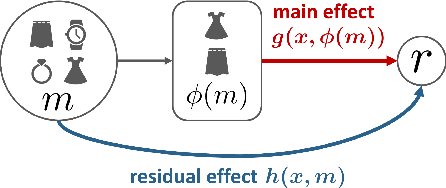
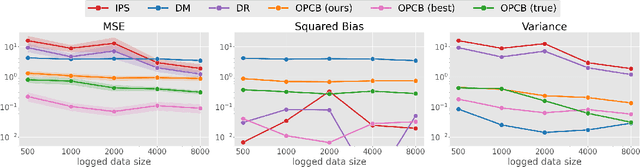
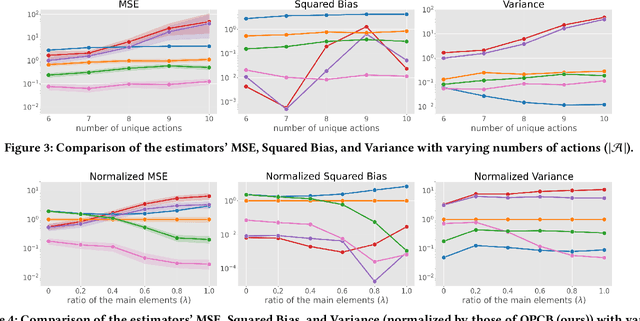
We explore off-policy evaluation and learning (OPE/L) in contextual combinatorial bandits (CCB), where a policy selects a subset in the action space. For example, it might choose a set of furniture pieces (a bed and a drawer) from available items (bed, drawer, chair, etc.) for interior design sales. This setting is widespread in fields such as recommender systems and healthcare, yet OPE/L of CCB remains unexplored in the relevant literature. Typical OPE/L methods such as regression and importance sampling can be applied to the CCB problem, however, they face significant challenges due to high bias or variance, exacerbated by the exponential growth in the number of available subsets. To address these challenges, we introduce a concept of factored action space, which allows us to decompose each subset into binary indicators. This formulation allows us to distinguish between the ''main effect'' derived from the main actions, and the ''residual effect'', originating from the supplemental actions, facilitating more effective OPE. Specifically, our estimator, called OPCB, leverages an importance sampling-based approach to unbiasedly estimate the main effect, while employing regression-based approach to deal with the residual effect with low variance. OPCB achieves substantial variance reduction compared to conventional importance sampling methods and bias reduction relative to regression methods under certain conditions, as illustrated in our theoretical analysis. Experiments demonstrate OPCB's superior performance over typical methods in both OPE and OPL.